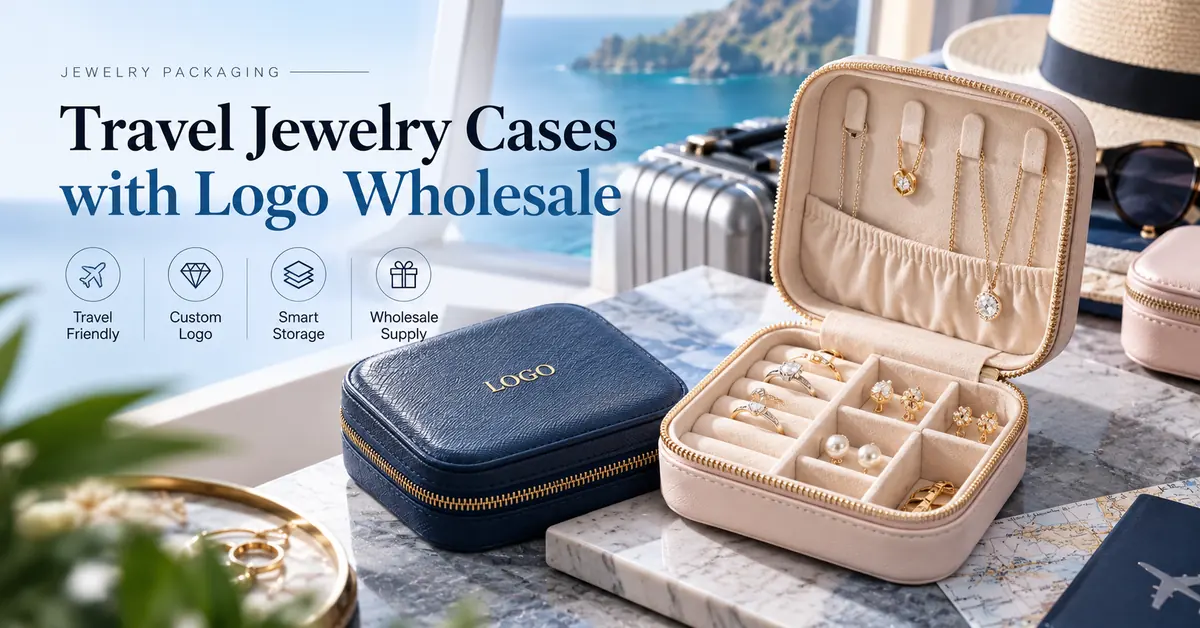
The most dependable way to source travel jewelry cases with logo wholesale is to approve the organizer's interior and closure before finalizing the logo. A useful case should separate necklaces, retain rings and earrings, close without catching jewelry, and remain practical to carry. Branded decoration only adds value when the case performs those everyday tasks reliably.
For jewelry brands, boutique retailers, private-label sellers and promotional-gift buyers, a portable organizer is both a reusable product and a visible brand touchpoint. This buying guide focuses on compartment design, dimensions, materials, logo methods, sample testing, wholesale economics and production checks—rather than general jewelry box manufacturer selection.
1. What Are Wholesale Travel Jewelry Cases With a Custom Logo?
Custom travel jewelry cases are compact, reusable organizers fitted with pockets, ring rolls, necklace holders, earring panels or removable compartments. They may close with a zipper, snap, fold-over flap or other design-specific fastener. A logo can be incorporated into the exterior or an approved interior branding area, depending on the material.
Unlike a presentation box used mainly at the point of sale, a travel case is handled repeatedly. Its zipper, stitching, insert retention and compactness are therefore core product specifications—not secondary packaging details.
The best-fit buyers include jewelry and accessory brands launching a travel collection, e-commerce private-label sellers, retailers creating branded add-ons, distributors sourcing multiple colors, and corporate-gift buyers seeking a practical keepsake. A fully custom program is less appropriate for an urgent purchase of a few unbranded, ready-to-ship units or for buyers unwilling to confirm a production sample.
Thinkpacking develops jewelry packaging and storage formats for brands, with projects coordinated around the intended product, materials, sample approval and production requirements.
2. Compare Four Travel Jewelry Case Structures Before Ordering
Not every compact organizer offers the same storage capacity or customer experience. Start with what the end user will carry and how often the case will be opened.
| Case structure | Storage features | Best commercial application | Main purchasing risk |
|---|---|---|---|
| Compact zip-around organizer | Ring rolls, dividers and necklace holders | Everyday travel accessories and retail add-ons | Crowded compartments and zipper snagging |
| Velvet zippered organizer | Soft outer and inner fabric, ring slots, small pockets | Boutique jewelry gifting and coordinated collections | Lint, surface wear and color transfer |
| Larger PU leather organizer with mirror | Multiple necklace hooks, earring flaps, removable dividers and mirror | Premium private-label accessory line | Added bulk, mirror attachment and component consistency |
| Fold-over / roll-up organizer | Flat-opening ring holder, earring strap and accessory pocket | Lightweight travel gifts and promotional sets | Flap retention, folding wear and small-item escape |
These are structure comparisons, not guaranteed stock models or quoted pricing tiers.
Thinkpacking's Compact Travel Jewelry Organizer Case illustrates a zip-around, multi-compartment design. The Vintage Velvet Jewelry Travel Organizer shows a softer fabric direction.
For a feature-rich option, examine the Premium Portable Leather Jewelry Organizer Box, with necklace hooks, earring flaps, removable dividers and a mirror.
A Red PU Leather Roll-Up Jewelry Organizer demonstrates a different flat-opening concept.
Product pages are design references; confirm current availability and custom-order terms with the team.
3. Design Compartments Around the Jewelry Customers Actually Carry
A good travel jewelry case prevents unnecessary contact and limits movement; it should not be advertised as eliminating every tangle or scratch. The interior needs to be tested with real items rather than judged by the number of compartments in a photograph.
Necklaces: Control Both the Chain and the Pendant
Necklace hooks alone may not solve tangling if the loose chain moves around the lid. Look for a corresponding elastic pocket, channel or retention point that holds the lower chain and pendant.
Test several chain lengths and delicate clasps. Check that the jewelry does not interfere with the zipper when the case is fully loaded.
Rings: Match the Roll to Band Width and Setting Height
Ring rolls should hold slim bands and thicker rings without excessive pressure.
A tall stone setting may require additional vertical clearance so it cannot rub against an earring flap or the opposite side of the closed case. Use representative rings to check retention and removal effort.
Earrings: Separate Posts, Hoops and Pairs
Studs may need a firm but accessible earring panel, while hoops and dangling earrings need more depth.
Check whether posts, backs or clasps can contact nearby jewelry or puncture the lining. A panel suitable for small studs is not automatically appropriate for large statement earrings.
Bracelets and Charms: Reserve Flexible Space
Removable dividers can be helpful for bangles or larger accessories, but confirm that the dividers stay in place during movement.
Small charms and loose backs benefit from a pocket that closes securely. Do not assume one interior layout fits every jewelry collection.
4. RFQ Specification Table for Private-Label Travel Jewelry Cases
Use the same written specification when comparing wholesale suppliers. The table below is a recommended buyer checklist, not a universal Thinkpacking product specification.
| RFQ field | Specify before sampling | What to check |
|---|---|---|
| User and sales channel | Travel retail, jewelry gift-with-purchase, boutique resale or corporate gifting | Appropriate appearance and durability |
| Case dimensions | External L × W × H; preferred packed size and weight | Fits intended handbag, luggage or retail display |
| Structure | Zip-around, double zip, snap or roll-up | Closure doesn't trap contents |
| Exterior | PU, velvet/fabric or other approved cover | Hand feel, abrasion and appearance |
| Lining | Color, fabric type, attachment and padding | No exposed hard edges or unacceptable transfer |
| Ring storage | Number of slots and representative ring sizes | Comfortable retention and removal |
| Necklace storage | Hook count, pocket design, chain length range | Reduced free movement and entanglement |
| Earring storage | Panel/holes, backing access, available depth | Posts and clasps don't contact other items |
| Logo | Vector artwork, dimensions, location, finish | Legibility and material compatibility |
| Hardware | Zipper type, puller, snaps, mirror if included | Smooth action and attachment |
| Commercial terms | Quantity by color, SKU mix, packing, destination | Comparable MOQ, costs and lead-time quote |
| Approval | Sample revision, defect criteria and pack-out reference | Repeatable production baseline |
5. PU Leather vs Velvet: Which Material Fits Your Brand?
PU leather is a common option for a structured, wipeable-looking exterior and a clean branded appearance.
Buyers should inspect its coating, edge finish, stitching, odor and resistance to visible scuffs. PU surfaces are not automatically waterproof or equally resistant to cracking.
Velvet or velvet-like fabric provides a softer visual and tactile effect.
It can suit gift collections, but buyers should evaluate lint collection, pile direction, surface wear and whether color can rub onto light-colored materials. A fabric that looks luxurious in a studio photograph may require more careful handling in everyday travel.
Lining quality matters independently of exterior material.
Examine adhesive marks, exposed seams and metal hardware near jewelry contact points. Claims such as "scratch-proof" or "anti-tarnish" require separate evidence; soft lining alone does not prove either performance.
For brands with textile color-transfer concerns, ISO 105-X12:2016, published by the International Organization for Standardization, provides a method for evaluating textile colorfastness to rubbing. This is a possible buyer-specified evaluation—not evidence that any featured case has been tested or certified.
Thinkpacking outlines broader materials and decorative finishing directions for customized packaging projects.
6. Which Logo Method Works Best on a Travel Jewelry Case?
Logo size and material compatibility are more important than choosing the most decorative process. Always approve the branding method on the actual selected exterior material.
| Branding method | Typical application | Buyer checkpoint |
|---|---|---|
| Debossing / embossing | Selected PU or suitable structured surfaces | Clarity, depth, edge distortion, repeatability |
| Hot foil stamping | Defined metallic logo on compatible materials | Foil adhesion, registration and wear at touch points |
| Printed logo | Suitable PU, fabric, label or accessory panel | Color accuracy, rub resistance and print durability |
| Branded fabric label / patch | Where direct surface printing is unsuitable | Seam attachment, placement and comfort |
| Printed gift sleeve or outer carton | Gift sets or wholesale retail packaging | Fit, artwork, added packing and freight cost |
7. How Do You Test Zippers, Stitching and Closure Reliability?
Closure failure is one of the most visible risks in travel jewelry organizers. A case that opens unintentionally or snags a chain can undermine the value of even an attractive custom logo.
For zip-around models, examine zipper track alignment, slider movement, puller attachment and how the zipper performs around corners.
Test repeatedly with the case empty and fully loaded. Look for interior fabric protruding into the zipper path.
For snap or fold-over styles, check opening force, hardware alignment and whether the flap stays closed with the intended jewelry assortment inside.
For roll-up styles, examine repeated folding at the same crease and retention of small loose items.
Stitching should be assessed for skipped stitches, loose ends, uneven seam allowance and separation where the case is repeatedly opened.
For mirrors or decorative metal components, inspect attachment, edge safety and protection from direct contact with jewelry.
A useful sample-approval protocol: define a buyer-agreed number of opening cycles, record any snagging or deformation, then inspect the contents after representative carrying and handling. Do not present an arbitrary cycle count as an industry-wide pass standard.
8. Bulk Quality Control: Create an Acceptance Standard, Not Just a Nice Sample
Every wholesale run needs the same approved dimensions, logo positioning, internal layout and usable closure performance.
Thinkpacking describes checkpoints for incoming materials, sample approval, printing or decorative work, structure and assembly, and pre-shipment condition in its quality control overview.
| QC stage | Practical inspection points | Recommended buyer record |
|---|---|---|
| Incoming materials | Cover color, lining, zipper, hardware and mirror components | Approved material references |
| In-process assembly | Stitching, panel alignment, hooks, dividers and adhesive condition | Check photos or inspection notes |
| Logo finishing | Position, sharpness, contrast and adhesion | Approved artwork and branded sample |
| Functional inspection | Zipper or snap action; compartment and ring-roll retention | Functional test method and results |
| Finished-case review | Cleanliness, symmetry, size and visible marks | Defect classification and sample record |
| Pre-shipment packing | Correct color/SKU, protective packing, carton count | Packing list and agreed export pack-out |
For formal lot-by-lot acceptance sampling, ISO 2859-1:2026 describes AQL-indexed inspection schemes for attributes. The buyer and supplier must agree on sampling levels and defect categories; the standard is not a claim of Thinkpacking certification or automatic application to an order.
Remember to inspect the shipping package separately. A consumer travel case is not automatically a protective parcel for international distribution.
For risk-sensitive shipments, ASTM International's ASTM D4169-23e1 provides a framework for assessing shipping containers and systems under distribution conditions. Any test would need to cover the actual packaged configuration.
9. What Determines Wholesale Price, MOQ and Delivery Timing?
The unit price of a branded travel jewelry case can depend on structure, material selection, lining, number of compartments, zipper and metal components, logo tooling, mirrors, color variants and the quantity ordered for each SKU.
Use this comparison when assessing quotations:
Landed cost per accepted case = (case production + customization/tooling + sample charges allocated to the order + retail/export packing + shipping and import charges + expected rework) ÷ accepted units.
MOQ: Determine whether the minimum applies to the entire project, each case style, each exterior color or each custom logo method. Do not assume a fixed company-wide threshold from an individual product listing.
Lead time and capacity: Request distinct timelines for artwork review, sample production, revision, material confirmation, bulk manufacture, final inspection and export.
Capacity is meaningful only when matched to your actual number of colorways, order size, construction and delivery window.
Which Buyer Should Choose a Smaller or Larger Format?
A small direct-to-consumer jewelry brand may prefer a simple compact case that can serve as a gift-with-purchase.
A lifestyle retailer selling the organizer as a standalone product may benefit from more compartments and a premium finish, provided the resulting selling price supports the landed cost.
Corporate-gift buyers may prioritize logo visibility, predictable color matching and protective retail packing over maximum interior capacity.
10. OEM/ODM Development: From Travel-Case Concept to Approved Sample
Thinkpacking's OEM and ODM support distinguishes OEM, where a buyer brings an established specification or reference, from ODM, where the structure and visual direction are developed together from a product brief.
The company's published six-step workflow moves through brief, design, physical sampling, materials confirmation, production and QC, and delivery coordination.
For a reusable travel organizer, the approval sequence should address function first, branding second:
-
Confirm the intended jewelry assortment and end-user scenario.
-
Select a reference case shape and establish external size limits.
-
Test hooks, ring rolls, earring panels, dividers and the loaded closure.
-
Approve exterior, lining, logo application and hardware.
-
Retain an identified physical sample and written inspection criteria.
-
Finalize the quantity by color, packing method and project delivery plan.
When the first sample needs a change to compartment depth, zipper path or logo placement, approve the revised detail before authorizing production. This reduces ambiguity during repeat orders.
11. Request a Quote for Branded Travel Jewelry Cases
For a meaningful travel jewelry cases with logo wholesale quotation, send the preferred product reference, exterior size, expected jewelry contents, desired compartments, logo artwork or reference, material and color preferences, quantity by color, destination and required delivery window.
Explore Thinkpacking's custom jewelry box and organizer collection or use the verified product examples above as starting points.
Then contact Thinkpacking for a project-specific quote to discuss available structures, sampling and production requirements. Availability and commercial terms should be confirmed for your proposed order.
Frequently Asked Questions
1. Can I Order Travel Jewelry Cases With My Logo in Wholesale Quantities?
Yes, logo customization is offered on selected travel organizer formats. Confirm the material, artwork method, quantities by color and sample requirements for the specific case rather than assuming every catalog reference has the same options.
2. Which Travel Jewelry Case Is Best for Necklaces That Tangle?
Look for separate necklace hooks paired with an elastic pocket or lower chain-retention feature. Test actual chain lengths and pendants in a fully loaded case; no organizer can guarantee zero tangling under all conditions.
3. Is PU Leather or Velvet Better for a Private-Label Travel Organizer?
PU may suit a structured, clean-looking fashion accessory; velvet offers a softer presentation. Evaluate coating wear, lint, rubbing colorfastness, hand feel, cleaning requirements and intended retail positioning before choosing.
4. Can the Interior Be Customized for Rings, Earrings and Bracelets?
The featured organizer categories show configurable layouts, including ring rolls, necklace hooks, earring flaps and dividers. The feasible configuration depends on case size and construction and should be confirmed during sample development.
5. How Do I Choose Between a Zippered Case and a Roll-Up Pouch?
A zippered case usually offers more defined compartments and a surrounding closure. A fold-over or roll-up format can be flatter, but small-item retention and closure security require particular attention. Choose by the intended jewelry assortment and travel use.
6. What Is the Minimum Order Quantity for Custom-Logo Travel Jewelry Cases?
MOQ depends on case style, exterior and lining materials, logo process, color variations and required components. Ask for a quote that separates quantities by SKU and identifies tooling or setup charges.
7. How Long Do Samples and Bulk Production Take?
Timelines vary with design readiness, revisions, material sourcing, production complexity, quantity and logistics. Request a milestone schedule after the project specification is reviewed.
8. Can a Travel Jewelry Case Protect Gold-Plated or Delicate Jewelry From Scratches and Tarnish?
Soft lining and separated compartments can reduce direct contact, but they do not prove scratch-proof or anti-tarnish performance. Test the actual jewelry materials and avoid unsupported protection claims.
9. Which Quality Checks Matter Most Before Shipment?
Inspect closure function, stitching, hook and divider retention, lining cleanliness, logo accuracy, dimensions, component attachment and retail/export packing. Agree on inspection method and defect acceptance before the production run.
10. What Should I Provide for an OEM or ODM Quotation?
Send a preferred case style, expected jewelry types, target dimensions, compartment requirements, logo files or references, quantity and color breakdown, target market, destination and launch schedule.
If the layout is not final, explain the customer problem the organizer must solve.
Conclusion
Travel jewelry cases with logo wholesale are most successful when the organizer's storage layout, material, closure and branding are developed as a single product.
Jewelry brands and private-label buyers should evaluate real necklace, ring and earring fit; test zippers or fold-over closures; approve logo finishes on the selected substrate; and define repeatable inspection standards before placing a bulk order.
Thinkpacking offers design references for compact zippered organizers, velvet cases, larger PU leather layouts and fold-over jewelry pouches, supported by OEM/ODM coordination and physical sample approval.
To develop a branded case suited to your retail collection or promotional program, request a tailored quotation from Thinkpacking with your product references, logo requirements and purchasing quantities.