Choosing a magnetic gift box manufacturer is a packaging-engineering decision, not simply a search for an attractive box at the lowest price. A magnetic closure needs to align consistently; the box must fit its contents; and the approved finish must survive handling, packing, and delivery. For beauty, jewelry, fragrance, and corporate gifting brands, a small mistake in any of these details can become a costly issue across thousands of units.
The practical answer: choose a collapsible magnetic box when inbound shipping volume and storage space are major constraints, and consider a pre-assembled magnetic rigid box when ready-to-fill convenience and a controlled presentation matter more. In either case, request a product-fitted sample, agreed quality criteria, and a quotation that separates box cost from inserts, finishes, packing, and freight.
Thinkpacking's custom paper box collection offers reference f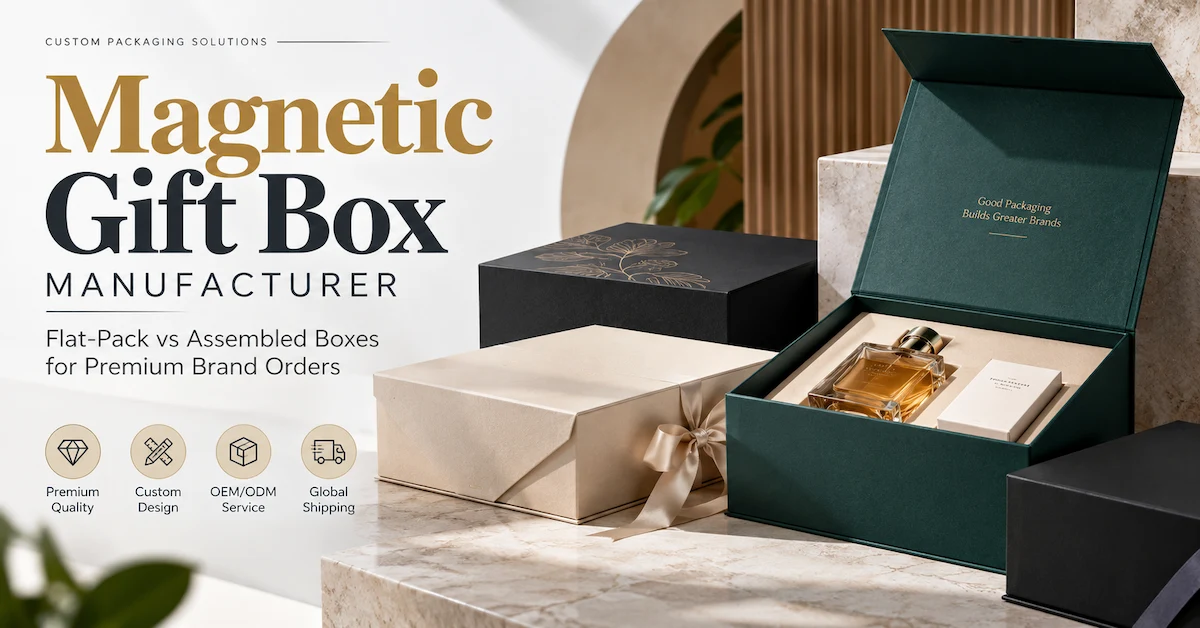 ormats for buyers planning custom presentation packaging. This guide explains what to verify before requesting an OEM or ODM quotation.
What Does a Magnetic Gift Box Manufacturer Need to Deliver?
A magnetic gift box is generally a paperboard-based presentation box with magnets concealed within a flap, wall, or closure panel. Many use a book-style hinged lid, although the finished configuration can vary. The magnet provides closing action; board construction, wrap, hinges, corner joints, and inserts provide the box's actual functional characteristics.
For a B2B buyer, a suitable supplier should be able to coordinate five related decisions: structure, magnetic closure, materials and branding, interior fit, and repeatable production. It should also clarify who owns drawing revisions, sample approval, inspection, and export packing. An attractive catalog image does not answer those questions.
Magnetic gift packaging is most relevant to premium skincare sets, fragrance presentation, jewelry and accessories, apparel gifting, event kits, and branded corporate gifts. It is less suitable when the lowest possible unit cost is the overriding goal or when a simple folding carton already meets the product's needs. A magnetic closure is also not a tamper-evident seal or a substitute for validated shipping protection.
Flat-Pack vs Pre-Assembled Magnetic Gift Boxes: Which Is Better?
This is often the most important commercial choice. Both formats can look substantial when presented to a customer, but they create different responsibilities for the supplier and the packing team.
| Decision factor | Collapsible magnetic gift box | Pre-assembled magnetic rigid box |
|---|---|---|
| Delivery condition | Ships flattened; assembled before filling | Arrives in its formed shape |
| Inbound freight and storage | Often uses less cubic space | Generally needs more carton volume |
| Fulfillment operation | Requires opening, securing corners, and checking the final shape | Typically simpler to fill immediately |
| Quality attention | Fold joints, corner adhesive, assembly consistency, magnetic alignment | Fixed corners, hinge, wrap finish, magnetic alignment |
| Typical buying priority | Seasonal programs, multi-location packing, warehouse efficiency | Premium presentation, controlled assembly, faster packing |
| Best comparison measure | Total landed and assembled cost | Total landed and ready-to-fill cost |
When does a collapsible magnetic box make financial sense?
Flat-pack construction can be useful when a brand imports empty boxes in bulk or distributes packaging to multiple fulfillment centers. However, the saving is not automatically the same for every design. Ask for the actual flat-pack carton dimensions, pieces per carton, gross weight, estimated assembly time, and the corner-fastening method. A box that occupies less inbound space may require extra labor or create more packing errors.
Thinkpacking's white foldable magnetic rigid gift box illustrates a collapsible book-style construction. Its matte black magnetic box with a red ribbon provides another visual reference for combining a magnetic closure with a gift-oriented finish. Treat these as design references; specifications, availability, and quotation terms require project confirmation.
When should you prefer an assembled rigid box?
An assembled format may be easier for retail packing teams that need a repeatable presentation without folding or adhesive application. It can also simplify inspection of completed corners before the product is inserted. The trade-off is higher packaging volume during transport and storage. If the brand operates a high-throughput fulfillment line, calculate both the receiving footprint and the time required per filled gift set before deciding.
Buyer takeaway: compare the two formats as complete operating systems, not just as unit-price alternatives.
Which Magnetic Gift Box Design Fits Your Industry?
| Buyer or application | Recommended design direction | Main technical concern |
|---|---|---|
| Skincare gift-set brand | Foldable book-style box with fitted tray | Bottle spacing, flap overlap, clean printing |
| Fragrance launch | Rigid magnetic presentation with shaped insert | Bottle and cap clearance, stable removal |
| Jewelry or accessories brand | Compact magnetic box with soft-contact insert | Scratch prevention, product positioning |
| Corporate gifting distributor | Foldable magnetic box for multiple SKUs | Repeatable assembly, insert interchangeability |
| Premium apparel retailer | Large collapsible magnetic box, possibly with ribbon | Corner stability, folding and warehouse volume |
| PR or influencer kit team | Branded magnetic presentation box with segmented layout | Multiple-item movement and fulfillment consistency |
These are selection guidelines, not claims that one construction has been performance-tested for every application. In particular, bottles, glass jars, and heavy accessories should be evaluated in a fully packed prototype, including the outer shipping carton.
If the unboxing experience depends on a ribbon, a contrasting interior, or a special insert, add those elements to the first structural discussion rather than treating them as late-stage decoration. For example, Thinkpacking's white magnetic gift box with ribbon provides a reference for combining the magnetic flap with a separate presentation detail.
Five Technical Checks That Separate a Reliable Supplier From a Risky Quote
1. Closure alignment and opening feel
A box can have concealed magnets and still close poorly. The position and orientation of the mating components, board thickness, wrap build-up, and flap overlap all affect how the finished closure feels. Ask the manufacturer to review magnet placement on a fully wrapped, assembled sample, not only on an unwrapped structural mock-up. Check whether the flap sits flush, whether gaps are visually consistent, and whether repeated opening causes unwanted rubbing.
The strongest-feeling closure is not always the best: excessive resistance may strain a flap or make an elegant gift awkward to open. Agree on an acceptable functional reference instead of assuming a universal pull-force number.
2. Structural board and corner construction
Rigid-board thickness, density, panel dimensions, cut quality, and joint design influence shape retention. For collapsible magnetic boxes, evaluate fold lines, corner adhesive or other joining methods, and whether the assembled walls remain square. For pre-assembled boxes, examine corner wrapping, visible seams, and hinge stability.
Request an identified board and wrapping reference rather than relying on terms such as heavy-duty or premium-grade. Board grammage alone cannot describe every structural characteristic.
3. Product-specific inserts
A magnetic gift box with a poor insert is still poor packaging. Confirm the product's maximum dimensions, weight, sensitive surfaces, preferred display orientation, and how customers will lift it out. Paperboard compartments may suit lighter coordinated sets; foam or fabric-covered inserts may suit some irregular or delicate products. The correct choice depends on fit, surface contact, cost, and disposal requirements.
4. Printed surfaces and decorative finishes
Foil stamping, embossing, debossing, lamination, and selected UV effects can help position a premium brand. They also introduce questions about artwork registration, corner wrapping, abrasion, and consistency between production lots. Approve a decorated physical sample when color or logo appearance is commercially important. See Thinkpacking's materials and finishes guide for the company's disclosed finishing directions.
5. Inspection standards based on the approved sample
Ask what the supplier checks before, during, and after production. For magnetic boxes, the purchase specification should explicitly include closure alignment, lid movement, corner integrity, product fit, surface appearance, and protective packing. Do not assume a supplier follows a particular AQL level, certification, or transport-test procedure unless it provides evidence for your order.
Magnetic Gift Box Specifications Buyers Should Confirm
Send a controlled specification rather than asking a manufacturer to infer details from a photograph.
| Specification | What to state or verify |
|---|---|
| Product and kit | Actual item dimensions, weight, quantity, orientation |
| Box size | Usable internal dimensions and target external footprint |
| Construction | Collapsible or assembled; flap/hinge orientation |
| Magnetic closure | Mating position, closing feel, flushness and visual gap |
| Board and wrap | Agreed material reference, texture, surface color |
| Insert | Cavity dimensions, material direction, removal method |
| Branding | Artwork version, logo position, printing and finishes |
| Packing format | Flat or assembled; protective wrap; units per carton |
| Inspection | Approved sample, dimensional and appearance criteria |
| Order program | Quantity per SKU, repeat orders, destination and timeline |
For multi-product gift sets, build the insert around the largest real component and its required clearance—not a nominal bottle size or an outdated CAD image. If a product dimension changes after sample approval, the insert and possibly the entire box must be rechecked.
How Much Does Custom Magnetic Gift Box Packaging Cost?
There is no credible single wholesale price without a defined box. Cost changes with board area, size, structure, wrapped material, the magnetic closure design, insert complexity, finishing, production quantity, and carton configuration. Different artwork variants may create additional setup and sorting work even if their structures are identical.
For a more accurate comparison, request prices for the same specification at your trial and expected repeat-order volumes. Ask whether quotations include structural development, tooling or printing setup, physical samples, inner trays, protective bags, master cartons, and export packing. The cheapest box-only offer may exclude the components that make a gift set usable.
Why MOQ and lead time must be confirmed by design
Some magnetic gift box product pages describe different minimum quantities or example timelines. That is why a buyer should request a written project-specific MOQ per size, colorway, and artwork version instead of treating one product-page figure as a sitewide policy.
Clarify separate milestones for structural sampling, decorated sample approval, material procurement, production, inspection, and dispatch. Also ask what starts the clock: approved dieline, final artwork, confirmed materials, or another agreed commercial milestone. This is especially important for seasonal launches where a missed delivery window can erase any unit-price saving.
A better way to compare landed cost
Calculate:
Total relevant cost = finished boxes + inserts + setup + protective packing + freight + applicable import charges + local assembly labor + allowance for rejected or reworked units.
Then compare cost per usable, ready-to-fill box. For collapsible packaging, use real carton and labor data rather than a generic freight-saving percentage. This gives purchasing teams a clearer basis for deciding whether flat-pack construction genuinely improves the program.
What Quality Control Should a Magnetic Gift Box Manufacturer Provide?
A practical inspection plan connects visible defects to the agreed sample. Thinkpacking describes quality control checkpoints for incoming materials, sample approval, print and surface work, structure and assembly, and pre-shipment review.
| Checkpoint | Problem to prevent | Approval or inspection evidence |
|---|---|---|
| Materials received | Wrong board, wrapping or accessory | Approved material references |
| First completed sample | Incorrect fold, flap or insert fit | Signed-off physical reference |
| Print and foil | Poor registration, marks or color differences | Artwork and finish reference |
| Magnetic closure | Misaligned or uneven closing | Opening/closing comparison to sample |
| Assembly | Weak corners, loose inserts, uneven shape | Agreed visual and functional criteria |
| Packed cartons | Abrasion, compression or mixed SKUs | Pack-out standard and carton labels |
For freight-sensitive products, ask how the finished packed system will be assessed against actual distribution conditions. A premium magnetic presentation box is not a guarantee of transit performance. Any requested transport testing and acceptance conditions must be specified separately.
OEM/ODM Workflow: From Concept to Bulk Gift Box Orders
Thinkpacking distinguishes OEM, where the buyer brings established specifications, from ODM, where structure and presentation are developed with the buyer. Its OEM/ODM service page and project workflow set out a sequence that can be applied to magnetic box projects:
-
Brief: Confirm product details, quantity, sales channel, box reference, and key priorities.
-
Design: Develop the magnetic flap, box construction, insert layout, and artwork direction.
-
Sampling: Review the physical box using the actual product and agreed opening experience.
-
Materials: Lock the board, wrap, insert components, and finishing references.
-
Production and QC: Check construction, closure, branding, and completed packaging against the approved sample.
-
Delivery: Agree on assembled or flat packing, export cartons, and shipping communication.
A good buyer keeps one revision-controlled approval record. That helps prevent a color adjustment, new insert cavity, or altered magnet position from being overlooked when production begins.
Planning a new collection? Send Thinkpacking your magnetic gift box requirements, including product dimensions, initial volume, design references, and whether flat-pack delivery is preferred.
Magnetic Gift Box Manufacturer RFQ Checklist
A useful RFQ should answer these questions before the supplier prepares a final price:
-
What is being packaged, and what are the exact dimensions and weight of each item?
-
Is the required box collapsible, pre-assembled, or open to both proposals?
-
What opening direction, closure feel, and internal layout are desired?
-
Which board, wrapping color, logo process, and insert materials are preferred?
-
How many units are needed per size, design, and delivery destination?
-
Who will assemble the boxes, and how much packing labor is acceptable?
-
What sample approvals, appearance standards, and shipment checks are required?
-
What is the target delivery window, and which commercial terms should the quote use?
For faster technical feedback, attach images of the product, a dimensioned sketch, and two or three design references. Ask the manufacturer to identify any assumptions and quote alternatives separately. This prevents a low-cost proposal from quietly excluding inserts or branding work.
Frequently Asked Questions
Are magnetic gift boxes always rigid boxes?
No. Many magnetic gift boxes use rigid paperboard construction, but some are designed to collapse for flat shipment. Confirm the actual panel material and assembly method instead of assuming that every magnetic gift box is an identical setup box.
Can magnetic gift boxes be customized with a logo?
Logo placement and surface finishing can be part of a custom project. Foil stamping, printing, embossing, and other finishes should be selected around the approved paper or wrap, with a decorated sample reviewed before production.
Are collapsible magnetic boxes cheaper than assembled boxes?
Not necessarily. Collapsible designs can reduce shipping and warehouse volume, but they may add assembly time and corner-joint considerations. Compare delivered cost per assembled usable box rather than unit price alone.
What should a buyer test on a magnetic closure sample?
Check flap alignment, repeated opening and closing, visible gaps, rubbing, closure feel, and how the box behaves with its actual contents. If the packaging will be shipped directly to consumers, also evaluate the full outer shipping configuration.
What is the minimum order quantity for custom magnetic gift boxes?
MOQ varies by design, material, artwork, and order configuration. Request a specific quote for each size and variant, including any shared-production or repeat-order considerations. Do not assume that an example MOQ on one product page applies to every new design.
Can a magnetic gift box hold perfume or skincare bottles?
It can be developed for these applications, but the insert must match the real bottle, cap, and kit layout. Confirm surface contact, ease of removal, and the complete shipping pack; the closure itself does not prove damage resistance.
Why Consider Thinkpacking for a Custom Magnetic Gift Box Project?
Thinkpacking supports packaging structure development, visual direction, physical sampling, material and finish coordination, production communication, quality review, and export delivery planning. Its magnetic gift box references provide starting points for discussing collapsible structures, ribbons, branded surfaces, and fitted inserts—not blanket promises about a new project's price or delivery date.
If you are comparing suppliers for an upcoming beauty launch, fragrance set, jewelry collection, or corporate gifting program, request a quotation against a defined sample and specification. Explore Thinkpacking's custom packaging support, then contact the team with your brief to discuss structure, sample development, quantity, and production requirements.
Conclusion
A reliable magnetic gift box manufacturer helps brands balance presentation, closure quality, product fit, assembly effort, and total landed cost. Decide whether flat-pack or pre-assembled construction suits your operation, approve a decorated and product-fitted sample, and agree on inspection checkpoints before the bulk order.
For a clearer sourcing decision, share your magnetic gift box RFQ with Thinkpacking. Include product dimensions, preferred structure, estimated quantity, design references, and delivery market so the quotation can be built around your actual requirements.