The best custom ring boxes for jewelry brands combine secure ring retention, sufficient stone clearance, suitable lining materials, and a controlled opening experience. A beautiful exterior alone is not enough. The ring must remain stable inside the box, avoid contact with the lid, and be easy for customers to remove without unnecessary pressure on the setting.
For engagement rings, wedding bands, gemstone collections, and premium jewelry retail, packaging directly influences how the product is presented and handled. Choosing the wrong insert or box depth can create problems even when the dimensions appear correct on a drawing.
This guide explains how jewelry brands can select ring box structures, evaluate materials, specify interior supports, and work with a custom packaging supplier to achieve more reliable bulk-order results.
1. Why Do Jewelry Brands Need Custom Ring Boxes?
Custom ring boxes are purpose-designed packaging solutions developed around the dimensions, appearance, and intended presentation of specific jewelry products.
Unlike generic stock boxes, custom packaging allows brands to coordinate exterior materials, interior supports, box dimensions, colors, and branding elements.
However, the primary advantage is not decoration. It is the ability to create a packaging structure that suits the ring itself.
For example, a raised solitaire engagement ring requires different internal clearance from a low-profile wedding band. A two-ring wedding set needs separate retention positions, while an oversized gemstone ring may require additional clearance around the setting.
Four practical reasons jewelry brands invest in custom ring packaging:
-
Product stability: A properly designed insert helps prevent excessive ring movement.
-
Presentation quality: The ring can be positioned at a suitable viewing angle when the box opens.
-
Brand consistency: Materials, colors, and packaging proportions can reflect the jewelry collection.
-
Purchase experience: The structure supports retail presentation, gifting, and special occasions.
Thinkpacking provides custom packaging solutions for jewelry brands, supporting structure development, material selection, sampling, and coordinated production.
Who Should Choose Custom Ring Packaging?
Custom ring boxes are particularly relevant for engagement ring brands, fine jewelry retailers, wedding jewelry businesses, independent designers, private-label jewelry companies, and packaging distributors.
They are less suitable for projects requiring only a few immediately available, unbranded boxes or buyers unwilling to approve a physical sample before a customized production run.
2. Which Ring Box Style Is Best for Your Jewelry Collection?
Different jewelry products require different packaging configurations. Buyers should select the structure based on ring dimensions, intended use, brand positioning, and storage requirements.
| Ring box type | Main characteristics | Recommended application | Primary consideration |
|---|---|---|---|
| Hinged PU leather ring box | Compact construction, hinged lid, soft interior | Engagement rings, wedding rings, jewelry retail | Lid alignment and insert fit |
| Velvet-covered ring box | Soft-touch exterior and coordinated lining | Premium jewelry presentations | Surface cleanliness and material quality |
| Rigid paper ring box | Paperboard construction with decorative wrapping | Branded retail collections | Structural rigidity and corner finishing |
| Wooden ring box | Wood or wood-based shell, decorative finish | Wedding gifts, premium collections | Surface finish and component consistency |
| Double ring box | Two separate ring positions | Wedding bands, couples' jewelry | Spacing between rings |
| Multi-slot ring display box | Multiple retaining slots or presentation positions | Showrooms and jewelry retail displays | Ring accessibility and slot consistency |
Single Ring Boxes for Engagement Jewelry
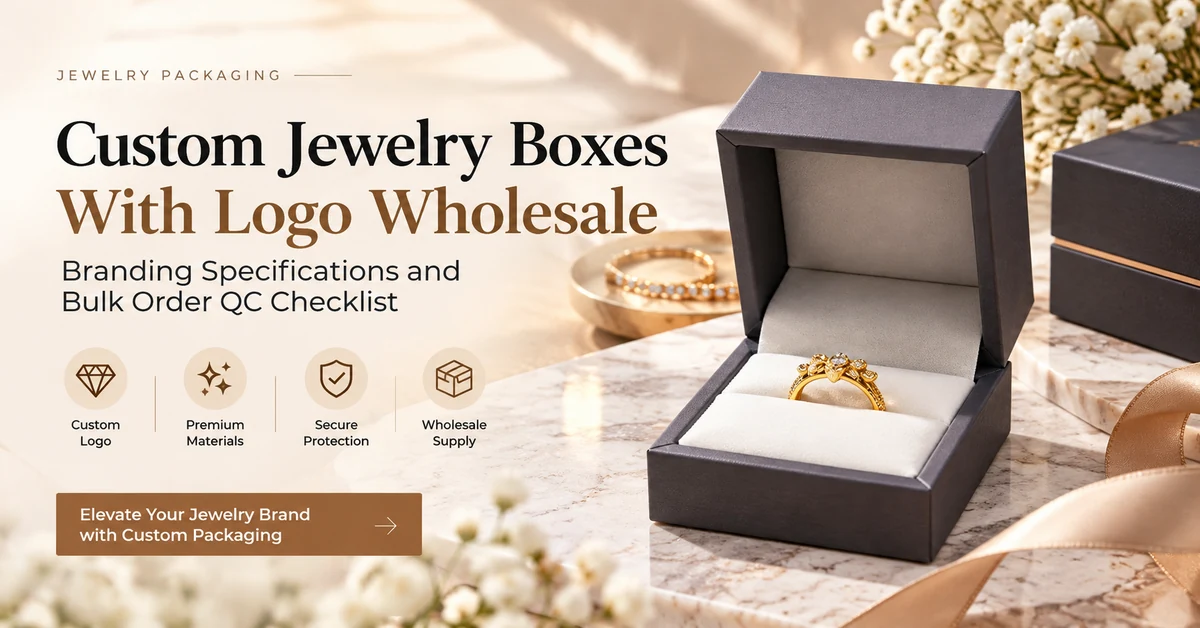
A single-ring hinged box is a practical option for engagement rings and premium jewelry gifts.
The structure normally uses a dedicated ring slot or cushioned support to hold one ring upright.
Thinkpacking's Classic PU Leather Ring Box is a relevant example. The product features a PU leather exterior, paperboard structure, soft velvet or fabric interior, hinged lid, and customizable logo and color options.
It is designed for one ring and is suitable for engagement rings, wedding jewelry, and gift packaging.
Double Ring Boxes for Wedding Sets
Wedding ring packaging may need to accommodate two rings of different sizes, widths, and settings.
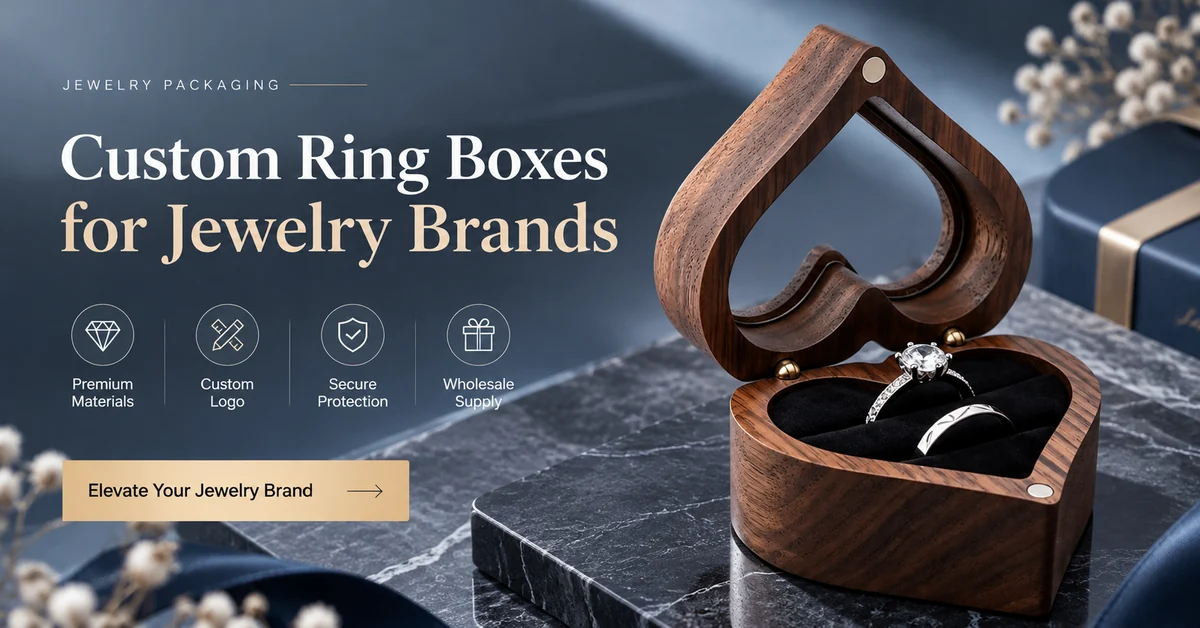
Thinkpacking also displays a Wooden Heart-Shaped Double Ring Box, featuring two ring positions, a wood or wood-based exterior, soft lining, and magnetic closure.
This format is relevant to wedding sets, couples' jewelry, and occasion-based gift collections.
For brands developing both engagement and wedding ring lines, separate single-ring and double-ring configurations can provide more appropriate product fit than forcing all products into one standard box.
3. How Do You Determine the Correct Ring Box Dimensions?
The correct ring box size is determined by the ring's full three-dimensional profile—not just its ring size.
One of the most common packaging specification mistakes is measuring the ring band while overlooking the setting height, gemstone projection, decorative shoulders, or internal lid clearance.
For reliable custom ring boxes for jewelry brands, buyers should measure:
-
Maximum external diameter or width of the ring.
-
Band thickness and width.
-
Maximum height of the gemstone and setting.
-
Shape and projection of prongs or decorative elements.
-
Required orientation inside the display insert.
-
Clearance between the highest point of the ring and the closed lid.
Why Stone Clearance Matters
A gemstone setting may extend significantly above the ring band.
If the ring is positioned too high, the gemstone or prongs may contact the inside of the lid when the box closes.
If the insert holds the ring too deeply, the product may appear poorly presented or become difficult to remove.
A practical rule: Design the box around the tallest and widest ring profile that the intended insert must accommodate, then verify the fit with actual samples.
The required clearance should be confirmed during sampling rather than assumed from an arbitrary universal measurement.
Why Ring Size Alone Is Not Enough
Two rings with the same nominal ring size may have different dimensions because of band width, construction, gemstone setting, or decorative features.
A wide wedding band and a slim solitaire may therefore behave differently in the same ring slot.
For brands with several ring collections, it is useful to identify the products with the most demanding packaging requirements before finalizing a shared box design.
4. Ring Box Technical Specifications: What Should Buyers Confirm?
Before requesting a quotation, a jewelry packaging buyer should prepare a clear specification that can be reviewed by the packaging supplier.
The following table is a recommended RFQ specification framework, not a list of fixed Thinkpacking product dimensions.
| Specification | Recommended requirement | Why it matters |
|---|---|---|
| Product capacity | One ring or two rings | Determines insert configuration |
| Exterior dimensions | Defined according to retail and packing needs | Controls display and logistics fit |
| Internal clearance | Verified against the tallest ring profile | Reduces lid-contact risk |
| Box structure | Hinged, magnetic, rigid lid-and-base, or custom | Determines opening behavior |
| Exterior material | PU leather, paper wrap, fabric, or wood-based material | Influences appearance and cost |
| Interior lining | Velvet, soft fabric, or other approved material | Supports ring presentation |
| Ring retention | Slot, cushion, or specially formed support | Controls ring position |
| Logo method | Foil stamping, embossing, printing, or suitable alternative | Supports brand identity |
| Color | Approved brand reference | Helps maintain visual consistency |
| Closure | Hinged, magnetic, or fitted lid | Influences usability and protection |
| Packing method | Individual protective packing and master cartons | Supports storage and export |
| Quality reference | Approved physical sample and specification | Supports production inspection |
Procurement recommendation: Request a dimensioned sample drawing and confirm usable internal space before approving the exterior box dimensions.
5. How Should Ring Box Inserts Be Designed?
The interior insert is one of the most important components of custom ring packaging.
Its purpose is to hold the ring in the intended position while allowing convenient removal and reducing unnecessary contact with harder box components.
Ring Slot Inserts
Ring slots typically use a narrow opening between supported surfaces.
The slot must provide sufficient retention without placing excessive pressure on the band or decorative elements.
For effective performance, evaluate slot width, material resilience, support depth, and the ring's resting angle.
Cushioned Ring Supports
A cushioned insert can support a ring while contributing to a premium presentation.
However, excessively soft materials may allow the ring to tilt, while overly rigid supports may make removal difficult.
A successful design should balance retention and accessibility.
Custom Inserts for High-Setting Rings
Solitaire and halo-style engagement rings often require closer attention to their setting geometry.
Check whether the insert allows the ring to sit at an appropriate height while preserving clearance around the stone and prongs.
Avoid allowing the insert to press against delicate settings.
Double Ring Inserts
For wedding ring sets, both rings should remain separated and visible.
The insert must account for differences in ring width, diameter, and setting height.
Important: Soft lining is not a guarantee against tarnishing, chemical interaction, or scratching. Material compatibility should be evaluated against the actual metal, plating, gemstones, and finishing processes used in the jewelry.
6. Which Materials Are Best for Luxury Ring Boxes?
Material selection affects appearance, handling, production complexity, and unit cost.
For custom ring boxes for jewelry brands, the most suitable material depends on the intended presentation and purchasing requirements.
| Material | Advantages | Limitations to evaluate | Typical use |
|---|---|---|---|
| PU leather | Smooth appearance, customizable surface | Wear, stitching, edge quality | Premium branded ring boxes |
| Velvet or fabric wrapping | Soft visual and tactile appearance | Dust, lint, abrasion | Luxury ring presentations |
| Rigid paperboard | Flexible shapes and decorative finishes | Corner finishing, structural stiffness | Retail and gift packaging |
| Specialty paper | Distinctive color and surface texture | Scuffing, color consistency | Boutique jewelry collections |
| Wood or wood-based material | Distinctive natural-style presentation | Surface finish, weight, variation | Wedding and special-edition boxes |
For a minimalist jewelry brand, a smooth exterior with restrained decoration may be more appropriate than multiple decorative elements.
A traditional wedding jewelry collection may benefit from fabric-covered or wood-based packaging.
Buyers should also consider where the packaging will be used. A store display box, presentation box, and separately shipped e-commerce order can have different handling requirements.
Explore Thinkpacking's materials and finishing options for the available development directions.
7. How Can Ring Box Manufacturing Quality Be Evaluated?
Ring box quality depends on the interaction of the structure, insert, covering material, finishing, and assembly.
Even a small variation can affect appearance or function.
Structural Assembly
For hinged ring boxes, confirm that the lid opens smoothly, remains correctly aligned, and closes without interfering with the ring.
Check hinge attachment, visible gaps, and box symmetry.
Interior Assembly
The insert should sit consistently inside the box.
Review its placement, surface cleanliness, retention behavior, and whether the ring remains positioned correctly during normal handling.
Decorative Finishing
Logo stamping, embossing, printing, and material wrapping should be consistent with the approved design.
Problems may include uneven foil application, misplaced artwork, wrinkled wrapping, or visible adhesive marks.
Packaging Consistency
For bulk orders, establish agreed tolerances and appearance references covering dimensions, materials, colors, surface defects, and closure functionality.
Thinkpacking's quality control workflow describes material checks, sample approval, printing and surface inspection, assembly review, and pre-shipment checks.
For formal lot inspection, buyers may consider ISO 2859-1:2026, published by the International Organization for Standardization, which defines acceptance-sampling schemes for inspection by attributes. This is a potential buyer-specified inspection framework, not a claim of supplier certification.
8. How Do Different Ring Box Designs Compare for B2B Buyers?
Consider three product directions when developing a ring packaging collection.
| Comparison | Classic PU Leather Ring Box | Wooden Heart-Shaped Double Ring Box | Multi-Slot Wooden Display Box |
|---|---|---|---|
| Main use | Single-ring presentation | Wedding and couples' rings | Multiple-ring retail display |
| Capacity | One ring | Two rings | Multiple rings |
| Main structure | Hinged | Magnetic closure | Hinged display construction |
| Exterior | PU leather | Wood or wood-based material | Wood or wood-based material |
| Interior | Soft fabric/velvet | Soft fabric/velvet | Velvet ring slots |
| Branding | Hot stamping/embossing | Engraving, printing or metal logo | Custom branding |
| Ideal buyer | Engagement jewelry brand | Wedding jewelry brand | Jewelry retailer or showroom |
| Main inspection focus | Single-ring fit | Two-ring spacing | Slot consistency |
These are product-format comparisons, not verified price or performance rankings.
For a fuller view of available styles, browse Thinkpacking's custom jewelry box collection.
9. What Affects the Cost and MOQ of Custom Ring Boxes?
The price of custom ring packaging is influenced by structure, size, material, finishing, insert complexity, and order quantity.
A compact hinged ring box and a decorative wooden double-ring box may have very different production requirements.
Important cost factors include:
-
Structure: Hinges, magnetic components, decorative shapes, and assembly steps.
-
Material: Exterior covering, structural core, lining, and insert components.
-
Customization: Logo tooling, artwork, special colors, and decorative finishing.
-
Quantity: Production setup and material-purchasing efficiency.
-
Logistics: Unit weight, protective packing, and carton utilization.
Rather than comparing unit prices alone, calculate the expected delivered cost of usable packaging, including tooling, sample charges, freight, and handling.
MOQ and lead time should be confirmed for each specific project. They may vary according to box construction, materials, order size, and design approval requirements.
For repeat orders, retain approved physical samples, drawings, material references, and artwork revisions.
10. OEM/ODM Custom Ring Box Development With Thinkpacking
Thinkpacking supports jewelry packaging development through coordinated OEM and ODM services.
For buyers with established packaging drawings, OEM collaboration focuses on executing the agreed structure, materials, and finishing requirements.
For brands developing a new collection, ODM support can help establish the packaging direction before the final specifications are approved.
Its OEM/ODM packaging services cover structural design, branding coordination, material selection, sampling, production review, and export preparation.
The typical development process follows six stages:
-
Project Brief: Confirm jewelry dimensions, collection requirements, quantity, and presentation preferences.
-
Packaging Design: Select the structure, material direction, insert arrangement, and visual design.
-
Physical Sampling: Review ring fit, lid clearance, exterior appearance, and interior support.
-
Material Confirmation: Confirm the components against the approved sample.
-
Production and Quality Control: Coordinate production and inspect packaging against approved requirements.
-
Export Delivery: Prepare protective packing and coordinate shipment communication.
The full process is described in Thinkpacking's How It Works guide.
11. What Should Jewelry Brands Test Before Bulk Production?
A physical sample is the most reliable way to identify packaging problems before they affect a full order.
Use the following checklist during sample approval.
| Test item | Recommended acceptance check |
|---|---|
| Ring fit | Ring remains properly positioned |
| Stone clearance | Setting does not contact the closed lid |
| Insert retention | Ring does not shift excessively during normal handling |
| Product removal | Ring can be removed without excessive force |
| Lid movement | Opening and closing are smooth |
| Exterior finish | No unacceptable marks, wrinkles, or defects |
| Interior quality | Lining is clean and properly assembled |
| Branding | Logo position and appearance match approval |
| Packaging protection | Finished boxes remain protected during packing |
| Reference control | Approved sample and specification are documented |
For e-commerce or international distribution, assess the complete shipping package rather than assuming the presentation box alone provides sufficient transport protection.
Where relevant, ASTM D4169, published by ASTM International, provides a framework for performance testing shipping containers and systems. Any testing requirement should be agreed for the actual distribution configuration.
12. How to Request a Custom Ring Box Quotation
If you are sourcing custom ring boxes for jewelry brands, a detailed initial brief will help the supplier recommend a suitable structure and provide a more relevant quotation.
Prepare the following information:
-
Ring type: engagement, wedding band, gemstone, or collection set.
-
Maximum ring dimensions, including setting height.
-
Number of rings per box.
-
Preferred box style and opening mechanism.
-
Exterior and interior material preferences.
-
Branding and logo requirements.
-
Estimated order quantity and reorder forecast.
-
Destination country and expected delivery schedule.
Looking for customized ring packaging for your jewelry collection?
Thinkpacking can review your ring dimensions, preferred design references, and packaging requirements to discuss suitable structures and sample development.
Contact Thinkpacking for a custom ring box quotation and share your product specifications to begin the project.
Frequently Asked Questions About Custom Ring Boxes for Jewelry Brands
1. What is the best ring box for an engagement ring?
A compact hinged ring box with a secure insert is a common option. The best design depends on the ring's gemstone height, band dimensions, and desired presentation. Always verify that the setting clears the closed lid.
2. Can custom ring boxes accommodate large gemstones?
Yes, custom ring box structures and inserts can be developed around larger settings. Buyers should supply the maximum ring height and gemstone profile so clearance can be assessed during sampling.
3. Are velvet ring boxes suitable for luxury jewelry brands?
Velvet and similar fabric finishes can create a soft, premium appearance. However, buyers should evaluate surface cleanliness, abrasion, lining quality, and compatibility with the actual jewelry.
4. What is the difference between single-ring and double-ring boxes?
Single-ring boxes have one dedicated ring position, while double-ring boxes accommodate two rings. Double-ring designs require appropriate separation, retention, and clearance for both pieces.
5. Can I customize the color and logo of a ring box?
Yes. Depending on the selected material and design, customization may include exterior colors, interior lining, foil stamping, embossing, printing, engraving, and other suitable branding methods.
6. How do I choose the correct ring slot size?
Use real product samples or accurate dimensions representing the intended ring range. Test retention, insertion, and removal. Ring size alone does not define the required slot design.
7. What is the minimum order quantity for custom ring boxes?
MOQ varies with material, structure, tooling, finishes, and order configuration. Buyers should request a project-specific quotation rather than assume a fixed minimum for all models.
8. How long does custom ring box production take?
Production timing depends on design approval, sampling, material availability, finishing processes, and order quantity. Request an agreed schedule covering sample approval, production, inspection, and shipment.
9. Can custom ring boxes be used for international e-commerce shipping?
Yes, they can form part of an e-commerce packaging system. However, the presentation box and its outer shipping protection should be evaluated together to determine whether the completed pack suits the delivery conditions.
10. What should I provide when requesting an OEM or ODM ring box sample?
Provide the ring's dimensions, photographs, preferred packaging style, material and color references, logo artwork if available, estimated quantity, and intended sales market. A physical ring sample can significantly improve the accuracy of fit evaluation.
Conclusion
Custom ring boxes for jewelry brands should be designed around the jewelry itself, not simply selected for their exterior appearance. Proper stone clearance, secure inserts, suitable materials, smooth opening mechanisms, and consistent assembly all contribute to a more reliable packaging experience.
For engagement jewelry, wedding ring collections, and premium retail presentation, brands should prioritize real-product fit testing, physical sample approval, and clearly documented production requirements.
Thinkpacking supports customized jewelry packaging through structural development, material and finishing coordination, sampling, and production quality checkpoints.
Whether you need single-ring presentation boxes, double wedding ring boxes, or customized packaging for a growing jewelry collection, contact Thinkpacking to discuss your design requirements and request a project-specific quotation.