The best way to buy custom jewelry boxes with logo wholesale is to define one repeatable branding standard, then adapt box sizes and inserts to each jewelry type. A matching logo across ring, necklace, and bracelet boxes does not guarantee consistency: substrate texture, foil registration, geometry, and lining color all affect the result.
Jewelry brands, importers, and distributors must maintain presentation across SKUs and reorders without unnecessary tooling, defects, or freight costs. This guide provides a practical specification framework, a comparison of branded box formats, and quality checkpoints to use before committing to bulk quantities.
What Are Custom Jewelry Boxes With Logo Wholesale?
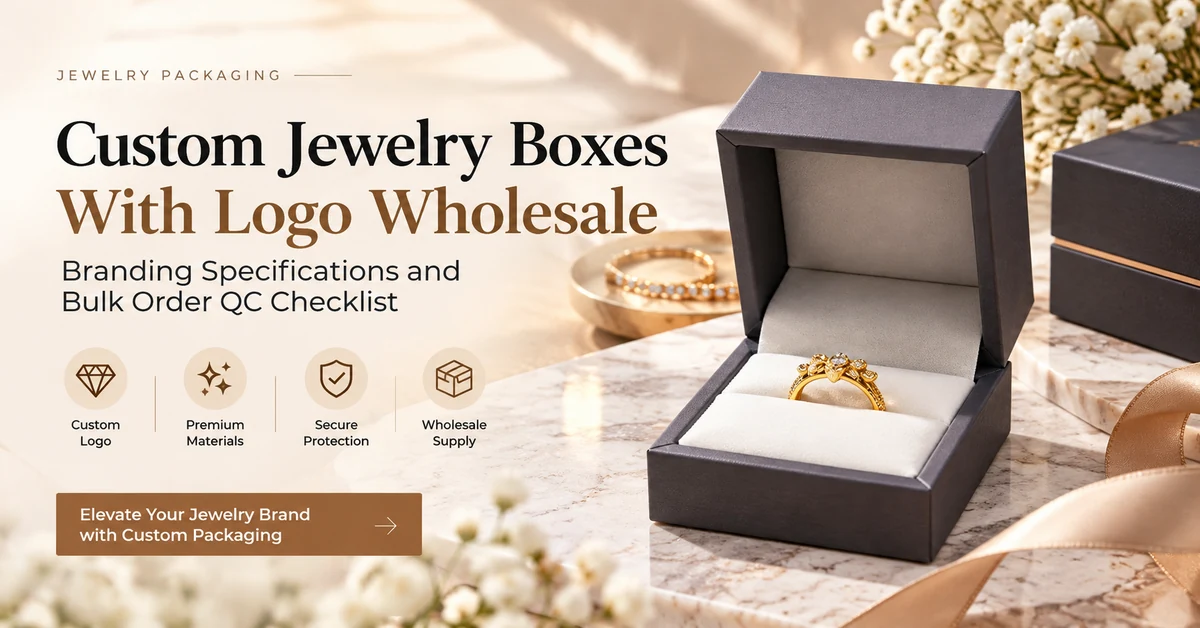
Custom jewelry boxes with logo wholesale are jewelry presentation or storage boxes purchased in commercial quantities with buyer-specified branding, such as printed logos, foil stamping, embossing, or other substrate-appropriate decoration. Depending on the project, buyers can also customize exterior colors, internal inserts, dimensions, opening structures, and secondary sleeves.
They are most relevant to jewelry brands expanding their collections, retail chains standardizing store packaging, e-commerce jewelry businesses improving the gift experience, and distributors serving multiple private-label customers.
They may not be the best option for buyers who need a handful of same-day, unbranded stock boxes, or who have not yet finalized product dimensions and want to skip sample approval. In those cases, basic stock packaging can be a better starting point.
Thinkpacking supports brand-led jewelry packaging projects built around product dimensions, structure, visual finish, sampling, and production coordination.
Choose the Box Format Before Choosing the Logo Finish
A logo that looks excellent on a flat paper lid may not reproduce identically on textured fabric or stitched PU leather. Define the box format and contact surface first, then approve branding on the actual substrate.
| Box format | Typical jewelry application | Branding opportunity | Main bulk-order check | Relative cost direction* |
|---|---|---|---|---|
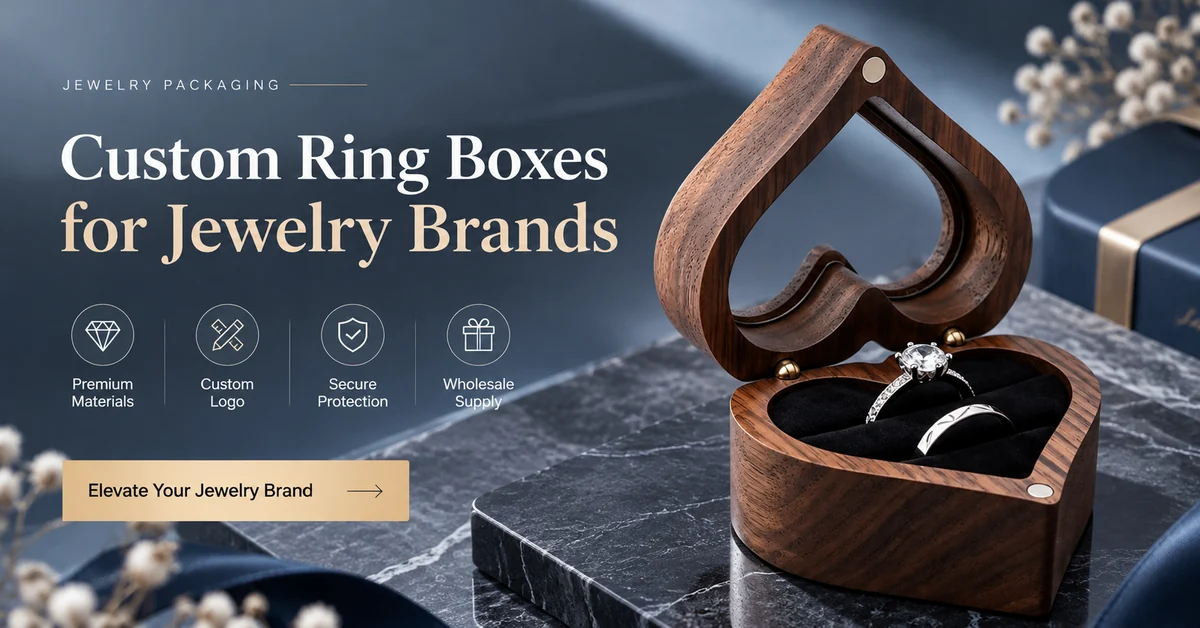
| Hinged ring box | Engagement and wedding rings | Foil or embossed logo on lid | Hinge alignment, ring-slot grip | Medium to high |
| Rigid lid-and-base box | Necklaces, earrings, gift jewelry | Printed wrap, foil or debossed lid | Lid fit, corner wrapping, tray placement | Medium to high |
| Flip-top fabric-wrapped box | Pendant sets, premium collections | Foil/print after substrate testing | Texture effect, flap alignment | Medium to high |
| Drawer-style jewelry box | Bracelets, necklaces, gift sets | Logo on outer sleeve or inner tray | Drawer clearance, pull-tab strength | Medium to high |
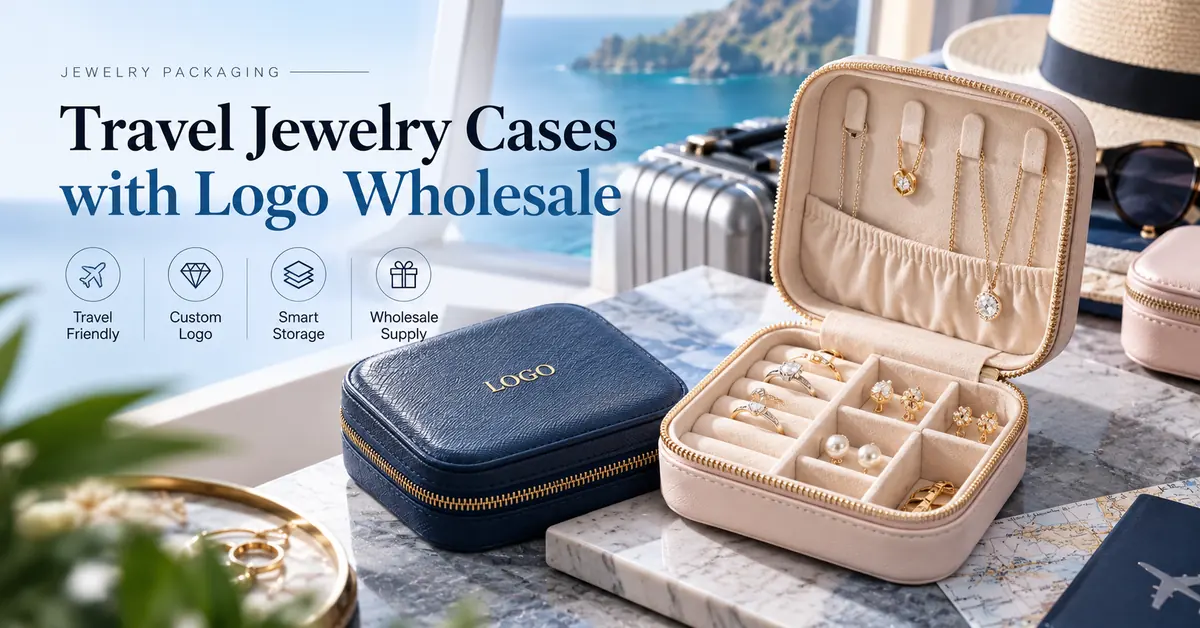
| PU travel jewelry organizer | Everyday accessories, private-label retail | Embossed, printed or stamped area | Stitching, zipper or closure function | Depends on construction |
| Multi-layer jewelry organizer | Mixed collections, storage gifts | Lid or exterior panel decoration | Compartment consistency, hardware fit | Usually more components |
Cost directions are qualitative comparisons, not quoted prices. Material, size, order volume, and tooling can change the ranking.
For tangible design references, compare the Classic PU Leather Ring Box, with a single-ring insert and foil/embossed logo options, against the Linen Flip-Top Jewelry Box, which uses a rigid structure with a textured exterior and customizable insert. A Multi-Layer Pearl Jewelry Storage Box illustrates a different configuration for multiple jewelry pieces. These are examples, not fixed specifications for every order.
How to Keep One Logo Consistent Across Multiple Jewelry Box Sizes
The strongest private-label packaging programs establish a brand master specification before approving individual SKUs. It should define what cannot change and what is allowed to vary with the box size.
1. Lock the logo artwork and minimum reproduction size
Provide a vector logo where available, plus a monochrome version and any approved simplified artwork for small boxes. Ask the supplier to confirm practical line thickness, foil detail, minimum text size, and the usable branding area for each substrate. Tiny trademark elements can fill in during foil stamping or lose definition on heavily textured material.
2. Specify placement relative to physical features
Avoid instructions such as “logo in the middle” without dimensions. Identify the logo's position from defined lid edges and keep it clear of seams, hinges, ribbons, stitched edges, and curved corners. Where small and large boxes cannot use the same physical logo size, agree on a controlled sizing rule rather than scaling by eye.
3. Approve color and finish on the real material
Paper, PU, velvet-like fabric, and linen-textured wraps reflect light differently. The same gold foil or ink can appear different on dark, light, smooth, or textured finishes. Compare samples under a defined light source, then record which surface and foil reference were approved. Do not assume a digital mockup is a valid color standard.
4. Make inserts part of the visual identity
A ring should sit upright, earrings should remain paired, and necklace chains should stay controlled. Interior color and jewelry positioning affect the branded presentation just as much as the logo. Soft lining can reduce direct contact with hard surfaces, but it should not be claimed to prevent tarnish or eliminate all scratching without relevant testing.
Thinkpacking outlines applicable material families and decorative options on its Materials & Finishes page.
Technical RFQ Specification for Wholesale Branded Jewelry Boxes
For custom jewelry boxes with logo wholesale, a detailed RFQ makes competing quotations genuinely comparable. This template is a buyer specification checklist, not a claim that Thinkpacking offers every parameter as a standard stock option.
| RFQ field | Information to provide | Approval evidence |
|---|---|---|
| Product/SKU | Ring, earring, necklace, bracelet or set; number of SKUs | SKU list with product photos |
| Jewelry dimensions | Maximum dimensions, weight, clasp/charm projections | Verified measurements or physical sample |
| Box structure | Hinged, two-piece, drawer, flip-top or organizer | Structural drawing and physical mockup |
| Box size | Required usable internal dimensions, outer size limits | Dimensioned sample |
| Body/surface | Rigid board, specialty wrap, fabric or PU direction | Confirmed material swatch |
| Interior | Ring roll, earring card, necklace hook, cushion or divider | Fit test with actual jewelry |
| Logo artwork | Vector file, size, position, color and finish method | Printed/finished production-representative proof |
| Multi-SKU consistency | Shared colors, logo placement rules, lining and hardware | Approved master reference plus SKU samples |
| Order quantity | Units per SKU, total units, reorder forecast | Price breaks and itemized quote |
| Packing and destination | Individual protection, master-carton target, destination | Pack-out specification and shipping plan |
Practical tip: When requesting wholesale jewelry boxes with logo, ask for a separate quote for each SKU and an additional consolidated quote. This reveals shared-material savings and unusually expensive small SKUs.
Which Logo Application Method Is Best?
For custom jewelry boxes with logo wholesale, there is no universally best branded finish. The right method depends on the base material, artwork complexity, brand position, touch points, and required durability.
| Logo method | Typical visual result | Works well when | Confirm before ordering |
|---|---|---|---|
| Foil stamping | Metallic or pigmented accent | A compact, high-contrast logo is desired | Die detail, foil coverage and registration |
| Embossing | Raised tactile logo | Material can retain a clean relief | Depth, sharpness and distortion |
| Debossing | Recessed logo | Minimal, understated branding is preferred | Consistent impression and surface marks |
| Printing | Flat color artwork | Fine details or multicolor graphics matter | Ink adhesion, color proof, edge clarity |
| Branded sleeve or insert card | Secondary printed identity | Different box formats need a shared campaign look | Sleeve fit, card position, added packing labor |
For a premium ring-box program, a small foil logo on the lid may be easier to control than a complicated multicolor mark on a curved or heavily textured surface. For a fashion jewelry travel organizer, a discreet embossed mark might match the product better. Choose from the actual sample, not a finishing menu.
Wholesale Pricing, MOQ, Lead Time, and Real Cost Risks
Wholesale pricing for custom jewelry boxes with logo depends on considerably more than the logo itself. The box structure, material sourcing, number of colors, logo tooling, insert complexity, total quantity and shipment configuration all affect cost.
A useful formula is:
Estimated landed packaging cost per usable box = (box production + logo/tooling + samples allocated to the order + individual/export packing + freight and import costs + expected rework) ÷ accepted units.
For example, an attractive low unit price can be outweighed by bulky assembled packaging, mismatched lining colors across SKUs, expensive separate logo dies, or a high rejection rate. A seemingly higher quote may produce a lower effective cost if it reduces handling and rework. This is an evaluation method, not an estimate of Thinkpacking's current prices.
MOQ: Ask whether the minimum applies per design, per color, per size, per logo method, or to the combined purchase order. Custom foil tooling or unique wraps may increase the viable run size. Do not assume a universal MOQ for every jewelry box.
Lead time: Request separate milestones for artwork review, sampling, sample revision, material confirmation, production, inspection and shipment. The schedule should be confirmed after specifications and quantity are known, rather than relying on a generic promise.
Capacity and reorders: Ask whether the supplier can support your exact mix of constructions, surface processes, seasonal peaks and replenishment batches. Preserve the approved artwork version, material references and packing rules to reduce repeat-order variation.
Approve a Physical Sample Before Releasing a Bulk PO
The sample stage must prove more than appearance. A branded jewelry box should protect the product, present the jewelry well, open predictably, and reproduce the approved logo on the intended material.
Use this seven-point pre-production approval checklist:
-
Product fit: Test the actual ring, necklace, bracelet or earring set. Include protruding stones, clasps and chains.
-
Logo fidelity: Check position, orientation, fill, small lettering, foil edges and relief definition.
-
Color harmony: Compare exterior, lining, ribbon, hardware and print/foil references.
-
Opening behavior: Test lids, drawers, hinges, magnets or zippers as applicable.
-
Surface and assembly: Examine corners, wrinkles, stitches, adhesive marks, dents and visible joins.
-
Pack-out: Confirm individual protection, master-carton arrangement and whether contents shift in typical handling.
-
Reference control: Record the approved sample, drawing revision, artwork revision and sign-off date for every SKU.
For multi-SKU collections, retain a brand master reference and approved samples for each size; one large-box sample cannot validate smaller formats.
Bulk Quality Control and Compliance: What to Verify
For custom jewelry boxes with logo wholesale, define measurable defect criteria before inspection. Critical defects might include a wrong brand logo or missing product-retaining component; major defects might include a misaligned logo, closure failure or visibly mismatched surface; minor defects may include small appearance variations within a separately agreed tolerance. The buyer and supplier should agree on defect classification before inspection.
| Control stage | What to inspect | Buyer-facing record |
|---|---|---|
| Incoming materials | Covering material, insert components, hardware, color direction | Material confirmation |
| Print and branding | Approved artwork, logo location, foil/print consistency | In-process photos or sample checks |
| Conversion and assembly | Corners, lid fit, seams, lining and closure function | Dimensional/function inspection |
| Finished units | Product fit, cleanliness, packaging condition | Final sampling record |
| Pre-shipment | Quantities, SKU separation, outer-carton protection | Packing list and inspection summary |
Thinkpacking describes these stages in its quality control workflow. For a formal acceptance-sampling plan, buyers may discuss ISO 2859-1 with their inspection partner, but that is an external sampling standard, not a certification or a claim that every Thinkpacking order follows it. Likewise, any material-compliance, recycled-content or sustainability claim should be supported by documentation for the specific materials and destination market.
When jewelry includes delicate finishes, validate compatibility of lining, adhesives and hardware with the actual item. A soft-touch interior alone does not establish suitability for every metal, gemstone or plating system.
OEM vs ODM: Which Route Fits Your Jewelry Brand?
Under OEM, the buyer typically supplies completed structure, artwork and key specifications; the supplier coordinates execution against those references. ODM is more appropriate when the buyer has a collection concept but needs assistance developing box structure, insert layout or material direction.
Thinkpacking's OEM/ODM packaging service covers structural direction, branding, material coordination, sampling and export communication. Its published six-step process moves from brief and design through sampling, material confirmation, production/QC and delivery.
For wholesale programs, the essential deliverable is a controlled specification package that supports repeatable appearance and function. That package should contain approved dielines, logo files, materials, component descriptions, sample references and an agreed change-control procedure.
If you are still at the general supplier-selection stage, the existing custom jewelry box manufacturer buying guide covers broader vendor evaluation. This article addresses the narrower problem of standardized branding and bulk-order control.
Request a Comparable Quote for Your Branded Jewelry Box Collection
If you plan to source custom jewelry boxes with logo wholesale, start with three things: an accurate jewelry product list, a branding reference, and a quantity forecast by SKU. Add sample photos or sketches, preferred materials, destination and your ideal launch schedule. You do not need to finalize every decorative choice before the first discussion, but identify which requirements are fixed and which are open.
Explore Thinkpacking's custom jewelry box collection, then send your packaging brief to the Thinkpacking team to discuss format options, sample development and a project-specific quotation. Asking for a like-for-like RFQ is the most effective starting point for a meaningful wholesale comparison.
Frequently Asked Questions
1. Can I order custom jewelry boxes with my logo in wholesale quantities?
Yes. Commercial orders may be developed with approved logos, colors, structures and inserts. The available finishes and minimum viable quantity depend on the selected construction and artwork, so confirm them for each SKU.
2. What is the best logo finish for luxury jewelry packaging?
Foil stamping is often chosen for a metallic accent, while embossing or debossing creates a tactile effect. Printing can better suit detailed multicolor artwork. The material and physical sample should determine the final choice.
3. Do I need separate tooling for every box size?
Not always, but artwork scale, lid dimensions and logo placement may require different dies or production setups. Ask for an itemized tooling schedule before approving a multi-size order.
4. Can one logo design work on ring, necklace and earring boxes?
Yes, provided each size has an approved reproduction rule. Use consistent artwork, brand colors and finish specifications, while allowing controlled changes in logo size or position when the box geometry requires them.
5. What is the MOQ for wholesale jewelry boxes with logo?
There is no reliable universal MOQ. It can vary by product, substrate, finish, tooling and units per SKU. Request an MOQ and tiered quote against your exact requirements.
6. How do I prevent necklaces from tangling inside their boxes?
Specify a suitable hook, card, recess or retaining arrangement for the actual chain and pendant. Test the filled box during handling before approving the insert for bulk production.
7. How long will logo sampling and bulk production take?
It depends on artwork readiness, tooling, sample revisions, material availability and order size. Ask for a schedule that separates sample approval, production and freight milestones.
8. What should I inspect before the jewelry boxes ship?
Check logo accuracy, dimensions, construction, inserts, closure performance, visible surface defects, SKU quantities and protective packing against the approved references and agreed acceptance criteria.
9. Can I reorder the same branded boxes later?
Repeat orders are easier to manage when artwork revisions, substrate references, approved physical samples and acceptable variations are preserved. Reconfirm material availability and specifications for each order rather than assuming a perfect automatic match.
10. What should I send to request an OEM or ODM jewelry packaging quote?
Provide jewelry dimensions, photos, SKUs, preferred box formats, logo artwork or references, estimated quantities, market, destination and target delivery window. For ODM, add the intended brand experience and design flexibility.
Conclusion
Custom jewelry boxes with logo wholesale deliver the most value when branding consistency and product fit are engineered together. Jewelry brands should select a suitable box format for each SKU, standardize logo artwork and finishing rules, approve actual jewelry-filled samples, and define bulk inspection criteria before ordering. Price matters, but total landed cost and repeat-order consistency determine whether a wholesale program can scale without avoidable rework.
Thinkpacking supports branded jewelry packaging projects through structural development, material and finishing coordination, physical sampling and quality checkpoints. To discuss custom ring, earring, necklace or multi-piece boxes for your next collection, request a tailored quote from Thinkpacking with your dimensions, artwork references and purchasing quantities.