A reliable cosmetic packaging box supplier should help you turn a product brief into an approved, repeatable packaging specification—not simply provide the lowest price per box. For skincare and makeup brands, that means confirming container fit, structural strength, artwork, surface finishes, inserts, sampling, inspection and export packing before the first bulk order.
The buying rule is straightforward: compare suppliers against the same finished-box specification, approve a physical sample containing the actual cosmetic product, and define what will be inspected in production. This prevents an attractive quotation from becoming an expensive packaging redesign after purchase-order approval.
This guide focuses on secondary cosmetic packaging—printed cartons, rigid presentation boxes and gift-set packaging around bottles, jars, tubes or compacts. It does not treat these boxes as primary packaging in direct contact with a cosmetic formula.
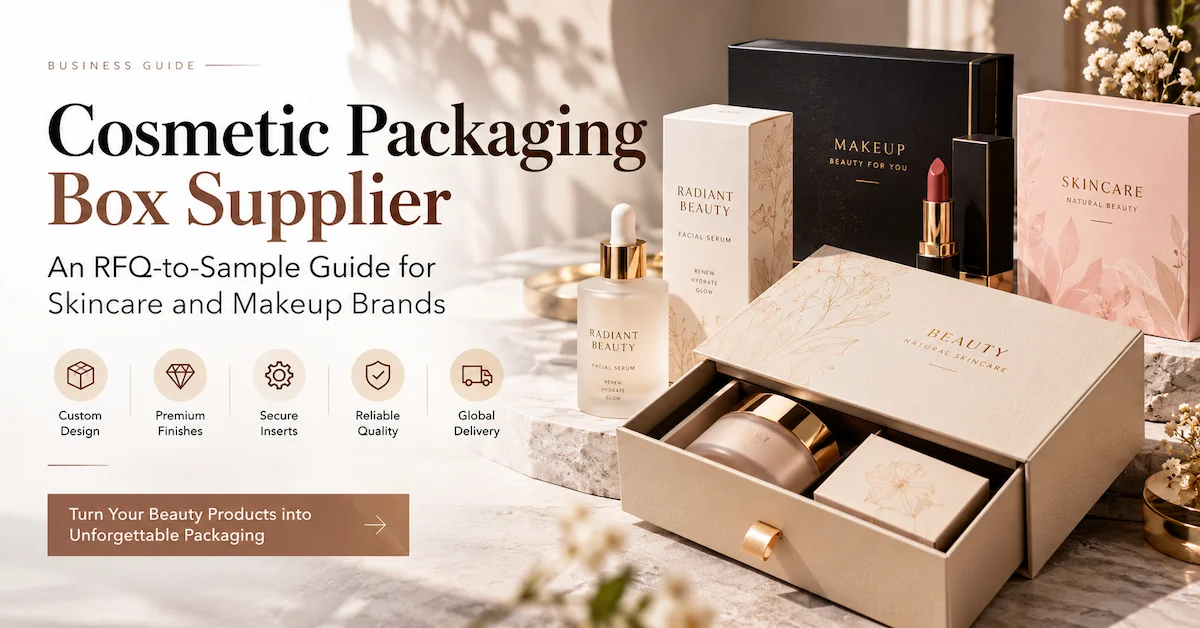
What Should a Cosmetic Packaging Box Supplier Actually Provide?
A qualified supplier for custom cosmetic packaging boxes should be able to discuss the entire packaging system: external structure, internal fit, printing, decorative finishes, pack-out method and approved production reference. The goal is a retail-ready result that works with your product and distribution channel.
Buyers typically need one of three outcomes:
-
Single-product retail cartons for serum bottles, creams, lipsticks and similar packaged cosmetics.
-
Premium presentation boxes for limited editions, launches, subscription collections or influencer PR kits.
-
Multi-item gift boxes that hold different cosmetic formats securely and present them in a planned opening sequence.
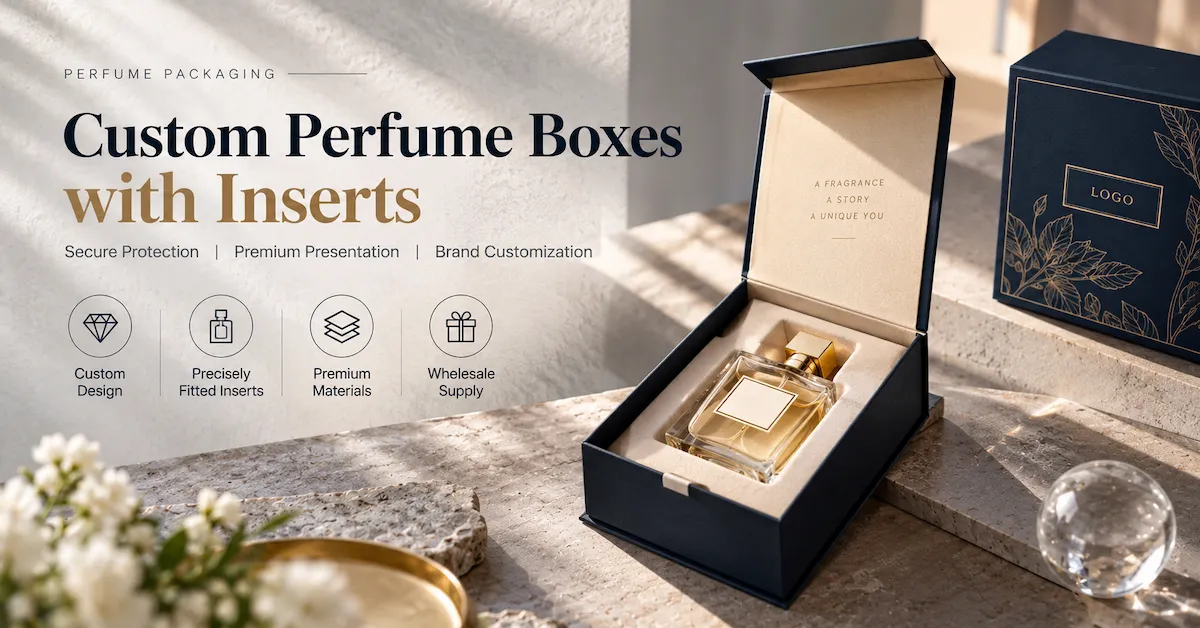
Thinkpacking's beauty packaging approach begins with product dimensions, presentation goals and a physical sample for fit and finish review. A good supplier conversation should begin with those inputs, not with decoration alone.
Who is this sourcing model for—and when is it not suitable?
This approach is particularly relevant to skincare founders, established makeup brands, contract-fillers sourcing secondary cartons, packaging distributors, brand agencies and purchasing managers managing multiple SKUs. It is less suitable when you only need an off-the-shelf, unprinted stock carton immediately, or when your project requires direct-contact bottles, pumps or cosmetic formulation compatibility testing rather than outer packaging. Those primary-packaging requirements need their own specialist validation.
Compare Cosmetic Box Structures by Application
The same beauty product may be suitable for several different box formats, but each has a different cost, presentation and logistics profile.
| Box format | Best-fit applications | Main procurement advantage | Key trade-off | Relative box cost* |
|---|---|---|---|---|
| Folding carton / tuck-end box | Individual serums, lipsticks, compact cartons | Lightweight and typically shipped flat | Limited luxury rigidity; fold accuracy matters | Generally lower |
| Rigid lid-and-base box | Premium skincare kits, gift sets | Strong presentation and straightforward opening | More assembled volume and material use | Generally higher |
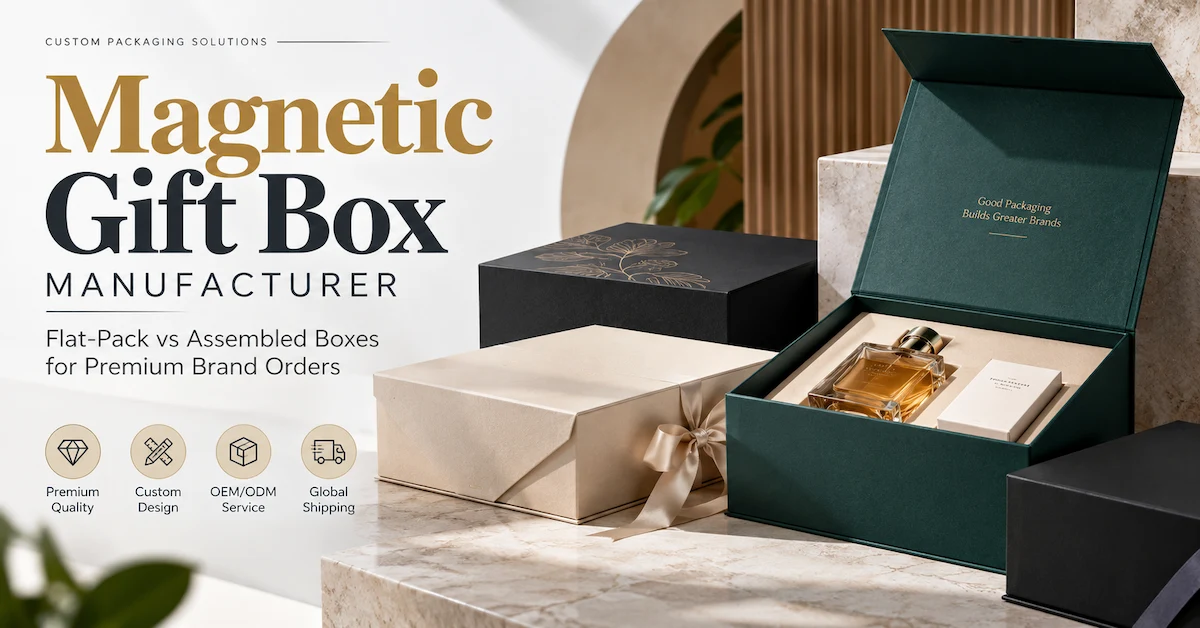
| Magnetic rigid box | High-end makeup kits, PR launches | Controlled opening experience and brand impact | Higher assembly complexity; magnet alignment matters | Generally higher |
| Drawer / sleeve-and-tray box | Small fragrance, lip products, beauty samples | Distinct reveal and easy separation of components | Sliding clearance and insert placement need testing | Varies by build |
| Collapsible rigid box | Larger gift boxes and seasonal campaigns | Can reduce storage and shipping volume before assembly | Setup time and adhesive/closure integrity must be verified | Generally higher |
Indicative only, assuming broadly comparable sizes and order conditions. Final pricing depends on materials, quantities, tooling and finishes.
For tangible starting points, review a white folding paper box for cosmetic bottles, a black magnetic box designed for lipstick sets, and a slide-out drawer paper gift box. These are format examples; the right dimensions and inserts still depend on your product.
A useful design decision is to separate shelf impact from transport protection. A beautiful rigid gift box is not automatically a validated shipping container. Fragile glass bottles may still need an engineered insert and protective outer shipping carton.
Build a Quote-Ready Cosmetic Packaging Specification
When shortlisting a cosmetic packaging box supplier, avoid vague requests such as “premium custom beauty box with logo”; they produce quotations that are difficult to compare. Instead, ask every shortlisted cosmetic gift box supplier to price the same specification.
| RFQ specification | What to define | Why buyers need it |
|---|---|---|
| Cosmetic product | Bottle/jar/tube dimensions, cap shape, filled weight, number of units | Establishes the real load and overall fit |
| Box dimensions | Required usable internal dimensions and approved external envelope | Avoids oversized or tight packaging |
| Structure | Folding, rigid, magnetic, drawer or collapsible; opening direction | Controls manufacturing steps and user experience |
| Board and covering | Paperboard/greyboard direction, surface paper, color and texture | Makes structure, feel and unit cost comparable |
| Insert | Paperboard, formed insert or other confirmed support; cavity layout | Prevents shifting, tipping and poor presentation |
| Decoration | Print method, brand colors, foil, UV, embossing or debossing | Defines tooling, registration and finish cost |
| Artwork | Approved dieline, logo files, copy, barcodes, required market text | Reduces prepress corrections and rework |
| Quantity and forecasts | Launch quantity, reorder quantities, number of SKUs | Supports realistic MOQ and price breaks |
| Inspection and packing | Approved sample, defect criteria, master-carton configuration | Defines bulk acceptance and export protection |
Do not guess insert clearances from nominal bottle volume. A 30 mL serum bottle and another 30 mL bottle may have different shoulders, caps, diameters and center-of-gravity behavior. Provide a physical filled reference when practical, or verified dimensional drawings covering the full container and closure.
Materials, Inserts and Finishes: Specify What Matters
For custom paper cosmetic packaging, material selection must support both structural performance and the intended retail appearance. Common approaches include paperboard for folding cartons, greyboard cores with decorative paper wraps for rigid boxes, and specialty papers for tactile presentation.
Insert selection is equally important. A board divider may work for an organized kit; a shaped cavity may be preferable for a heavy glass serum bottle. Test for insertion effort, removal effort, tipping, edge contact and whether the container shifts during normal handling. Material choice should also consider visible dust, odor and color transfer where the insert touches a finished product container.
On the outside, choose decoration for a specific reason. Foil stamping adds a defined metallic accent; embossing and debossing add tactile detail; spot UV creates localized contrast; and lamination changes the surface appearance and handling characteristics. Thinkpacking documents these options in its materials and finishes guidance.
Avoid promising that a finish is scratch-proof, moisture-proof or fully recyclable without appropriate verification. For US-facing environmental marketing, the Federal Trade Commission's Green Guides (16 CFR Part 260) advise against broad, unqualified claims such as “eco-friendly.” Request evidence for specific recycled-content or recyclability statements instead.
Sample Approval: The Critical Gate Before Mass Production
An on-screen render or digital proof cannot confirm how a cosmetic bottle sits inside an actual box. Before approving production, review a physical sample against the written specification and the intended customer experience.
A practical six-point sample approval sequence:
-
Verify fit: Check the real bottle or cosmetic item, including lid, dropper, cap, label and weight; confirm easy insertion and controlled removal.
-
Check structural function: Open and close the box repeatedly; inspect lid alignment, drawer travel, hinges or magnetic closure as applicable.
-
Inspect graphics: Review text, ingredients or other buyer-supplied copy, barcodes, logo position and print legibility against signed artwork.
-
Approve surface appearance: Compare approved color references, foil location, lamination and tactile effects under agreed viewing conditions.
-
Review pack-out: Confirm how units are protected in inner packs and master cartons, including visible abrasion risks.
-
Record the golden sample: Retain a signed sample or documented photo/measurement reference with the revision number and approval date.
Your cosmetic packaging box supplier should also explain which details could change when moving from a handmade sample to production tooling. If the first sample misses a requirement, revise the specification before treating the design as approved.
Quality Control for Repeatable Bulk Orders
An effective cosmetic packaging box supplier should be able to explain how defects are prevented and reviewed. Beauty packaging defects are often visible at retail: misregistered foil, inconsistent wrapping, poorly aligned drawers, crushed corners or inserts that fail to hold containers upright. For a repeat order, these faults can also damage brand consistency across SKUs.
| Inspection point | Practical check | Buyer evidence to request |
|---|---|---|
| Incoming materials | Correct board, wrap and insert components | Material confirmation against the approved specification |
| Print and decoration | Color direction, registration, foil and coating placement | Press/finish approval records or representative inspection images |
| Box conversion | Folds, corners, joints, hinges and closure function | In-process samples or dimensional checks |
| Finished assembly | Insert orientation, cleanliness, product fit | Random finished-unit inspection results |
| Pre-shipment | Surface condition, quantity, carton protection | Shipment inspection and pack-out confirmation |
Thinkpacking outlines incoming-material, sample, printing, assembly and pre-shipment review stages in its quality control process. Buyers should agree on inspection methods and acceptance criteria for the specific order; a generic “100% quality” promise is not a measurable specification.
For high-risk distribution, discuss whether your complete shipping pack should undergo a relevant test program. ASTM International’s D4169-23e1 standard is one recognized framework for performance testing of shipping containers and systems, but citing a standard does not mean a particular supplier or carton has already passed it.
Cost, MOQ, Production Lead Time and Hidden Trade-Offs
Before choosing a cosmetic packaging box supplier for repeat orders, compare the complete cost rather than the headline unit price. The cheapest quoted box is not necessarily the cheapest packaging decision. A lower unit price can be offset by extra assembly labor, unusable inserts, bulky freight, damaged cartons or repeated artwork changes.
A practical purchasing comparison considers:
Estimated delivered packaging cost = box and insert cost + tooling/sample charges allocated to the order + export packing + freight and import charges + local assembly/handling + expected rework or loss.
Compare supplier quotations only after normalizing size, materials, decoration, quantity, insert design, incoterms and pack-out method. Ask whether the quoted price includes plates or dies, finished inserts, protective sleeves and master cartons.
MOQ is project-specific. It can change with printed paper sourcing, tooling, artwork complexity, material selection and the economics of each production run. Likewise, sampling and manufacturing schedules depend on approved artwork, material availability, revision rounds, order volume and logistics. A single fixed number should not be assumed for every cosmetic box style.
Capacity matters, but the useful question is not simply “How many boxes can you make per day?” Ask whether your supplier can manage your structure, decorative process, number of SKUs, approval windows and planned reorder schedule. If your launch has a non-negotiable date, disclose it before placing the order.
A buyer-friendly supplier evaluation scorecard
Use this suggested 100-point comparison method to make evaluations less subjective. It is a purchasing aid, not an industry certification or a claim about any one supplier.
| Criterion | Suggested weight | What earns confidence |
|---|---|---|
| Structural and product fit | 25 | Real-container sample fits and functions consistently |
| Print, surface and assembly quality | 20 | Approved finish with defined defect criteria |
| Quote transparency and total cost | 20 | Matched specifications and clear commercial inclusions |
| Sampling and engineering response | 15 | Actionable revisions and traceable sample approval |
| Delivery and reorder planning | 10 | Credible schedule and change management |
| Communication and documentation | 10 | Clear drawings, approvals, inspection and shipping records |
A supplier scoring well on price but poorly on fit or revision control may be a higher-risk choice for a launch than a slightly more expensive alternative.
How Thinkpacking Approaches Cosmetic Packaging OEM/ODM
Thinkpacking works with beauty and lifestyle brands on coordinated outer packaging and presentation projects. Its OEM and ODM support distinguishes between executing a customer-established packaging specification and developing a design direction from the product brief.
The company's stated workflow moves through brief, design, sampling, materials, production and quality control, and delivery. This gives overseas buyers a practical sequence for deciding what must be approved before committing to a bulk order. The six-step packaging workflow explains these handoffs in more detail.
Its custom paper box collection offers starting points for printed cartons and decorative gift packaging; a foldable magnetic rigid gift box illustrates another direction for skincare gift sets. The correct project configuration must still be developed and confirmed against the buyer's actual product and target market.
Ready to request a relevant quotation? Share your cosmetic product dimensions, actual item photos, preferred box structure, artwork or mood board, estimated quantity, destination and launch date through Thinkpacking's contact page. If your artwork is not final, start with the product brief and identify which decisions remain open.
Frequently Asked Questions
1. What is the difference between primary cosmetic packaging and a cosmetic packaging box?
Primary packaging directly contains or dispenses a formula, such as a cream jar or pump bottle. A cosmetic packaging box is usually secondary packaging around that container, intended for presentation, labeling organization and additional handling protection. Material-contact and formula-compatibility requirements are different.
2. What should I send a cosmetic packaging box supplier for an accurate quote?
Send product dimensions and weight, container photos or samples, box format, material and finish preferences, artwork status, estimated quantity, SKUs, destination and desired delivery window. List anything that is mandatory rather than simply desirable.
3. Are folding cartons or rigid boxes better for skincare brands?
Folding cartons often suit individual retail units and flat-pack logistics. Rigid boxes suit premium gift sets and an elevated presentation. The better choice depends on shelf positioning, product weight, distribution method, packing labor and total delivered cost.
4. Can cosmetic boxes be customized with logos and premium finishes?
Yes, project-dependent options may include custom graphics, foil stamping, spot UV, embossing, debossing and specialty paper. Confirm the process on a physical sample because screen mockups do not reliably communicate color, texture or foil registration.
5. How can a box protect glass serum bottles during shipping?
Specify the actual filled bottle, a tested insert and an appropriate outer shipping carton. Confirm that the insert limits movement without stressing the dropper, pump or cap. Where distribution risk is high, agree on testing for the complete shipping configuration.
6. What affects the minimum order quantity for custom cosmetic boxes?
Printing setup, tooling, board and wrapping materials, finish complexity and number of variants can all affect MOQ. Request the minimum feasible run and price breaks for your exact design rather than relying on an advertised company-wide number.
7. How long do samples and bulk production take?
Timing depends on design readiness, sample revisions, materials, printing and finishing requirements, volume and shipping. Ask for a milestone-based schedule showing artwork approval, sample approval, production start, inspection and dispatch, with dates confirmed for your order.
8. How do I prevent color and foil inconsistencies across repeat orders?
Use approved print references, a retained physical sample and documented acceptance criteria. Specify which changes require renewed approval. For critical brand colors, agree on the viewing conditions and proofing approach before production.
9. Can a supplier guarantee recyclable or sustainable cosmetic packaging?
Do not rely on broad claims. Ask for the actual material construction, coatings, inserts and supporting evidence relevant to the destination market. Recyclability may depend on the entire pack, component separation and available local collection systems.
10. What quality records should I request before shipment?
At minimum, agree on an approved sample reference, inspection checkpoints, defect criteria, pack-out specification and final shipment review. If you need external testing or a particular certificate, request documentation for the specific material, configuration or facility involved—not a generic statement.
Conclusion
Choosing a cosmetic packaging box supplier is a specification and risk-management decision as much as a branding decision. The most dependable buying process starts with the actual skincare or makeup product, compares suppliers on identical box requirements, validates physical samples, and defines quality and delivery expectations before production.
For brands sourcing custom cartons, premium cosmetic gift boxes or multi-product presentation packaging, Thinkpacking offers an OEM/ODM-oriented project process built around structure, materials, sampling and coordinated quality checkpoints. Explore the relevant formats, then contact Thinkpacking with your product specifications and order plan to discuss a tailored packaging quotation.