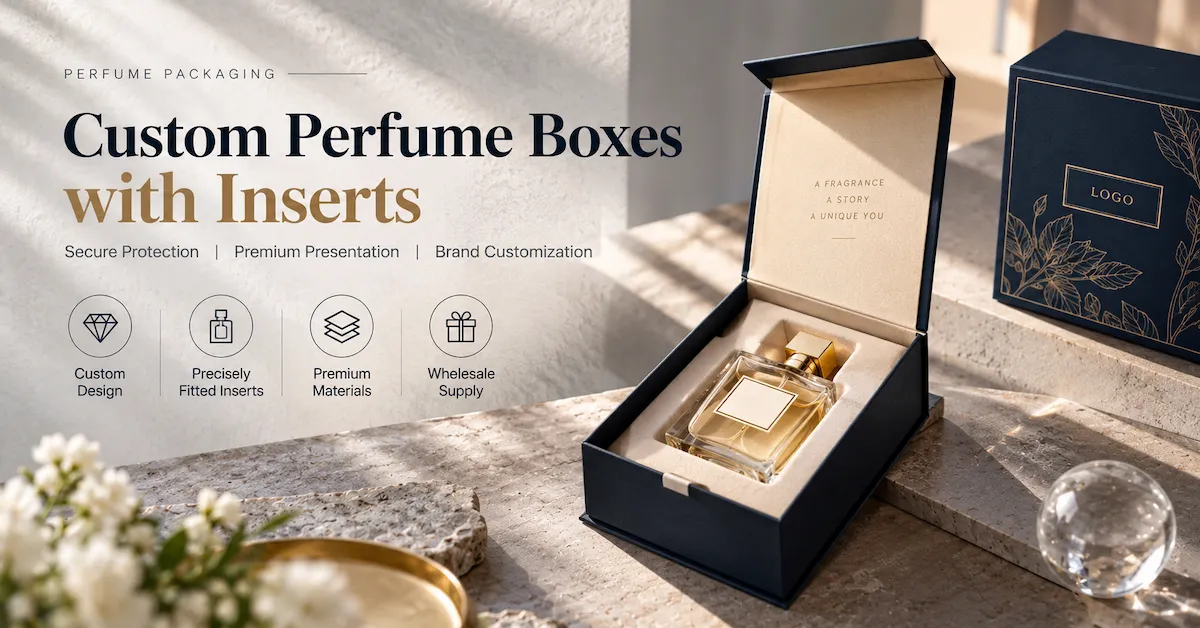
Custom perfume boxes with inserts work best when the bottle, insert, outer box, and shipping pack are designed as one system. The insert should restrain movement at suitable contact points, leave clearance around the sprayer and cap, and allow the customer to remove the bottle comfortably. Its performance must be assessed with the actual filled bottle and the intended distribution conditions—not judged from the outer box alone.
For fragrance brand owners, packaging developers, and wholesale buyers, a seemingly small cavity error can create rattling, scratched labels, damaged closures, or expensive repacking. This practical guide focuses on the technical decisions that distinguish well-fitted perfume packaging from an attractive but unreliable gift box.
1. What Are Custom Perfume Boxes With Inserts?
Custom perfume boxes with inserts are secondary packaging systems that combine an outer presentation carton or rigid box with a shaped internal support. The insert positions one or more bottles, manages movement, and establishes how the fragrance appears when the package opens.
Typical buyers include niche perfume houses, luxury fragrance brands, gift-set developers, packaging importers, and private-label fragrance businesses. They may need a single-bottle retail pack, a premium discovery set, or a multi-bottle gift presentation.
This guide is not a substitute for primary bottle, pump, fragrance-formula, or leakage testing. An insert cannot correct a faulty atomizer seal. Brands needing direct-contact packaging or shipping classification of alcohol-based fragrances must verify those requirements separately.
Thinkpacking describes its fragrance packaging approach as structure-first development, coordinated materials and finishing, and physical-sample approval.
2. Start With the Bottle, Not a Standard 30ml, 50ml, or 100ml Box
Bottle capacity does not determine the cavity dimensions. Two 50ml perfume bottles can have different glass thicknesses, shoulder profiles, cap heights, bases, and filled weights. A standard-looking rectangular bottle may also have rounded edges that change the points of contact.
Before discussing the insert, provide:
-
Maximum bottle width, depth, and overall height with the cap fitted.
-
Filled mass, center-of-gravity concerns, and whether the bottle is glass.
-
Shoulder, base, and cap geometry, including protruding atomizers or decorative details.
-
Label location, coating, engraving, or other surfaces that should not rub against an insert.
-
Orientation: upright, lying flat, or angled for presentation.
-
Whether the consumer should lift the bottle by its sides, a ribbon, or a finger recess.
Practical fit principle: support the bottle on suitable structural areas, then protect fragile or decorative surfaces with appropriate clearance. Do not rely on a tight fit against the spray head or ornamental cap to keep a heavy bottle in place.
For mixed collections, design against the actual minimum and maximum production dimensions of the container, not just one ideal sample. Ask the bottle supplier for tolerances or measure representative units.
3. Which Insert Material Is Best for Perfume Packaging?
EVA foam, formed or folded paperboard, molded pulp, and fabric-covered trays serve different goals. None is universally best; the decision depends on bottle mass, shape, display effect, recycling considerations, cost, and verified performance.
| Insert option | Main advantages | What buyers must test | Suitable project direction |
|---|---|---|---|
| Die-cut EVA foam | Custom cavity shapes; stable presentation when properly specified | Fit variation, compression, odor, surface contact, removal force | Heavy or irregular glass bottles; luxury sets |
| Velvet-lined foam tray | Soft-looking premium presentation with shaped support beneath | Fabric adhesion, lint, color transfer, actual support provided by core | High-end fragrance display boxes |
| Folded or die-cut paperboard | Lightweight, printable, adaptable partitions | Fold stability, edges, movement, bottle load | Single bottles and mixed gift kits |
| Molded pulp | Formed bottle-support features with paper-fiber aesthetics | Dimensional consistency, surface finish, moisture response | Paper-based packaging concepts |
| Multi-material insert | Can combine structural support with a decorative top layer | Assembly repeatability, component compatibility, disposal claims | Premium launches with complex layouts |
Important distinction: velvet is usually a surface finish, not the main structural support. The support beneath it must still control bottle movement. Similarly, calling an insert “eco-friendly” or “shockproof” requires evidence specific to its composition and tested pack design.
Thinkpacking's perfume product pages describe die-cut EVA, velvet-lined trays, molded pulp, and cardboard fittings as project options. Its materials and finishes overview emphasizes confirming materials and components against an approved structure.
4. How Should a Perfume Insert Cavity Be Engineered?
Rather than specifying one arbitrary clearance for every bottle, use a four-part fit review.
A. Retention
The bottle should not rock, rotate excessively, or collide with neighboring items in the intended handling conditions. Examine the base, shoulders, and supported sidewalls; avoid gripping delicate nozzles or labels unless specifically designed and tested.
B. Clearance
With the box fully closed, the bottle cap and atomizer must clear the lid and any opposing insert surface. Include tolerances for glass, closures, insert manufacture, glue-up, and box assembly.
C. Removal
The customer should be able to remove the bottle without pulling on a fragile cap or tearing the tray. A finger recess, ribbon lift, or accessible side grip may be necessary. The required removal effort should be agreed and assessed in a physical sample.
D. Appearance
Check that the bottle sits straight, centered, and at the intended display height. A loose cavity may look cheap even if the bottle does not break; an overly deep cavity may hide the product and make extraction awkward.
A successful fit passes all four tests, not just “the bottle fits in the hole.”
5. Perfume Box Insert RFQ: The Technical Specification Buyers Should Send
Use the same specification to request quotations from different suppliers. These are RFQ fields, not fixed dimensions or performance promises for all Thinkpacking products.
| Specification | Buyer input / acceptance reference | Why it matters |
|---|---|---|
| Bottle identity | SKU, filled bottle sample, drawing revision | Prevents designs based on the wrong container |
| Maximum dimensions | Width × depth × height, including cap | Defines the usable fit envelope |
| Weight and orientation | Filled weight; upright or horizontal | Influences support layout |
| Sensitive surfaces | Label, decorated glass, pump, collar | Identifies contact areas to avoid |
| Box style | Shoulder-neck, drawer, magnetic, or folding | Controls closure and insertion direction |
| Insert material | EVA, paperboard, pulp, fabric-covered option | Aligns appearance, load, and budget |
| Cavity geometry | Contact zones, clearances, finger recess | Enables retention and removal approval |
| Decoration | Artwork, color reference, foil and wrap | Establishes visual acceptance criteria |
| Order details | Units by SKU, destination, delivery window | Enables comparable quotes and planning |
| Pack validation | Retail-only or parcel/export route; test plan | Distinguishes display quality from transport performance |
If the fragrance bottle has not been finalized, confirm the bottle specification before signing off insert tooling. A cap or shoulder redesign may invalidate an otherwise finished cavity.
6. Choose the Outer Box Around the Insert and Opening Experience
The same insert material can behave differently in a lift-off box, a sliding drawer, or a magnetic presentation box. Match structural choice to both the bottle and the retail experience.
| Box structure | Relevant Thinkpacking product reference | Presentation advantage | Critical technical check |
|---|---|---|---|
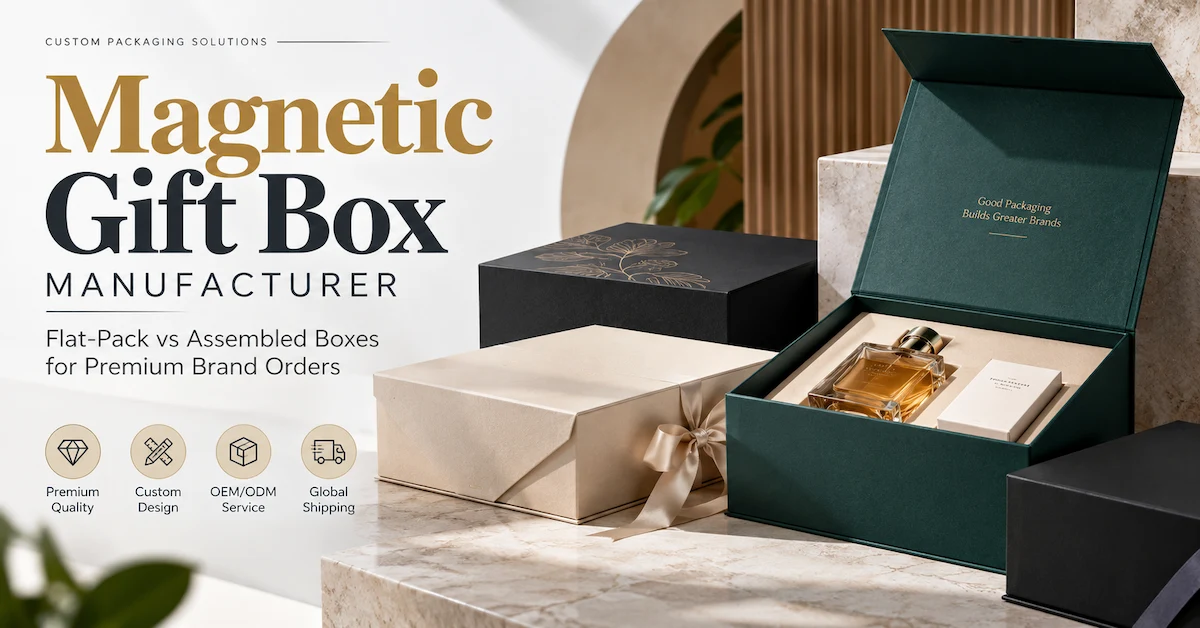
| Shoulder-neck rigid box | Black-and-white shoulder perfume box | Deep lift-off reveal for a single hero bottle | Bottle-to-lid clearance; shoulder fit |
| Drawer rigid box | Forest-green ribbon-pull perfume box | Controlled slide-out opening for a fragrance | Insert retention; drawer movement |
| Deep cube drawer box | Matte-black cube fragrance box | Extra interior depth for selected containers | Pull-tab strength; bottle height and load |
These listings illustrate available design directions rather than guaranteed stock or tested performance for every bottle. Their custom fit, MOQ, and production timing require project-specific confirmation.
For glass perfume gift sets, check the clearance and separation between bottles as carefully as the fit of each individual cavity. Two glass containers should not collide when the complete pack is moved.
7. How Do You Validate Inserts Before Approving Bulk Production?
A visual rendering cannot establish impact resistance or the way a filled glass bottle behaves inside the actual packaging. Follow a sample-led approval sequence:
-
Fit test: Insert representative bottles at the low and high ends of their allowed dimensional range, if available.
-
Contact test: Check whether labels, glass decorations, collars, caps, or sprayers touch unwanted surfaces.
-
Closure test: Close the complete box repeatedly; listen for contact and inspect lid and drawer clearances.
-
Removal test: Confirm the bottle can be lifted safely without damaging the insert or requiring force on the cap.
-
Handling test: Examine movement after realistic handling with the bottle in the final orientation.
-
Shipping-pack test: If the product will be shipped, evaluate the entire retail box, cushioning, and outer carton together.
-
Approval record: Retain a physical reference and document bottle SKU, insert material, artwork, revision, and acceptance criteria.
Transit testing is a separate decision. ASTM International's ASTM D4169-23e1, Standard Practice for Performance Testing of Shipping Containers and Systems, addresses distribution testing of shipping units. The International Safe Transit Association's ISTA Procedure 3A addresses suitable individual parcel shipments. Which method applies depends on the real shipping environment, and neither standard establishes that a particular Thinkpacking product has passed testing.
For alcohol-based fragrances, also confirm applicable carrier and dangerous-goods requirements for the filled retail product. Packaging strength and transport regulatory eligibility are different questions.
8. Common Problems With Perfume Box Inserts—and How to Prevent Them
| Problem found in sampling | Likely design issue | Recommended correction |
|---|---|---|
| Bottle rattles | Cavity too large or insufficient contact points | Revise geometry and recheck actual bottle tolerances |
| Bottle difficult to remove | Excessive friction or no grip access | Add suitable finger access or adjust support zones |
| Cap touches lid | Insufficient vertical clearance | Recalculate closed-pack stack-up and retest |
| Label rubs or scuffs | Insert presses against printed or decorated area | Move retention to appropriate bottle features |
| Drawer binds | Insert or contents distort tray alignment | Check insert height, tray fit, and assembly |
| Insert appears crooked | Assembly positioning or cutting inconsistency | Add positioning reference and inspection checks |
| Glass breaks in transit | Inadequate complete-pack protection | Review retail pack, outer cushion, and distribution test |
Do not solve a loose insert only by adding more adhesive, wrapping, or padding. Uncontrolled changes can affect fit, odor, customer experience, and repeat-order consistency.
9. Quality Control, Materials and Compliance
Before bulk approval, agree on what will actually be measured and inspected. The approved physical sample is the baseline for both appearance and function.
Incoming materials: Review board, insert components, liners, adhesives, and decorative surfaces against agreed references.
During production: Check die-cut position, formed cavities, insert orientation, dimensional fit, box opening, and print/foil placement.
Finished units: Verify bottle fit using an approved method, inspect cleanliness, confirm closure, and check export packing.
Thinkpacking describes these stages in its quality control process. Buyers should request project-specific inspection criteria and any required evidence rather than infer certification from marketing language.
Where recycled content, recyclability, colorfastness, or emissions are commercially important, request documentation that applies to the specific materials and finished configuration. An alternative insert material should be assessed for performance and disposal claims separately; paper-based construction does not automatically guarantee lower environmental impact in every system.
10. What Determines the Cost, MOQ and Lead Time?
A custom insert can change the economics of an entire perfume packaging project. Cost drivers include bottle complexity, number of cavities, material, depth, insert tooling, lining, box structure, finishes, assembly labor, and quantity per SKU.
A practical sourcing comparison is:
Landed cost per accepted package = (outer box + insert + tooling and sampling allocated to the order + packing + freight/import costs + expected losses) ÷ accepted units.
An economical-looking insert may cost more overall if it requires extra assembly, creates fit failures, or increases the size of the rigid box and shipping carton.
MOQ, sample timing, production capacity, and delivery dates are design-dependent. Request an itemized quotation that identifies the quantity per bottle version and separates sample, tooling, production, and logistics milestones. Do not assume that all catalog products share one universal commercial commitment.
For a fragrance line with 30ml, 50ml, and 100ml SKUs, ask whether the box exterior can share a controlled design while the insert geometry changes. This may simplify branding, but it must not compromise fit or increase dead space unnecessarily.
11. How Thinkpacking Supports OEM/ODM Perfume Packaging Projects
Thinkpacking supports custom packaging development for fragrance brands through structure, materials, physical sampling, manufacturing coordination, and export delivery. An OEM project typically starts with a defined drawing and artwork, while ODM collaboration can begin with the bottle, brand references, and desired presentation.
Its published six-step packaging workflow progresses from brief and design to sampling, material confirmation, production and quality checks, and delivery. Its OEM/ODM service overview explains how these steps support buyers at different development stages.
For perfume packaging, that process should produce a traceable fit specification: the bottle version, the approved insert sample, box construction, decorative references, inspection method, and export packing plan. This is more valuable to a repeat buyer than an unsupported promise that every box is “100% protective.”
12. Request a Quote for Custom Perfume Boxes With Inserts
To discuss custom perfume boxes with inserts for a retail launch, luxury collection, or wholesale gift set, prepare the following:
-
Photos or physical samples of the filled perfume bottles, including caps and sprayers.
-
Bottle dimensions, filled weight, SKU count, and desired orientation.
-
Preferred outer box style and initial material/insert direction.
-
Logo artwork or visual references, estimated quantity by SKU, and destination market.
-
Whether the finished product will ship through retail distribution, parcel delivery, or both.
-
Intended launch date and requirements that must be tested before release.
Browse Thinkpacking's custom perfume box collection, then contact Thinkpacking for a project-specific quotation. A clear bottle-and-insert brief will make sample development and price comparison substantially more useful.
Frequently Asked Questions
1. What is the best insert for a heavy glass perfume bottle?
A die-cut EVA or another appropriately engineered support may be suitable, but there is no universal answer. The correct choice depends on filled weight, geometry, surface finish, allowable movement, opening experience, and validated shipping performance.
2. Can 30ml, 50ml, and 100ml bottles use the same perfume box insert?
Not automatically. Different capacities can correspond to very different shapes. Shared outer packaging may be possible with separate insert designs, but every bottle and cavity combination requires a fit review.
3. Is EVA foam better than molded pulp for perfume packaging?
EVA allows detailed cavities and can offer stable support; molded pulp can support paper-fiber design goals. Compare dimensional repeatability, bottle contact, actual protection, finish, cost, and disposal requirements before selecting either material.
4. How much clearance should a perfume bottle have inside an insert?
There is no single safe universal clearance. Define allowed bottle variations and insert tolerances, then test retention, cap clearance, rubbing, and customer removal using production-representative samples.
5. Can a velvet-lined perfume insert protect a bottle during shipping?
A velvet-like layer can improve presentation, but it does not prove shock protection. The structural core and complete shipping pack must be assessed against the intended distribution conditions.
6. How can an insert prevent a perfume bottle from rattling?
A properly designed cavity supports the bottle at suitable points, reduces free movement, and keeps fragile features away from rigid surfaces. The result should be verified with filled bottles in the final pack.
7. What is the MOQ for custom perfume boxes with inserts?
MOQ depends on the box structure, insert material, cutting or forming tooling, decoration, and volume per SKU. Request a specific quotation rather than relying on a blanket minimum.
8. How do I test perfume packaging before export?
Approve the bottle-insert fit first, then assess the retail box and complete shipping configuration. Depending on the route, a relevant ASTM or ISTA shipping test procedure may be specified with an independent laboratory.
9. What information does a perfume packaging supplier need for OEM/ODM?
Provide bottle samples or drawings, filled weight, closure dimensions, box style, insert preferences, artwork, quantities, destination, and testing requirements. ODM projects can begin before final artwork if the product and desired experience are clear.
10. Can perfume boxes with inserts be customized with logo and luxury finishes?
Yes. Depending on the selected structure and approved materials, options may include printed wraps, foil stamping, embossing, debossing, and other confirmed finishes. Always approve the combined box-and-insert sample rather than decoration alone.
Conclusion
Custom perfume boxes with inserts are most reliable when the support cavity is engineered around the actual glass bottle and approved as part of the complete packaging system. Material choice, dimensional variation, cap clearance, product removal, closing action, and shipping conditions all matter more than a visually impressive render.
Fragrance brands and wholesale buyers should begin with accurate bottle data, compare EVA, molded pulp, and paperboard options for their specific use, and approve physical samples with clear inspection criteria before placing bulk orders. Thinkpacking offers custom perfume box design directions and OEM/ODM coordination to support that process. Contact Thinkpacking with your bottle specifications, preferred structure, and purchasing plan to request a tailored quotation.