When engineering a flagship fragrance gift set, sourcing a well-built rigid box is rarely just an aesthetic decision. It is an exercise in tactile weight, tolerances, and retail durability. Fragrance flacons are notoriously dense, irregularly shaped objects; paired with an ancillary vial or accessory carton, they require an enclosure that prevents internal movement while establishing prestige the second a customer lifts the lid. For procurement teams and packaging designers, bridging the gap between an evocative concept and a production-grade container requires careful scrutiny of board structures, lamination finishes, and interior fitments.
The Architecture of Magnetic Presentation Boxes
Modern fragrance packaging often leans toward the hinged magnetic format. Unlike conventional two-piece lift-off lids, a hinged structure provides an anchored unboxing sequence that guides the consumer's eye.
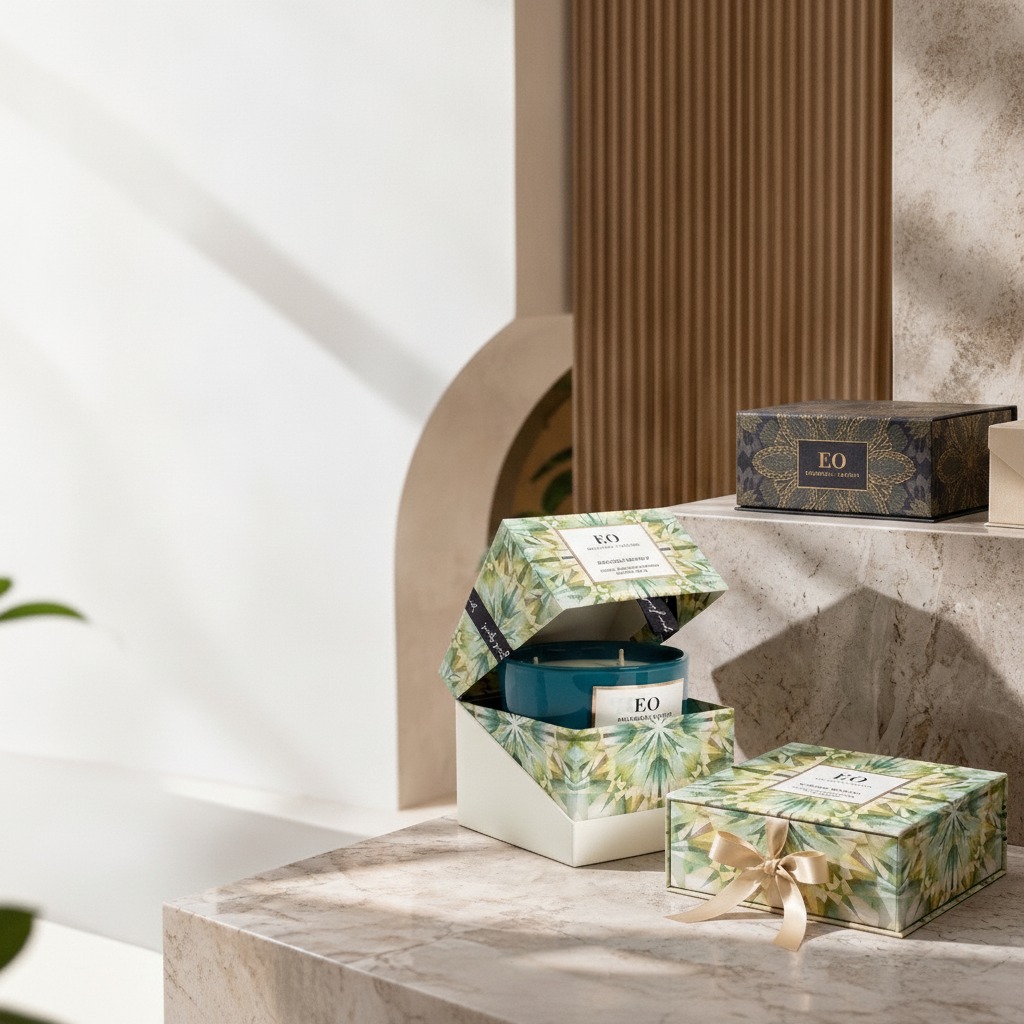
In high-end retail executions, the exterior is typically wrapped in a saturated, deeply tinted paper—such as a deep botanical green—contrasted by crisp metallic foil stamping. Underneath that surface wrap lies dense chipboard or greyboard, which gives custom rigid boxes their signature clean 90-degree corners and solid heft. When the flap drops shut, concealed neodymium magnets embedded beneath the board plies pull the lid flush with an audible, reassuring snap. That acoustic feedback is a critical psychological cue for luxury rigid boxes, signaling structural integrity before the customer even inspects the bottle inside.
In some seasonal configurations, decorative accents such as gold grosgrain or satin ribbons are applied to the exterior. While secondary ties can elevate shelf appeal for holiday promotions, production managers should verify whether the ribbon is purely ornamental or functional. A closure that relies strictly on hand-tied bows adds assembly friction on the fulfillment line, whereas a hidden magnetic closure maintains consistent alignment across thousands of retail units.
Flat-Pack vs. Pre-Assembled: Sourcing Trade-Offs
One of the most consequential decisions when specifying a rigid packaging box program is delivery format. Premium packaging generally travels through one of two supply routes:
Pre-Erected Set-Up Boxes
These are delivered fully formed with the inner trays glued into position. The structural rigidity is unmatched, corners remain pristine, and fulfillment teams can begin bottle loading immediately. The downside is brutal on transportation budgets: you are paying to ship air. For international freight, the cubic volume of assembled boxes can rapidly inflate logistics costs.
Collapsible (Flat-Pack) Magnetic Boxes
Engineered with precision score lines and adhesive corner tabs or integrated folding flaps, these units ship flat and are popped into three-dimensional form on the pack-out line. For brands managing limited warehouse space or high container rates, collapsible premium rigid packaging offers substantial storage savings. However, buyers must evaluate the fold points: repeated folding can stress certain laminated papers, causing micro-cracking along dark ink borders if the substrate grain direction is misaligned during die-cutting.
Interior Fitments: Protecting the Flacon
A custom-tailored rigid enclosure is only as capable as its internal nesting. In a dual-compartment layout designed for a perfume bottle and a secondary accessory—such as a travel atomizer or miniature carton—the insert must balance grip and presentation.
Die-cut EVA or high-density cross-linked polyethylene foam wrapped in flocked velvet remains a popular choice for high-impact protection. The friction fit prevents glass-on-glass chatter during transit. Alternatively, for brands pursuing single-material circularity, stepped paperboard inserts or dense molded pulp can be color-matched to the outer case. If you specify a light, contrasting tray against a dark green or navy wrap, ensure the insert edges are neatly turned or bevel-cut; raw, unlined board edges instantly degrade the perceived value of custom printed rigid boxes.
Practical Caveats for Quality and Sustainability Claims
During procurement discussions, factory mockups often look flawless, but production realities demand vigilance:
* Magnet Depth and Glue Bond: Ensure the supplier sets magnetic discs flush with the milled greyboard cavity. If seated too deep under the wrap, magnetic attraction weakens; if set too high, the surface paper will stretch, bubble, or wear through after minimal handling.
* Foil Stamping Abrasion: Metallic gold graphics on smooth matte-laminated surfaces must pass cross-hatch adhesion and rub tests. Fragrance oils occasionally leak during consumer use; unvarnished metallic foils can tarnish or lift if exposed to alcohol vapors.
* FSC Documentation: Artwork often displays an FSC certified logo, but buyers must request the actual Chain of Custody (CoC) certificate number tied to the manufacturing facility and confirm whether the claim covers the core board, the outer wrap, or solely the insert paperboard.
Summary Sourcing Checklist
Before releasing purchase orders for production runs, verify the following details on physical pre-production samples:
1. Drop test clearance: Test the assembled pack with filled bottles to ensure the insert holds under drops without puncturing the bottom board.
2. Closure alignment: Check that the hinged lid lands squarely without overhanging the front lip.
3. Finishing resilience: Inspect dark edge wraps for white paper show-through along hard scores.
4. Assembly labor: If using flat-pack formats, clock your packing line to confirm that box-erection speed aligns with your fulfillment budget.
Frequently Asked Questions
Can collapsible rigid boxes provide the same rigidity as traditional set-up boxes?
When properly engineered with high-density board and strong corner adhesive strips or hidden magnets, collapsible boxes mimic traditional setups closely. However, they naturally possess subtle score seams where the panels fold, which discerning luxury buyers can distinguish from seamless, wrapped set-up boxes.
What should I provide a manufacturer to get accurate tooling quotes?
Provide exact outer bottle dimensions (including pump caps), the weight of the filled bottle, the dimensions of any secondary product, CAD drawings or a sample of the product itself, and your target unboxing layout. Specify whether you require pre-assembled delivery or flat-pack supply.