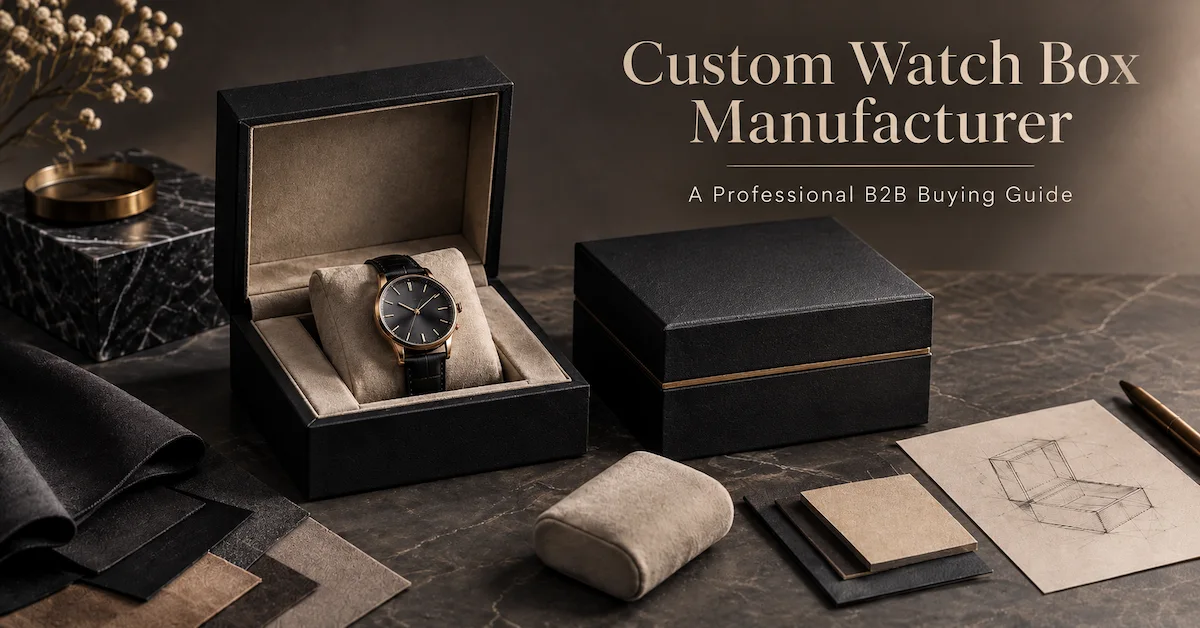
The right custom watch box manufacturer does not simply put your logo on an existing case. A suitable production partner should help you match the packaging structure to the watch, select materials appropriate for retail or travel use, confirm the watch holder and closure with a physical sample, and maintain agreed details during bulk production. For an international order, clear specifications and export-packing arrangements matter just as much as the appearance of the finished box.
Before requesting a quotation, define five things: the watch model and dimensions, the intended selling environment, the packaging format, the expected order quantity, and the branding standard. Then compare suppliers on sample quality, fit, inspection procedures, communication, and total cost—not unit price alone. A beautiful box that allows a heavy watch to move inside may be a poor purchase; a simpler box with the right insert can be the stronger commercial decision.
For buyers comparing available directions, Thinkpacking's custom watch box collection includes single-watch presentation boxes, travel cases, pouches, and multi-watch storage formats. These are useful starting points for a product-specific discussion rather than universal specifications for every order.
What Does a Custom Watch Box Manufacturer Actually Provide?
A watch box is a small packaging system with several interacting parts: the outer structure, lid or closure, watch holder, lining, decorative surfaces, and any protective shipping pack. Changing one part often affects another. A thicker insert alters the usable internal height; a different watch pillow changes how the bracelet closes; a metal badge or foil logo may require a different surface treatment.
A custom watch box manufacturer or development partner may support structural drawings, materials, samples, production, assembly, and inspection. The precise division of work varies. Some suppliers operate particular production processes directly, while others coordinate specialist printing, case-making, sewing, or finishing workshops. Rather than relying on labels such as “factory direct,” buyers should ask who owns the specification, who approves the sample, where final assembly occurs, and who is responsible for correcting defects.
Thinkpacking describes its role as an export packaging partner coordinating the product brief, design, physical sampling, material direction, production communication, quality review, and global delivery. Its OEM and ODM packaging service separates projects with existing specifications from projects that need development support. That distinction is useful for watch businesses because a mature brand ordering a familiar box has different requirements from a startup launching its first watch collection.
A good supplier conversation should move quickly from inspiration photos to measurable details: the watch's real size, the box's usable space, the method of holding the watch, color and logo requirements, acceptance criteria, and delivery expectations. This is where an attractive concept becomes a repeatable purchase order.
Which Buyers Need Custom Watch Boxes—and When Are They Not the Best Choice?
Watch brands launching a new collection often need a coherent retail presentation. They may require matching packaging across several case sizes, a consistent logo treatment, a warranty-card compartment, and sufficient protection for distribution. An ODM-style development process can help when no complete packaging specification exists.
Established watch companies are more likely to prioritize repeatability. They may already have approved artwork and a physical reference box. Their procurement teams need stable materials, recorded revisions, predictable inspection, and a clear method for handling replacements or later reorders.
Wholesalers and importers may purchase several box formats for different price segments. They need a realistic MOQ for each design, carton quantities, dependable specifications, and a clear distinction between stock items and fully customized production.
Jewelry retailers, gift suppliers, and e-commerce brands sometimes use watch boxes as accessories or gift products rather than primary packaging. A multi-watch organizer or travel pouch can be sold independently, while a rigid single-watch box is usually part of the watch's point-of-sale presentation. This difference changes how the buyer should evaluate closures, aesthetics, handling, and perceived value.
Custom packaging is not automatically the best option. For a short event with very few units and no need for unique dimensions, a stocked neutral box may be more practical. A highly customized rigid case can also be inefficient for a brand that frequently changes watch sizes without allowing time for sampling. The best manufacturer should explain these trade-offs rather than insist that the most complex design is always superior.
Which Watch Box Structure Fits Your Sales Channel?
When working with a custom watch box manufacturer, the first technical decision is the box format. A customer opening a gift at home, a retail associate displaying a watch, and a traveler putting two watches into luggage interact with packaging differently.
| Watch packaging format | Main advantages | Best-fit buyers and uses | Points to verify |
|---|---|---|---|
| Rigid paperboard presentation box | Defined shape, printed branding, broad surface-finish options | Watch retail, promotional collections, brand gifting | Internal support, edge wrapping, shipping protection |
| Sliding drawer watch box | Controlled reveal, compact geometry, distinctive unboxing | Boutique watch brands, gift sets, DTC retail | Drawer friction, pull tab, insert movement |
| Hinged or flip-top watch box | Simple access, reusable storage feel | Premium single-watch presentation, repeat-use storage | Hinge alignment, lid opening, pillow removal |
| PU leather watch case | Tactile exterior, stitched or formed designs | Private-label accessories, travel, storage | Surface durability, seams, closure reliability |
| Multi-slot display or storage box | Multiple compartments, collection organization | Wholesalers, collectors, retail display | Slot dimensions, dividers, lid clearance |
| Watch roll or soft pouch | Compact, easy to store and carry | Travel accessories, after-sales gifts, compact DTC products | Padding, watch-to-watch separation, fastening |
Rigid Boxes and Sliding Drawer Boxes for Retail
A paperboard rigid box can make sense when branding, shelf presentation, and predictable external dimensions matter most. The exterior can be covered with specialty paper, and a well-designed insert can position the watch without filling the entire package with expensive materials. However, the box's rigid appearance should not be confused with tested shipping protection; the assembled pack still needs to suit its distribution route.
Drawer boxes create a more staged opening experience. Watch movement, the friction between sleeve and tray, and the clearance around the insert need attention. Too loose, and the tray feels uncontrolled; too tight, and the customer struggles to open it. Thinkpacking's Premium Sliding Watch Box is a relevant product reference: its listing describes a single-watch drawer construction with a paperboard exterior, soft lining, and cushioned watch pillow.
Hinged and PU Leather Cases for Reusable Packaging
A flip-top case can become part of the customer's everyday storage routine. That increases the importance of how the lid opens and how easily the watch can be removed. PU leather provides a leather-like appearance without being genuine leather, and it allows several color and texture directions. Buyers should inspect seams, edge treatment, adhesive visibility, and any hardware in addition to the exterior color.
For example, Thinkpacking lists a Leather Single Watch Box with a faux-leather exterior, flip-top lid, and removable padded pillow. This is a useful reference for buyers seeking a reusable one-watch package, but its listed configuration should not be treated as the specification for every custom project.
Travel Cases, Rolls, and Multi-Watch Organizers
Travel packaging has a different job. The user may move the case repeatedly, turn it on its side, or place it inside a crowded bag. A soft surface alone is not enough: the watches must remain separated, the closure must stay secure during expected handling, and the internal geometry must accommodate straps and bracelets without forcing them into awkward shapes.
A six-slot case and a single-watch retail box therefore require different validation. Thinkpacking's six-slot leather watch travel case illustrates a compartment-based PU design, while its velvet watch travel pouch represents a lower-volume, soft-sided direction. Buyers should select a format based on the intended watch models and handling conditions, then verify the physical sample.
Important distinction: a passive watch storage box is not the same as an automatic watch winder. A winder adds motors, power components, operating characteristics, and potentially different electrical compliance and warranty questions. If your project includes a powered winder, request a separate technical specification rather than quoting it as an ordinary presentation box.
Technical Specifications: Measure the Watch Before Designing the Box
Packaging projects can fail even when an initial 3D image looks convincing. A watch's nominal case diameter tells only part of the story. Two watches described as 40 mm can differ in crown projection, case thickness, strap stiffness, bracelet shape, and clasp position. For packaging purposes, the controlling dimension is often the largest real envelope of the product in the position in which it will be packed.
Ask the watch product team for physical samples or verified drawings. Confirm case diameter, total width including the crown, maximum thickness, lug-to-lug length, strap or bracelet type, clasp details, and the intended orientation. For a watch with an unusually stiff metal bracelet, a small pillow may cause excessive tension. For a loose fabric strap, a wider holder may be needed to prevent rotation.
Internal dimensions and external dimensions should be recorded separately. External size affects retail shelving, master-carton packing, and freight; usable internal size controls watch fit. The manufacturer should account for board thickness, fabric wrapping, glued layers, and insert compression rather than assuming the outer box measurement is available inside.
| Specification to include in your RFQ | What to provide or confirm | Why it matters |
|---|---|---|
| Watch envelope | Case, crown, lug-to-lug and maximum thickness | Prevents contact with lid and sidewalls |
| Strap or bracelet | Leather, rubber, fabric, metal bracelet; clasp position | Determines pillow form and holding tension |
| Packed orientation | Dial up, upright display, flat or angled | Defines insert geometry and visual presentation |
| Interior fit | Pillow dimensions, usable cavity and intended clearance | Reduces unwanted movement or compression |
| Box structure | Drawer, hinged, rigid lid-and-base, roll or pouch | Controls opening experience and assembly |
| Exterior and lining | Paperboard, wrapped paper, PU, fabric or other confirmed materials | Affects appearance, wear and production methods |
| Branding files | Vector artwork, dimensions, color references and logo placement | Reduces printing and finishing revisions |
| Order plan | Trial quantity, first bulk order, forecast and SKU split | Allows realistic quotation and procurement planning |
| Shipment conditions | Destination, freight mode and retail or e-commerce channel | Informs protective packing and cartons |
| Acceptance criteria | Approved sample, visual limits, functional checks and inspection plan | Makes quality discussions measurable |
The table is a buyer's specification template, not a list of pre-set Thinkpacking manufacturing tolerances. Numerical limits must be agreed for the actual watch and packaging design. If several watch models share one retail box, test the smallest and largest realistic configurations instead of assuming a single sample proves universal fit.
How to Choose Exterior Materials and Interior Linings
A custom watch box manufacturer should help compare complete material systems, because a material that photographs beautifully can create problems in the wrong structure. Consider the entire material stack, not just the visible surface.
Paperboard and Specialty Paper
Rigid paperboard structures are frequently selected for branded retail packaging because they can be wrapped, printed, and finished in many ways. A specialty-paper surface can add texture without needing complicated hardware. Key sampling checks include corner neatness, consistent folding or wrapping, adhesive marks, and the stability of the completed structure.
If a paperboard box must travel through parcel distribution, discuss the outer shipping carton separately. Decorative retail packaging and the distribution pack do not have identical purposes.
PU Leather and Wrapped Surfaces
PU leather is useful for structured organizers and reusable watch cases. It can produce a tailored appearance, but durability depends on the particular substrate, coating, reinforcement, and construction. Do not assume every PU surface is waterproof or abrasion-proof. If moisture resistance, rubbing resistance, or accelerated aging matters to your market, specify an agreed test or obtain substantiated material data.
Ask whether a printed logo, debossed mark, or metal emblem is best suited to the chosen surface. A technique that works on smooth paper may not reproduce the same fine detail on textured PU.
Velvet, Suede-Like Fabrics, and Other Soft Linings
Interior fabric is both a visual and functional component. It influences how the watch feels when lifted from the box and how exposed metal surfaces contact the insert. Buyers should compare lint shedding, fabric direction, seams, adhesive bleed-through, color transfer risk, and the behavior of the lining when rubbed against representative watch finishes.
Calling a lining “soft” is not an adequate acceptance test. Check it with the actual metal bracelet, buckle, crystal edge, and case geometry. A premium-looking fabric that attracts visible lint can create avoidable unboxing complaints.
Wood and Wood-Based Boards
Wood or wood-based structures can be appropriate for larger presentation and storage products, particularly multi-slot organizers. They may create a substantial feel, but also introduce questions about surface finishing, weight, hinges, edge consistency, and the protection of watches during transport. Compare a wooden solution against rigid paperboard or PU alternatives based on your end use rather than assuming that heavier always means higher quality.
Thinkpacking's materials and finishes overview explains its paper, board, wrapped-surface, interior-component and finishing directions. Final material combinations should be evaluated in a physical sample.
The Watch Pillow or Insert May Be More Important Than the Exterior
Watch buyers notice the exterior; packaging engineers must concentrate on what happens inside. The pillow, insert, or shaped holder determines whether the watch stays presented at the intended angle, whether the bracelet sits naturally, and whether the user can remove the watch without pulling hard on the strap.
Consider three scenarios. First, a heavy steel sports watch on a loosely fitting pillow can tilt and touch the wall of a rigid box. Second, a compact watch with a short metal bracelet may not close comfortably around an oversized pillow. Third, a soft pouch holding two watches without a divider can permit metal-to-metal contact. The suitable solution is different in each case.
For a single-watch box, test insertion and removal with the real watch, not just an empty cushion. Check the crown and clasp, and examine any direct contact points. For a display box, confirm that a watch stays at the intended angle when the lid is opened. For travel storage, assess movement with the case in the orientations a customer is likely to use.
A Practical Insert Approval Procedure
-
Place each target watch model into the proposed holder and photograph the final packed position.
-
Check whether the bracelet or strap is excessively stretched, folded, or compressed.
-
Close the box slowly and check clearance around the crystal, crown, and case back.
-
Open and remove the watch repeatedly, noting snagging, excessive friction, or movement.
-
Inspect the lining for loose fibers and contact marks after handling.
-
Record approved pillow dimensions, cushioning material, covering fabric, and attachment method.
For a multi-SKU collection, specify whether one universal insert is acceptable or whether separate cavities are required. A “one size fits all” design may lower tooling complexity but increase presentation and fit compromises. Good customization is a documented choice, not an assumption.
Branding and Surface Finishes: Match the Process to the Material
A custom box should support the brand, but the strongest result is not always the one with the most decoration. Logo treatment should complement the watch's positioning, survive normal handling, and reproduce consistently.
| Branding method | Typical visual effect | Buyer review point |
|---|---|---|
| Printed logo | Clean colors and fine artwork where substrate permits | Color proof, registration and legibility |
| Foil stamping | Metallic or pigmented accent | Foil adhesion, edge definition, substrate compatibility |
| Embossing | Raised tactile detail | Relief clarity, material distortion, consistency |
| Debossing | Recessed, understated mark | Depth, alignment and visibility on textured surfaces |
| UV detail | Controlled surface contrast on appropriate print | Placement, gloss consistency and abrasion expectations |
For a classic dress-watch brand, a restrained logo on a dark specialty paper may work better than a large metallic mark. A sports-oriented brand may prefer a more functional-looking case with minimal exterior artwork. An anniversary set might justify a more elaborate surface treatment because the packaging has a gift or display role.
Before production, request a sample on the actual selected material, not only a digital mockup. The same artwork can appear different on coated paper, textured paper, and PU. Thinkpacking identifies lamination, foil stamping, UV, embossing and debossing among its documented finishing options; the suitable combination must still be confirmed for the specific box.
OEM vs ODM Watch Box Manufacturing: Which Route Should You Choose?
OEM works best when your company already has a detailed specification. You may supply drawings, dielines, material standards, artwork, color references, an approved reference sample, and an inspection checklist. In this model, supplier selection emphasizes execution, consistency, commercial terms, and transparent change management.
ODM is more appropriate when you have a watch, brand direction, price target, and reference images but still need a packaging solution. The supplier may help explore a structure, materials, insert design, and finishing direction before physical sample approval. ODM does not mean you should skip documentation; it means the documentation is developed during the project.
A new watch brand may begin with an ODM concept and use the resulting approved specification for later OEM-style repeat orders. That can be a practical transition: the first order establishes the system, and subsequent orders seek consistency and controlled improvements.
When discussing intellectual property, clarify ownership or permitted use of supplied artwork, custom structural files, and any paid tooling before development starts. Avoid relying on vague assurances. Keep a dated record of approvals and revisions, especially when several agencies or factories participate. Buyers seeking help with either route can review Thinkpacking's OEM/ODM process and submit the current stage of their project.
Sampling: The Most Valuable Step Before a Bulk Watch Box Order
A digital rendering can confirm the intended look, but it cannot demonstrate drawer friction, pillow compression, fabric contact, hinge alignment, or the actual feel of a foil logo. Sampling should be treated as a purchase-risk control rather than a formality.
For a custom watch box manufacturer, a useful development sequence starts with a structural or unbranded sample, when appropriate, followed by a sample using the chosen materials and finishes. The buyer then confirms the final configuration in writing. For complex projects, more than one iteration may be necessary; the number of rounds should be agreed commercially instead of assumed.
What to Sign Off on the Final Sample
Structure: external and usable internal dimensions, lid movement, drawer fit, hinge or zipper operation, and finished assembly.
Watch fit: actual watch positioning, crown clearance, pillow firmness, bracelet closure, and insertion/removal experience.
Appearance: material identity, color against the agreed physical reference, logo dimensions, placement, and surface finishing.
Quality standard: acceptable minor visual variation, no-go defects, inspection method, and packaging configuration for dispatch.
Commercial readiness: quantity per design, carton assumptions, documentation version, and any tooling or sample charges still outstanding.
Thinkpacking states that physical sampling and approval precede production. Its six-step development workflow connects the initial brief, design, sampling, material confirmation, production review, and delivery coordination. Ask which sample will serve as the controlled reference for bulk inspection. If an approved sample changes, document the revision; do not rely on an informal message saying the difference is acceptable.
Quality Control for Watch Boxes: What Should Actually Be Inspected?
Quality review with a custom watch box manufacturer should focus on failures a watch brand's customer would notice and failures that could compromise product fit. The most useful quality system begins with a mutually agreed sample and written criteria. Generic promises about “strict quality” are less helpful than evidence of what inspectors check.
| Inspection stage | Watch packaging checkpoints | Typical defect or risk |
|---|---|---|
| Incoming materials | Board, wrap, PU or fabric type; visible condition | Substituted material, inconsistent texture |
| Print and finishing | Logo placement, foil/print coverage, visible scratches | Off-center logo, poor edge definition |
| Structure and assembly | Lid, drawer, zipper, hinge, corners and alignment | Binding drawer, poor lid fit, loose hardware |
| Insert and pillow | Correct shape, attachment, lining and watch fit | Watch movement, exposed hard contact points |
| Pre-shipment review | Quantity, mixed-SKU labels, protective carton packing | Wrong variant, damaged outer cases |
A buyer can go further by separating defects into critical, major, and minor categories with the supplier. For example, a sharp exposed staple or incorrect insert that risks watch contact may be treated differently from a small cosmetic mark in a non-visible area. The definitions and any sampling limits must be explicitly agreed; there is no universal tolerance that fits every watch box and brand.
For a branded presentation box, consider a simple opening-and-closing check and an insertion/removal check during sample approval. For travel cases, also consider closure security and movement within the intended carrying conditions. If protective performance is a contractual requirement, specify a suitable, agreed testing method and the test configuration. Neither a rigid exterior nor a soft lining by itself proves impact protection.
Thinkpacking's published quality control checkpoints cover incoming materials, approved samples, printing and surface work, structure and assembly, and pre-shipment condition. Use that framework as a starting point for discussing the inspection report or review evidence applicable to your project.
MOQ, Unit Price, and Tooling: Understand the Real Cost Drivers
“What's your lowest MOQ?” is a reasonable question, but it should not be the only one. A minimum order quantity can change when the box structure, material, printing method, logo treatment, insert shape, and number of color variants change. A stocked black watch case with a straightforward logo application is a different sourcing project from a newly tooled multi-slot organizer in an exclusive color.
A quotation from a custom watch box manufacturer should separate one-time development costs from recurring unit costs. Ask what is included in sample development, artwork adjustment, tooling or molds if any, packaging of the finished boxes, and export preparation. For multiple SKUs, confirm whether MOQ is calculated per structure, per color, per logo, or per combined purchase order.
The cheapest box at the factory can be more expensive after freight, storage, assembly, product damage, and returns are considered. A slightly more compact structure may reduce carton volume. A simpler insert may lower assembly complexity, but only if it still holds the watch properly. Conversely, reducing material quality to meet a target price can create visible problems that undermine a premium product.
A Practical Cost Comparison Formula
For purchasing decisions, compare total packaging cost per sellable watch: box unit cost + allocated development/tooling + inbound freight and duties where applicable + warehouse handling + expected packaging-related loss or rework. This is a planning framework, not an assertion that a particular supplier will have a fixed loss rate.
When requesting tiered prices, keep the specification constant. A quotation for 500 identical units with one printed logo cannot be compared fairly with a quote for 2,000 units across five colors and different interiors. Ask suppliers to list assumptions on the same quotation sheet.
Thinkpacking advertises flexible MOQ discussion, but individual product pages show different quantities and lead-time assumptions. Treat any published figure as product-specific until a current written quote confirms your exact design. Buyers can send planned quantities and target packaging details through the contact and quotation page.
Lead Time, Production Milestones, and International Delivery
Lead time is a sequence, not a single number. A realistic watch packaging schedule may include brief confirmation, structural design, material sourcing, sampling, revisions, written approval, bulk production, inspection, and export packing. A supplier's production estimate should specify when the clock starts—for example, after sample approval and receipt of required production materials—and what is excluded.
Design complexity also matters. Printed paperboard presentation boxes, sewn PU travel cases, and wooden multi-watch organizers can involve different material lead times and assembly processes. The number of variants influences artwork checking and production changeovers. Public lead times for one product should not be copied into the procurement plan for another.
As a concrete illustration, the Thinkpacking Premium Sliding Watch Box listing indicates sample development of approximately 7–10 days and bulk production of around 15–35 days, subject to design and quantity. These are that product page's stated ranges, not a guaranteed schedule for all orders; confirm an updated timeline in your quotation.
For overseas buyers, agree on whether the shipment is priced on an ex-works, port, or delivered basis, depending on the actual trade arrangement. Verify master-carton size, gross weight, cartons per SKU, carton labels, protective packing, and who handles booking and customs paperwork. If your retailer requires a specific delivery window, share it early enough to plan backward through sample approval and inspection.
How to Compare Suppliers Without Relying on Marketing Claims
An effective supplier audit is not only a video tour or a gallery of attractive boxes. Request specific evidence of the supplier's ability to execute your packaging design and manage communication from development to dispatch.
Consider the following illustrative buyer scorecard. The weights are a suggested purchasing method, not an industry-mandated certification scheme.
| Supplier evaluation area | Suggested weight | Evidence to request |
|---|---|---|
| Physical sample and watch fit | 25% | Sample tested with target watch models |
| Quality and specification control | 20% | Inspection points, approval and revision records |
| Materials and finishing consistency | 15% | Agreed swatches, process samples, sourcing details |
| Communication and problem resolution | 15% | Named contact, response process, clear quotations |
| Pricing and commercial transparency | 15% | Unit cost, MOQ basis, tooling, payment and exclusions |
| Export and delivery coordination | 10% | Carton plan, documentation responsibility, shipping terms |
Ask who will sign off on the final sample, what happens if a component is unavailable, and how production deviations will be reported. Clarify whether subcontracted operations are involved and which party remains accountable for the finished result. A specialized manufacturing network can work well when responsibility and specifications are clear; opaque production arrangements are the greater risk.
A strong answer will usually be concrete: “We will check this lid clearance with your watch and confirm it in the sample,” not merely, “We produce premium quality.” You want a partner who can explain trade-offs and document decisions, including cases where your preferred concept needs adjustment.
Three Practical Watch Packaging Sourcing Scenarios
Scenario 1: A Boutique Watch Brand Preparing Its First Retail Collection
The brand has two watch designs, a logo, and a desired launch period but no packaging drawings. The most sensible first step is to provide both watch samples, the intended retail price positioning, and visual references. An ODM discussion can determine whether one box size can serve both models without compromising fit. A rigid drawer box with an approved single-watch pillow may meet its presentation objective without needing a heavily constructed wooden case.
The project should establish brand color, artwork placement, insert configuration, and sample approval before bulk quotation is finalized. The key purchasing question is not “How luxurious can the box look?” but “Can customers consistently receive the same clear brand presentation without watch movement or awkward removal?”
Scenario 2: An Importer Developing a Private-Label Watch Organizer
The buyer wants a product that can be sold separately, perhaps with six compartments and a branded exterior. This is a consumer storage accessory, not merely disposal packaging. Closure performance, divider stability, fit across different watch sizes, exterior wear, and consistency between units now carry greater weight.
A multi-slot PU case may be promising, but the importer should first test representative small and large watches, examine the strap and pillow combination, and review carton efficiency. If the organizer is advertised for travel, customer-use testing becomes particularly important. The six-slot watch travel case example provides one product direction to discuss, subject to sample verification and current specifications.
Scenario 3: An Established Brand Reordering Seasonal Packaging
The brand already has a successful presentation box and needs a repeat order with a new logo color. Its greatest risk is uncontrolled change. It should send the last approved sample or specification version, define exactly what will change, and ask the supplier to confirm whether the new foil or print behaves differently on the existing surface.
A small design change can still affect setup, color matching, or material sourcing. In this case, strong version control and confirmation of the revised sample often matter more than brainstorming new box styles. That is why a supplier's documentation and communication process can be as valuable as its product catalogue.
A Complete RFQ Checklist for Custom Watch Boxes
When contacting a custom watch box manufacturer, the quality of your first inquiry influences the usefulness of the quotation. A manufacturer cannot accurately assess a complex watch box from the phrase “black luxury box, best price” alone. Use the following checklist as an RFQ brief.
Product and use: State whether the box is retail packaging, a luxury gift box, an accessory for resale, a travel case, or a multi-watch organizer. Include the destination markets and whether goods will move through parcel delivery or retail distribution.
Watch details: Provide dimensions or physical samples, strap/bracelet types, the largest and smallest target models, preferred orientation, and any known sensitive contact areas.
Packaging concept: Attach reference images or drawings and identify your preferred box structure, approximate external size, internal compartments, closure, and watch holder. If the project is still conceptual, state which parts need ODM assistance.
Branding and materials: Attach vector logos if available. Specify intended colors, logo application, paper or PU direction, interior fabric, and whether sustainability documentation is required. Ask for evidence before making recyclability or certification claims in your own marketing.
Commercial information: Provide a first-order quantity per design, realistic annual forecast if known, number of colors, sample deadline, desired delivery date, shipping destination, and preferred quotation currency or delivery terms. Request that optional features and one-time development charges be shown separately.
Approval requirements: Ask how many samples are included, how revisions are priced, what physical sample becomes the master reference, and which inspection checks will apply before dispatch.
You can send this information directly to Thinkpacking's packaging inquiry team. A detailed brief makes it easier to review structure, material direction, sampling needs, and an appropriate next step without inventing a universal MOQ or a guaranteed price.
Frequently Asked Questions About Custom Watch Box Manufacturers
1. What is the difference between a custom watch box manufacturer and a watch box wholesaler?
A manufacturer or manufacturing-development partner normally participates in specifying and producing a customized design, whereas a wholesaler may primarily resell existing products. The terms are not legally precise descriptions of a supplier's facilities. Ask who develops samples, approves materials, coordinates production, and accepts responsibility for finished quality. For a private-label project, those answers are more useful than the company label alone.
2. Can I order custom watch boxes with my brand logo?
Yes, subject to the selected design and material. Common options include printing, foil stamping, embossing, and debossing. The best method depends on whether the exterior is wrapped paperboard, textured specialty paper, PU, or another substrate. Provide vector artwork and request a physical logo sample to approve scale, position, and finish.
3. What is the MOQ for custom watch boxes?
There is no reliable universal figure. MOQ may depend on whether the item is stocked, the box structure, the number of variants, materials, custom inserts, and finishing processes. Ask for a quotation stating the MOQ per design and per color, and distinguish sample quantities from bulk production. Thinkpacking discusses MOQ according to project requirements rather than offering one fixed number across its entire collection.
4. How long does it take to manufacture custom watch boxes?
The schedule includes development and sample approval before production, then inspection and delivery. Complexity, materials, volume, and changes to the artwork or insert can all affect timing. Ask for separate dates for sample readiness, approval deadline, production completion, and shipment preparation. Do not treat a sample timeline from one product listing as a promise for a different watch case.
5. What is the best material for a luxury watch box?
There is no single best material. Wrapped rigid board may be appropriate for premium retail presentation with detailed printing. PU can suit reusable storage or travel cases. Wood or wood-based construction may make sense for a heavier multi-watch organizer. The right selection depends on product positioning, handling requirements, the desired surface treatment, budget, and evidence from an approved sample.
6. How do I make sure the watch pillow fits different watch sizes?
Provide representative watches rather than relying on nominal case diameter alone. Assess bracelet circumference, strap stiffness, pillow compressibility, dial orientation, and closure clearance. If the same box must serve several models, confirm the smallest and largest realistic watch configurations during sampling. Where fit requirements conflict, separate insert sizes may be the better solution.
7. Are rigid watch boxes suitable for international shipping?
They can form part of an appropriate shipping system, but decorative rigidity does not by itself establish protective performance. Review how the watch is fixed, how the retail box is packed into a master carton, and which handling hazards apply to the delivery channel. Where necessary, agree on a suitable package test with your logistics and quality teams.
8. Can a manufacturer develop my watch packaging without finished artwork?
Often, yes, through an ODM-style process. You should still provide the watch, brand positioning, rough dimensions, target quantity, preferred materials, reference images, and commercial limits. The supplier can then explore structures and visual directions before a physical sample is approved. Later production should be based on a documented specification rather than the original inspiration images.
9. How can I check bulk-order quality before shipment?
Approve a physical sample, define critical defects and appearance expectations, and agree on inspection points for materials, branding, structure, insert fit, and final packing. Request review evidence appropriate to the project. If the supplier proposes a numerical acceptance scheme or special test, confirm its scope in writing rather than assuming every order follows the same standard.
10. What information should I send to request an accurate watch box quote?
Send the product use, watch dimensions or samples, preferred structure, material and logo directions, number of SKUs, quantity per variant, target launch schedule, destination, and any reference images. State whether you need OEM execution or ODM development. For a practical starting point, review Thinkpacking's custom watch boxes and then submit your packaging brief.
Conclusion
Choosing a custom watch box manufacturer is ultimately a question of fit, repeatability, and commercial clarity—not just visual luxury. Select the structure for your sales channel, validate the watch holder with real products, approve materials and branding on a physical sample, and agree on QC checkpoints and landed-cost assumptions before bulk production. Whether you need a single-watch retail box, a PU travel case, or a multi-slot organizer, you can explore Thinkpacking's watch packaging range and request a project-specific quotation with your watch dimensions, design references, and target quantity.