What Should a Custom Paper Box Manufacturer Deliver?
A custom paper box manufacturer should translate your product requirements into a box that can be sampled, produced, packed, and reordered consistently. That means agreeing on the structure, usable internal space, materials, artwork, inserts, acceptance criteria, and delivery configuration before bulk production begins.
The first question is not “Which box looks most expensive?” It is “What must this packaging do?” A retail carton for one serum bottle, a presentation box for a fragrance collection, and a mailer for an online order solve different problems. Applying the same material and construction to all three can create unnecessary cost or leave important requirements unresolved.
A practical selection sequence is product fit → sales channel → box structure → materials and branding → sample approval → production and delivery. Start with the product and work outward; do not force the product into an attractive catalogue image.
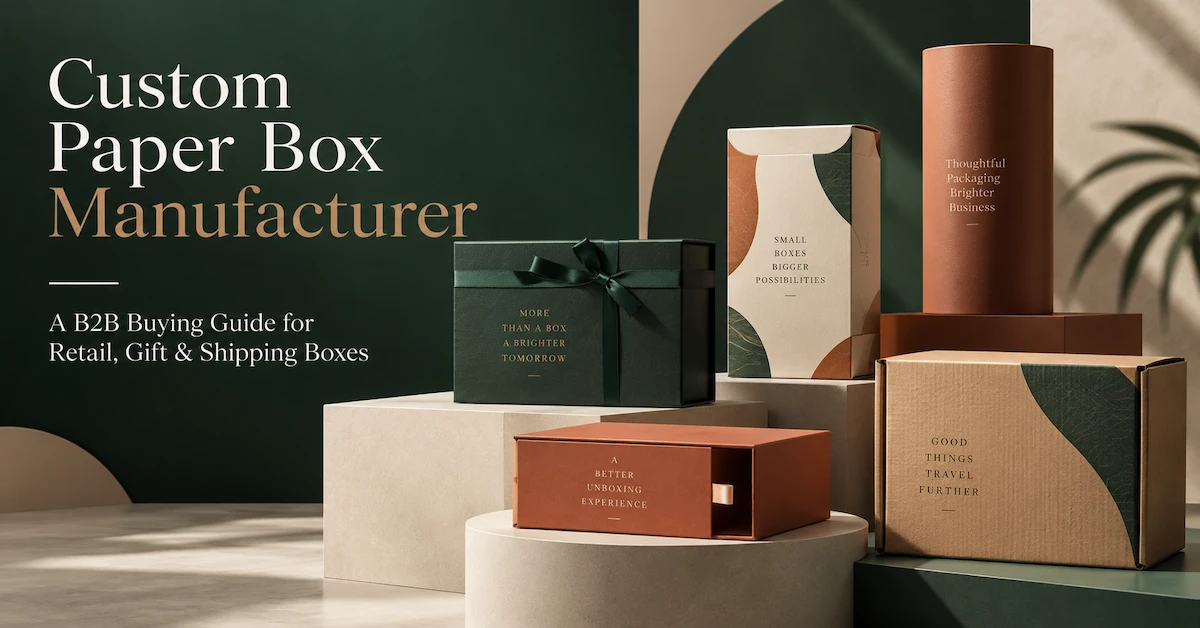
Thinkpacking’s custom paper box collection includes folding formats, drawer gift boxes, corrugated mailers, and paper cylinders. These provide starting points for a packaging brief, not a universal specification suitable for every product. thinkerpack.com
Start With the Product, Sales Channel, and Packing Operation
For a beauty brand selling individual products through stores, consider shelf dimensions, readable artwork, bottle identification, and how quickly the carton can be filled. For a gift collection, consider the arrangement of several products, the opening sequence, and how the customer removes each item.
For direct-to-consumer orders, map the complete pack: the product, its retail box, any cushioning or dividers, and the shipping container. Decide whether the branded box is only the presentation layer or is also intended to serve as the shipping container. That decision needs validation with the actual packed product.
A wholesale importer has another concern: consistency across designs and reorders. Give each packaging variation its own item code, artwork version, and quantity. A design agency may instead need a manufacturing partner to turn a visual concept into a workable structure. These buyers should not receive the same proposal simply because both requested “custom paper boxes.”
A Practical Example: One Serum, Three Packaging Jobs
Consider an illustrative brand selling the same serum individually, in a three-product gift set, and through its online store. The individual product could begin with a folding-carton proposal. The gift set could begin with a drawer or rigid-box proposal and separate product positions. The online shipment still needs a distribution-pack review.
This is a planning example, not a claimed customer case study. Its lesson is simple: one product can require several packaging functions, even when the brand identity stays the same.
Fully customized production may be unnecessary for a very small, one-off promotion when a suitable stock box already exists. Likewise, products requiring liquid containment, sterile barriers, or other specialized functions need dedicated specifications; a decorative paper box is not evidence of those capabilities.
Compare Folding Cartons, Rigid Boxes, Mailers, and Paper Tubes
Ask a custom paper box manufacturer to compare structures before discussing decorative upgrades. The comparison should identify the intended function, packing method, and limitations—not just the visual difference.
| Box structure | Best starting application | Main selection value | Trade-off to review |
|---|---|---|---|
| Folding carton | Individual cosmetics, small bottles, compact retail products | Printed presentation with a foldable format | Assembly, closure, and internal product restraint |
| Rigid presentation box | Premium sets, jewelry, fragrance gifts | Defined shape and an organized presentation | Empty-box volume, component count, and assembly |
| Drawer box | Discovery sets, boutique products, gift collections | Sleeve-and-tray opening with a staged reveal | Sliding fit, tray retention, and insert movement |
| Corrugated mailer | Online orders, subscription kits, bundled products | A shipping-oriented structure that can also carry branding | Product protection, sealing, and complete-pack testing |
| Paper tube | Bottle-shaped products, candles, selected gift items | Distinctive cylindrical presentation | Usable diameter, lid fit, product removal, and carton layout |
These are selection directions, not performance ratings or a fixed price ranking. Actual results depend on dimensions, materials, interior support, and manufacturing details.
Folding Cartons for Compact Retail Products
A folding carton is worth evaluating when the product needs a compact branded exterior and the packing team can assemble the approved format. Thinkpacking’s slim folding paper box for compact products is listed as a tuck-end design for items such as perfume atomizers, cosmetic tubes, and samples, with flat shipment and optional internal supports. 杭州欣派包装制品
During sample review, check the filled carton rather than only the empty shell. Can staff insert the product without catching the closure? Does the product press against the top flap? Is the bottom closure suitable for the filled weight? A slim appearance does not remove the need to evaluate these details.
Rigid and Drawer Boxes for Gift Presentation
A rigid gift box can organize several components and establish a deliberate opening sequence. A drawer construction adds an outer sleeve and an inner tray, making the sliding fit part of the customer’s experience.
Thinkpacking’s slide-out drawer paper gift box illustrates this sleeve-and-tray approach for cosmetics and small fragrance products. Its listed insert directions include paperboard trays, dividers, and selected foam-based options. 杭州欣派包装制品
Test whether the tray opens comfortably with the products loaded. Check where the customer grips it, whether the sleeve stays aligned, and whether the insert moves independently of the tray. Also confirm whether the proposed construction ships assembled or has a specifically developed collapsible format. Do not assume that every paper box ships flat.
Corrugated Mailers for E-Commerce Orders
For an online order, discuss a mailer alongside the complete product arrangement. Thinkpacking’s custom corrugated mailer box is listed as a roll-end tuck-top format using E-flute corrugated material, with options for interior support. 杭州欣派包装制品
Treat that product description as a starting structure, not proof that every product will survive your distribution route. Agree on the filled configuration, closing method, any additional sealing, and the required evaluation. A self-locking flap is not automatically a tamper-evident feature.
Paper Tubes for Cylindrical Products
Thinkpacking’s round paperboard tube packaging offers a telescopic cylinder direction for bottle-shaped products and selected gifts. 杭州欣派包装制品
Specify usable internal diameter and height, not just exterior measurements. Check how the customer removes a short or tightly fitted bottle. For a tall cap or pump, verify clearance when the tube is closed. End-cap materials and internal supports should be identified separately because “paper tube” does not describe every component in the finished package.
Create a Production Specification, Not Just a Reference Image
A reference photograph communicates appearance. It does not define the product’s weight, usable cavity, board grade, closing method, or acceptance criteria. To obtain comparable quotations, send the same written brief to each custom paper box manufacturer under consideration.
Measure the complete product, including caps, pumps, protrusions, labels, and any protective sleeve used during packing. Where product dimensions vary, supply the realistic range or representative samples. Record whether measurements refer to the product, usable box interior, or finished exterior.
| Specification field | What the buyer should provide or approve | Why it belongs in the brief |
|---|---|---|
| Product and application | Product type, filled weight, sales channel, and handling conditions | Defines what the packaging must accomplish |
| Product dimensions | Maximum dimensions and relevant variation | Establishes fit and closure clearance |
| Box construction | Folding, rigid, drawer, mailer, or tube; opening direction | Prevents quotations for different structures |
| Interior arrangement | Product orientation, insert, dividers, and accessories | Controls presentation and positioning |
| Material definition | Structural board, outer paper, lining, and added components | Makes material substitutions visible |
| Artwork and finish | Current files, colors, logo placement, and decorative processes | Defines the appearance being quoted |
| Order configuration | Quantity per size, artwork, and color | Clarifies setup and MOQ assumptions |
| Delivery configuration | Flat or assembled, carton arrangement, destination, and responsibilities | Supports receiving and logistics planning |
| Acceptance reference | Approved sample, drawing revision, and agreed checks | Establishes the basis for production review |
There is no universal clearance or board specification that this table can supply. Those details must be established for the actual product. For automated packing, involve the filling or packing equipment team before approving a carton intended for that line.
Choose Board, Surface Paper, and Inserts as One System
The outer appearance is only one layer of a paper box. Ask your custom paper box manufacturer to separate the structural material, printed or wrapped surface, and interior support in the specification. Otherwise, two suppliers may quote visually similar boxes built from different combinations.
Do Not Treat Paper Weight as a Complete Strength Specification
Grammage, commonly expressed in grams per square meter, describes mass per unit area. Caliper describes thickness. Neither number alone defines how a finished box will perform.
For a folding carton, ask the manufacturer to propose a grade and construction suitable for the product, folds, and packing method. For a rigid box, identify the structural board separately from the decorative wrap. For corrugated packaging, record the proposed board construction rather than describing it only as “thick cardboard.”
The useful question is: “Can this complete structure meet the agreed requirements?” Buying more material without addressing the box geometry or insert may not solve the actual problem.
Choose the Surface for the Brand and the Approved Finish
White, colored, textured, and kraft surfaces provide different visual starting points. Thinkpacking’s natural kraft paper gift box is one example of a folding format for small bottles. 杭州欣派包装制品
Request the intended artwork on the selected surface before final approval. A design developed for a white background should not be assumed to look identical on brown or deeply colored paper. Also inspect visible corners, folds, edges, and seams; these are part of the finished appearance.
Design the Insert Around Product Contact Points
For bottles, review support at the base and body, clearance around the cap, and access for removal. For a gift set, check the spacing between products and whether a heavier item can move toward a lighter one.
Ask for the complete insert specification, including its material, shape, covering where applicable, and attachment method. A paper insert may support a material-reduction objective, but it still needs to fit the product and intended handling. A foam insert may provide a useful shaped cavity, but its presence alone is not a verified cushioning result.
Printing and Finishing: What Must Be Approved?
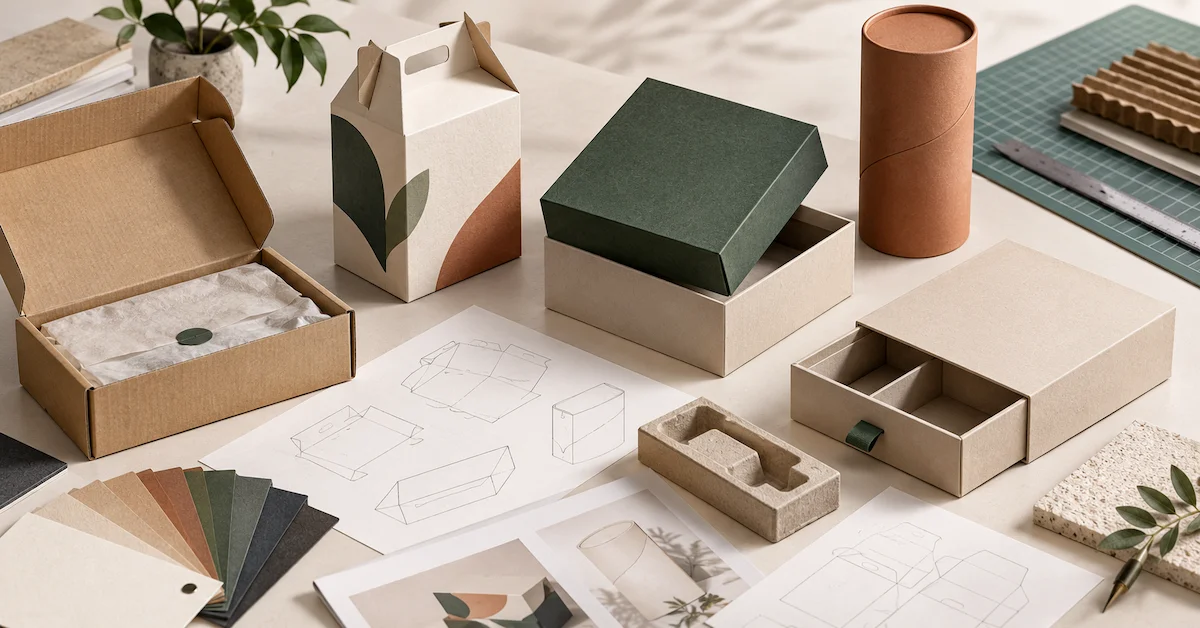
An attractive digital layout does not settle every printing decision. A custom paper box manufacturer needs production artwork positioned on the approved structural drawing, with the intended surfaces and decorative areas clearly identified.
A dieline is the layout used to communicate the box’s cutting, folding, and assembly geometry. Before artwork approval, confirm the correct version, panel orientation, glue areas, and the required allowances around cuts and folds. Do not send a logo file and assume the supplier knows the intended size or placement.
Thinkpacking’s materials and finishing options include lamination, foil stamping, UV effects, embossing, and debossing. Choose these selectively: foil can emphasize a logo, embossing creates a raised detail, and debossing creates a recessed impression. 杭州欣派包装制品
Review the actual combination rather than approving each element in isolation. A fine logo, textured surface, and chosen foil need to work together. For a dark printed box, inspect fold lines and handling marks. For a drawer box, check whether the decorated sleeve still slides as intended.
Color approval should refer to an agreed physical reference and viewing method, not a phone photograph alone. Where numerical color tolerances are important, agree on the measurement method and limits for that project rather than importing an arbitrary standard into every order.
Also ask what the sample demonstrates. A digitally printed development sample may establish layout without fully representing the appearance of a different bulk-production printing process.
OEM or ODM: Turn the Brief Into an Approved Sample
Use OEM support when you already have an established structure, artwork, and production specification. Use ODM support when you have a product and brand direction but need to develop the packaging configuration. Thinkpacking distinguishes these two routes in its OEM and ODM packaging service. 杭州欣派包装制品
For an OEM project, identify what must remain unchanged and where alternatives are permitted. For an ODM project, agree on the development scope, sample charges, revision process, and ownership or permitted use of custom files and tooling.
A useful sampling plan separates three questions.
Does the structure work? Review fit, loading, opening, removal, and closure with the actual product. An unprinted structural sample can help resolve geometry before expensive decoration is finalized.
Does the finished appearance work? Review the selected paper, printing, surface treatment, logo, and visible assembly. Record any sample components that differ from intended production materials.
Can the approved result be repeated? Identify the signed reference sample, drawing revision, material list, artwork files, and written approval. A photograph is helpful documentation, but it does not replace the physical reference for texture or fit.
Thinkpacking’s six-stage packaging development workflow connects the brief, design, sampling, material confirmation, production and QC, and delivery. For your project, ask what information must be approved before each stage can proceed. 杭州欣派包装制品
If an essential dimension, material, or finish changes after approval, review the affected sample details again. The aim is not to create paperwork for its own sake; it is to prevent two teams from working from different versions of the same box.
Quality Control for Custom Paper Boxes
A custom paper box manufacturer should connect the buyer’s specification with observable quality-control checks. “Premium quality” does not explain whether a loose tray, an off-center logo, or a visible glue mark is acceptable.
Thinkpacking’s packaging quality control process identifies incoming materials, sample approval, print and surface work, structure and assembly, and pre-shipment review as checkpoints. Ask how the relevant checks will be recorded for your order. 杭州欣派包装制品
| Checkpoint | What to inspect | Why the result matters |
|---|---|---|
| Materials | Approved grade or component, surface appearance, visible condition | Detects differences before conversion or assembly |
| Print and finish | Artwork version, placement, coverage, and agreed visual reference | Controls brand presentation |
| Folding and structure | Crease condition, closure fit, lid or drawer alignment | Checks whether the box functions as intended |
| Interior support | Correct cavities, dividers, orientation, and attachment | Confirms the approved product arrangement |
| Finished packing | Quantity, SKU identification, surface protection, and cartons | Supports correct shipment and receiving |
Separate functional failures from cosmetic differences. A bottom closure that opens under the intended load requires different treatment from a small mark outside the main presentation area. Define defect categories and inspection arrangements with the supplier; do not assume one sampling level applies to every design.
Validate the Product and Shipping Pack Together
An empty-box inspection cannot establish how a filled package performs during distribution. Agree on a test plan that reflects the product, complete packaging configuration, and expected shipping route.
ISTA’s published test framework distinguishes early screening tests from procedures that simulate transport environments. The practical implication for a buyer is to select testing for the intended shipment—not simply request an unspecified “drop test.”
Any performance claim should identify what was tested and under which conditions. This guide does not establish that a particular Thinkpacking design has passed a transport test.
MOQ and Cost: Make Quotations Comparable
The minimum order quantity, or MOQ, needs to be confirmed for the exact design. Ask a custom paper box manufacturer whether it applies per structure, size, artwork, color, or material combination. An order of several thousand boxes spread across many variations is not necessarily equivalent to one production run of identical boxes.
Separate development and setup charges from recurring unit costs. Ask which tooling, print preparation, finishing, inserts, assembly, and export packing are included. For quantity-tier comparisons, keep the specification unchanged.
Thinkpacking’s slim folding-carton listing, for example, publishes a base MOQ of 1,000 units. Treat that as information for that listing, subject to current confirmation—not a guarantee that every custom project has the same minimum. 杭州欣派包装制品
Compare Cost per Usable Package, Not Just Cost per Empty Box
A useful purchasing model includes the box and insert, allocated development costs, inbound transport, packing labor, storage, and any relevant rework. Use your own operating data rather than assuming a universal saving or defect rate.
For a flat-shipped box, include the work required at the packing station. For an assembled rigid box, include the space occupied during shipment and storage. The better choice depends on the complete operation.
Illustrative volume comparison: a rectangular box measuring 20 × 14 × 8 cm occupies 2,240 cm³. A revised box measuring 18 × 12 × 6 cm occupies 1,296 cm³—about 42% less exterior volume.
That is a geometry comparison, not a 42% freight-saving promise. Carton layout, actual weight, carrier charging, protective materials, and safe product clearance still affect the result. Reduce dimensions only after confirming that the revised structure remains suitable.
Before removing an insert or reducing a material specification, ask which requirement the original component satisfied. Cost reduction should eliminate unnecessary complexity, not a necessary function.
Production Capacity, Lead Time, and Delivery Planning
A quoted production duration is useful only when its starting point and exclusions are clear. Ask whether it begins after artwork approval, sample approval, material availability, payment, or another agreed milestone.
Build the schedule backward from the date packaging must arrive at the filling or fulfillment location. Include development, sample transit, revisions, manufacturing, inspection, export preparation, and transportation where applicable.
Discuss capacity at the process and project level. Ask about the proposed production window, relevant process availability, component sourcing, and the effect of multiple SKUs. A large headline capacity figure would not, by itself, confirm that your specific project can be scheduled.
For a repeat order, identify the approved specification version and require review of relevant substitutions. Reordering the “same black box” is less precise than reordering a controlled product code with unchanged materials and artwork.
Confirm How the Boxes Will Arrive
Specify flat or assembled delivery, units per bundle or carton, carton identification, gross weight, and protection for decorated surfaces. For multiple sizes, agree on labels that your receiving team can distinguish quickly.
Discuss expected storage and transport conditions, including any known humidity or temperature exposure. Request a suitable storage and protective-packing recommendation rather than treating a decorative surface layer as an environmental-performance guarantee.
Finally, record the agreed shipping arrangement, named delivery location, and responsibility for documents and freight. Production completion and arrival at your warehouse are different milestones.
Sustainability Claims and Certification Documents
Evaluate environmental claims at the finished-pack level. Ask what the box contains, which components can be separated, what documentation supports the proposed claim, and what guidance applies in the destination market.
“Paper-based,” “recycled content,” “FSC-labeled,” and “recyclable” are not interchangeable purchasing requirements. Brown kraft appearance alone does not establish any of the latter three.
FSC’s chain-of-custody framework concerns the traceability and controlled handling of forest-based materials through the supply chain. When your project requires FSC-labeled packaging, request confirmation of the appropriate certified supply route and documentation before approving the claim or artwork. Do not infer product certification from a general company statement or a photograph of paperboard.
For practical material reduction, compare unnecessary box space, decorative components, and avoidable layers while preserving the required function. A simpler design may be worth testing; it is not automatically the better option if it leads to an unsuitable pack.
Where packaging has direct contact with food or another sensitive product, raise that requirement at the start. A gift-box listing does not establish suitability for every contact application.
How to Evaluate a Custom Paper Box Manufacturer
Shortlist suppliers against your actual structure rather than the size of their catalogue. Ask for a relevant sample and discuss the production steps needed for that design: printing, cutting and creasing, wrapping where applicable, insert preparation, assembly, and inspection.
Clarify which operations are performed directly and which are coordinated with specialist partners. The essential purchasing question is who controls the approved specification and remains accountable for the finished order.
Use three evidence-based approval gates:
Technical approval: the filled sample fits the product, opens correctly, and supports the intended packing process.
Commercial approval: the quotation states the configuration, quantities, development charges, delivery basis, and exclusions.
Production approval: the reference sample, artwork revision, inspection arrangements, schedule, and change-control responsibilities are documented.
A responsive custom paper box manufacturer should explain trade-offs and unresolved requirements. An answer such as “We need to test the insert with your filled bottle” is more useful than an unsupported promise that every box provides maximum protection.
For an initial technical discussion, you can request a paper packaging review with the product dimensions, intended application, and a reference design. Starting with those details makes it easier to identify a suitable route before committing to a finished visual concept.
Prepare an RFQ That Leads to a Useful Quotation
A request for quotation should explain what the buyer needs to approve, not just ask for the lowest price. Keep the brief concise, but include enough information to prevent suppliers from quoting different products.
For a custom paper box manufacturer, the essential inputs are the product and filled weight, maximum dimensions, preferred box structure, internal arrangement, materials, artwork, quantity per variation, destination, and required arrival date. Identify any information that is still undecided and request alternatives for those items.
A fragrance gift-set brief, for example, should state how many bottles it contains, their sizes, the desired opening direction, and whether the set will be shipped directly to consumers. A retail-carton brief should also explain how the product is loaded and closed at the packing station.
Ask for a base quotation and separately priced alternatives where useful. Comparing the same box with two finish options is more informative than comparing two proposals that change the structure, insert, materials, and quantity simultaneously.
Thinkpacking describes its role as connecting development, sampling, production communication, and export delivery for jewelry, beauty, fragrance, and lifestyle brands. Its packaging development capabilities and paper-box collection provide a basis for discussing both existing formats and projects needing OEM/ODM support. 杭州欣派包装制品
Send your brief to request a project-specific packaging quotation, identifying the details already approved and those requiring a recommendation. This gives the discussion a concrete starting point without relying on an unsupported universal price, MOQ, or delivery promise.
Frequently Asked Questions
1. What does a custom paper box manufacturer need to quote accurately?
Provide product dimensions and filled weight, preferred structure, interior support, materials, artwork, quantity per variation, and delivery requirements. Include a reference image or physical product where available. Identify undecided features so the quotation can distinguish a proposed option from an approved specification.
2. What is the difference between a folding carton and a rigid paper box?
A folding carton uses a cut-and-creased structure intended to fold into shape. A conventional rigid presentation box retains its assembled form. The distinction affects packing and delivery arrangements, but the actual construction must be confirmed; specially developed collapsible rigid boxes should not be confused with ordinary folding cartons.
3. Can custom paper boxes protect glass bottles during shipping?
They can form part of a suitable packaging system, but the exterior box alone does not establish protection. Review bottle restraint, clearance, inserts, closures, and the shipping container together. Where transport performance matters, agree on testing of the filled configuration for the intended distribution route.
4. What MOQ should I expect for custom printed paper boxes?
Request the minimum for your exact structure, material, size, and artwork. Clarify whether the quantity applies to each variation or can be combined. A product listing may provide a starting figure, but only the confirmed quotation establishes the purchasing conditions for your order.
5. Can I start without a dieline or finished artwork?
Yes, a project can begin through ODM support using product information, brand references, and commercial requirements. Thinkpacking’s stated process allows this development route. Agree on the design scope and sample process, then approve the resulting structural and artwork files before production. 杭州欣派包装制品
6. Should I choose kraft or white paperboard?
Choose according to the intended appearance, printing result, material requirements, and approved construction. Request samples on the proposed surface rather than judging color from a screen. Neither a brown nor a white appearance, by itself, establishes recycled content, certification, or suitability for a particular product.
7. Can one outer box serve several product sizes?
It may be practical when the products can be supported with suitable inserts or dividers. Evaluate every relevant configuration and check the additional space and component cost. A shared exterior is useful only when it does not compromise product fit, presentation, or packing efficiency.
8. Which branding details should I approve on a physical sample?
Review the chosen material, color reference, logo size and position, print appearance, and decorative finishes. Check the assembled box as well as individual surfaces. Confirm whether the sample uses the intended production process and record any differences that still require approval.
9. How can I reduce custom packaging costs without sacrificing function?
Begin with unnecessary dimensions, decorative complexity, duplicated sizes, and components that do not serve a defined purpose. Compare flat and assembled delivery alongside packing labor and storage. Keep product restraint and required performance intact, and approve a revised sample before adopting material or structural changes.
10. How do I keep repeat orders consistent?
Use controlled product codes, approved physical samples, current artwork, material references, and written inspection requirements. Identify the specification version on each order. Require review of relevant substitutions and record any approved changes so the purchasing, production, and receiving teams refer to the same packaging definition.
Conclusion
The right custom paper box manufacturer helps you choose a structure that fits the product, supports the sales channel, and can be produced consistently. Compare complete specifications, approve the filled sample, and evaluate cost alongside packing and delivery requirements—not appearance alone.
To develop your next retail carton, gift box, mailer, or paper tube, share your packaging brief with Thinkpacking, including product dimensions, reference images, quantity, and destination, for a project-specific quotation.