How to Choose the Right Watch Packaging Supplier
A reliable watch packaging supplier should do more than deliver attractive boxes. For watch brands, retailers, and wholesale buyers, the right supplier must support consistent product presentation, appropriate packaging structures, dependable customization, approved production samples, quality control, and repeat orders.
The most important purchasing decision is not simply which company offers the lowest price. It is whether the supplier can deliver packaging that meets your product requirements and remains consistent as your business grows.
For B2B buyers, evaluating a watch packaging supplier involves six essential questions:
-
Can the supplier provide packaging suitable for your watch collection and sales channels?
-
Can box dimensions, internal supports, materials, colors, and branding be customized?
-
Are the minimum order quantities and pricing structures suitable for your purchasing plan?
-
Can physical samples be approved before bulk production?
-
How does the supplier control quality between different orders?
-
Can the supplier coordinate packaging production and international delivery according to your commercial requirements?
These questions matter because watch packaging serves several purposes simultaneously.
It protects the product during handling and storage, communicates brand positioning, supports retail presentation, and contributes to the customer experience. For online retailers, it may also influence warehouse operations, shipping arrangements, and packaging-related customer complaints.
A supplier that understands these interconnected requirements can help buyers make better decisions about structure, materials, customization, and long-term packaging costs.
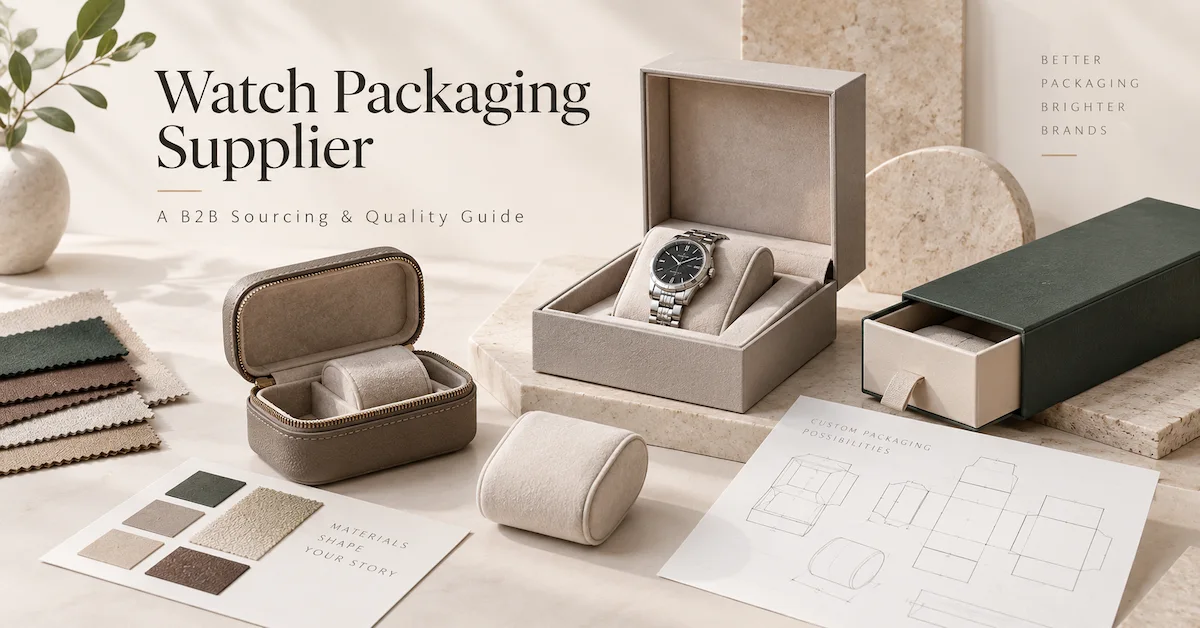
For brands evaluating available options, Thinkpacking's custom watch box collection offers examples of single-watch presentation boxes, PU leather cases, travel pouches, and multi-compartment storage solutions.
The most effective sourcing process begins by defining the packaging application and purchasing requirements before comparing supplier quotations.
What Does a Watch Packaging Supplier Actually Provide?
A watch packaging supplier provides packaging products and related procurement support for businesses selling, distributing, displaying, or storing watches.
Depending on its business model, a supplier may provide ready-made packaging, customized standard designs, or packaging developed around a customer's specifications.
Some suppliers specialize in bulk distribution. Others provide OEM manufacturing support, ODM packaging development, sampling, production coordination, quality inspection, and export services.
These differences influence the supplier's suitability for your project.
Standard and Wholesale Watch Packaging
Standard packaging is generally suitable when buyers need an established design without extensive structural development.
A retailer may require simple single-watch boxes for daily sales. A distributor may need several common packaging styles for different customers. An e-commerce business may want a compact travel case that can be branded without changing the entire structure.
Standard designs can reduce development complexity when the available dimensions, materials, and features already meet the intended use.
However, buyers should confirm whether the item is genuinely available for immediate purchase or still requires production. A product shown in a catalogue is not necessarily stocked.
Customized Watch Packaging
Custom packaging involves modifying the structure, dimensions, materials, insert, color, or branding to suit a particular product or business.
For example, a watch brand introducing a new collection may need a packaging system that accommodates two case sizes while maintaining a consistent external appearance.
Another brand may want a single-watch presentation box with a separate compartment for warranty cards and care instructions.
Custom development allows these requirements to become part of the packaging specification.
OEM and ODM Packaging Services
OEM packaging generally means producing according to an established customer design or approved specification.
ODM support is more appropriate when the buyer has a product and brand direction but requires assistance developing a packaging solution.
For emerging brands, ODM collaboration may reduce the difficulty of moving from a concept to a physical sample. For established brands, OEM-style execution can support repeatability when detailed specifications already exist.
Thinkpacking outlines both approaches through its OEM and ODM packaging services, which connect product requirements, design, sampling, production coordination, and quality review.
The important distinction for procurement teams is the level of development required—not simply the label a supplier uses.
Which Businesses Benefit Most From a Professional Watch Packaging Supplier?
Different buyers have different commercial objectives. A packaging proposal that works for a luxury watch brand may be unsuitable for a wholesale accessories distributor.
Understanding the customer type is essential before selecting a supplier or packaging format.
| Buyer type | Primary purchasing requirements | Packaging priorities |
|---|---|---|
| Luxury watch brands | Premium presentation and consistent brand identity | Rigid boxes, refined finishes, custom inserts |
| Independent watch brands | Development flexibility and manageable purchasing requirements | Customized standard designs, sampling, logo application |
| Watch distributors | Stable supply across multiple product lines | Wholesale pricing, specification consistency, reorder support |
| Retail chains | Consistent store presentation across locations | Standardized designs, reliable availability, controlled quality |
| E-commerce watch brands | Packaging efficiency and shipping suitability | Compact dimensions, appropriate protection, brand presentation |
| Private-label businesses | Branded products and repeatable supply | OEM options, custom colors, logo finishing |
| Corporate gift buyers | Attractive presentation for promotional watches | Gift boxes, personalized branding, project scheduling |
| Watch accessory wholesalers | Products suitable for resale | Multi-slot organizers, travel cases, display boxes |
Luxury and Premium Watch Brands
Premium watch brands usually treat packaging as part of the complete product presentation.
Customers expect the box to match the watch's positioning. The materials, opening experience, interior fit, and branding should feel coherent.
A complex box is not automatically more premium. A carefully proportioned rigid case with a restrained logo and well-designed interior may communicate more value than a heavier package with excessive decoration.
Luxury brands should evaluate material consistency, surface details, and the ability to reproduce an approved design across production batches.
Emerging and Independent Watch Brands
New brands often face a different challenge: they need distinctive packaging but may not have finalized structural drawings or extensive procurement experience.
Their priorities commonly include sample development, understandable customization options, clear pricing, and realistic order quantities.
For these buyers, a supplier that can explain design trade-offs may be more valuable than one offering a large catalogue without development support.
Watch Distributors and Retail Chains
Distributors and retail chains generally place greater emphasis on repeatability and operational efficiency.
They may require several packaging styles for watches at different retail price points.
The purchasing team must manage consistent specifications, packaging inventory, reorder quantities, and coordination across sales locations.
For this type of customer, the ideal watch packaging supplier should understand that availability and consistency are part of product quality.
E-commerce and DTC Watch Brands
Direct-to-consumer brands need packaging that delivers a satisfactory opening experience without creating unnecessary logistics costs.
A large decorative box may appear impressive in photographs but increase storage and shipping volume.
A compact presentation box may be more efficient, provided the watch is properly supported and the complete shipping pack is appropriate for parcel handling.
E-commerce buyers should evaluate retail presentation and distribution packaging as related but separate requirements.
When Custom Packaging Is Not the Best Option
Fully customized packaging is not always commercially justified.
If a business needs only a small number of boxes for a short-term event, an existing design may be more practical.
Likewise, if watch specifications change frequently, expensive dedicated inserts or complicated structures may create unnecessary redevelopment costs.
A knowledgeable supplier should be prepared to recommend a simpler solution when it better supports the buyer's commercial objectives.
Watch Packaging Types: Match the Product to the Sales Channel
Choosing a packaging format begins with understanding how the watch will be sold, presented, transported, and stored.
A single-watch retail gift box and a six-watch travel organizer have different functions. Their construction, internal components, and quality expectations should therefore be evaluated separately.
Single-Watch Presentation Boxes
Single-watch boxes are commonly used for watch retail, branded collections, and gift packaging.
They typically include an outer case and a support that positions the watch for presentation.
Important considerations include watch compatibility, external dimensions, ease of opening, and the relationship between the interior and the brand's visual identity.
Thinkpacking's Premium Sliding Watch Box provides an example of a paperboard-based single-watch presentation design with a sliding drawer and cushioned watch holder.
This type of structure can be relevant for brands seeking a controlled opening experience rather than a conventional hinged case.
PU Leather Watch Boxes
PU leather watch boxes offer a leather-like exterior and can be appropriate for retail presentation, storage, or branded accessories.
The exterior surface may be combined with soft interior fabric, a cushioned insert, and different closure structures.
A supplier should confirm whether the proposed PU material is suitable for the intended handling requirements.
For example, the Black PU Leather Single Watch Box demonstrates a hinged single-watch format with a velvet interior and branding options.
Buyers should assess the physical sample for alignment, exterior texture, lining, and overall presentation rather than assuming all PU materials perform identically.
Watch Gift Boxes With Accessory Compartments
Some watch collections require more than a single display compartment.
Warranty cards, certificates, care instructions, spare straps, and other accessories may need dedicated storage.
A combined presentation and accessory box can organize these components while maintaining a coherent opening experience.
Thinkpacking lists a Luxury Flip-Top Single Watch Box with Drawer, which illustrates a design combining a watch display area with an additional lower drawer.
This format may be suitable for gift collections or watch brands that include supporting documents and accessories.
Multi-Watch Storage and Display Boxes
Multi-compartment boxes are designed to organize several watches.
They may feature individual cushions, dividers, display windows, hinged lids, or multiple layers.
These products serve a different market from disposable retail presentation packaging.
Typical buyers include watch collectors, accessories distributors, specialist retailers, and private-label storage brands.
When sourcing these products, buyers should consider the number of compartments, spacing, watch compatibility, lid clearance, and the durability of frequently used closures.
Travel Watch Cases and Pouches
Travel packaging prioritizes portability, closure security, and product separation.
A watch travel pouch may use a padded soft structure, while a multi-watch travel case may rely on defined compartments and removable supports.
The correct format depends on the watches being carried and expected handling conditions.
Thinkpacking's Premium Velvet Watch Travel Pouch and six-slot leather watch travel case illustrate two different approaches.
Travel suitability and protective performance should always be assessed for the actual product and use conditions.
Watch Packaging Format Comparison
| Packaging format | Main function | Typical customers | Important sourcing considerations |
|---|---|---|---|
| Rigid single-watch box | Retail presentation | Watch brands, retailers | Appearance, insert fit, external size |
| Sliding drawer watch box | Premium opening experience | Boutique brands, gift suppliers | Drawer movement, structure, assembly |
| PU leather watch box | Presentation and storage | Premium brands, private-label buyers | Surface quality, lining, closure |
| Flip-top box with drawer | Watch and accessories packaging | Gift collections, retail brands | Additional compartments, construction |
| Multi-slot display box | Storage and collection display | Retailers, wholesalers | Capacity, dividers, transparent lid |
| Travel watch case | Portable watch storage | E-commerce and accessory brands | Closure, padding, product separation |
| Soft watch pouch | Compact presentation or carrying | DTC brands, promotional buyers | Material quality, fastening, cushioning |
The strongest purchasing decision is usually the format that meets the functional and branding requirements with the least unnecessary complexity.
Build a Packaging System Instead of Buying Unrelated Boxes
For businesses managing several watch collections, packaging should be treated as a coordinated product system.
Without standardization, a company can accumulate multiple box sizes, different black finishes, inconsistent logos, incompatible watch pillows, and separate supplier requirements for products that should appear part of one brand.
This creates additional complexity for procurement, warehousing, merchandising, and reorder management.
Establish Packaging Tiers
One practical approach is to divide packaging into three product tiers.
Essential presentation packaging supports entry-level or everyday collections. The focus is a clean appearance, reliable product fit, and efficient purchasing.
Premium collection packaging may use more distinctive structures, soft-touch surfaces, or selected decorative finishes.
Special-edition packaging can support gift collections, anniversary releases, or products where the opening experience is part of the commercial proposition.
These tiers are a purchasing framework rather than fixed industry categories.
The exact materials and designs should reflect the brand's positioning.
Standardize Shared Components Where Practical
A watch brand may be able to use a common external box across several watch models while changing only the internal support.
Another company may use consistent exterior colors and logo placement across different box sizes.
Shared components can simplify procurement and improve visual consistency, although they must not compromise product fit.
The supplier should identify which components can realistically be standardized and which require separate specifications.
Maintain a Packaging Specification Library
Every approved packaging design should have a controlled specification.
This may include:
-
A unique packaging SKU or item code
-
Approved exterior and interior dimensions
-
Structure and materials
-
Color references
-
Artwork files and logo placement
-
Watch holder or insert specification
-
Approved sample reference
-
Carton configuration
-
Revision history
A documented packaging system makes future orders easier to manage and reduces reliance on informal communication.
Technical Information a Watch Packaging Supplier Needs Before Quoting
One of the most common procurement mistakes is requesting a quotation without defining the product sufficiently.
A supplier cannot compare manufacturing methods, materials, and order quantities accurately if the buyer provides only a reference photograph.
The specification should describe both the watch and the required packaging.
Product Dimensions and Watch Compatibility
Watch packaging dimensions should account for more than the watch case diameter.
The crown, lug-to-lug length, case thickness, bracelet shape, strap stiffness, and clasp can all influence how the watch sits inside its packaging.
For example, a rigid metal bracelet may require a different pillow shape from a flexible leather strap.
If multiple watch models use the same package, each relevant configuration should be checked during sampling.
Packaging Dimensions and Structure
External dimensions affect display space, carton loading, and shipping volume.
Internal dimensions determine how much usable space remains after materials, wrapping, and inserts are installed.
Buyers should therefore distinguish between the two.
A packaging drawing should also show the lid, hinges or closures, drawer arrangement if applicable, and the intended location of accessories.
Material and Branding Specifications
A complete specification should identify the intended exterior material, interior lining, insert material, logo method, and color direction.
When exact materials have not yet been selected, the RFQ should identify the desired appearance and functional requirements so the supplier can propose alternatives.
| Specification | Information to provide | Purchasing significance |
|---|---|---|
| Watch model | Product type and representative sample | Establishes the packaging application |
| Watch dimensions | Maximum physical dimensions, including crown and strap considerations | Supports proper internal fit |
| Packaging structure | Rigid, hinged, drawer, pouch, travel case | Determines construction requirements |
| Outer dimensions | Target length, width, and height | Supports display and logistics planning |
| Interior support | Pillow, insert, divider, or accessory compartment | Controls product positioning |
| Materials | Paperboard, specialty paper, PU, fabric, other options | Affects appearance and construction |
| Branding | Logo file, colors, finishing direction | Supports quotation and sample development |
| Quantity | Initial order and expected reorder plan | Helps establish MOQ and pricing assumptions |
| Destination | Country and required shipping terms | Supports export and freight planning |
| Quality requirements | Approved sample and relevant inspection expectations | Establishes acceptance criteria |
Providing this information early can reduce unnecessary quotation revisions and support more meaningful supplier comparisons.
How to Evaluate a Watch Packaging Supplier's Capabilities
Supplier selection should be based on evidence relevant to the specific project rather than broad marketing claims.
A supplier may advertise hundreds of products, but that does not establish its ability to manage your chosen materials, production requirements, and reorder schedule.
Evaluate Product Category Experience
Ask whether the supplier has handled packaging similar to your intended product.
Experience with single-watch retail presentation boxes is useful, but it does not automatically demonstrate equal expertise in complex travel organizers or powered watch winders.
Request relevant samples, product specifications, and explanations of how the proposed packaging structure is produced.
Powered watch winders should be evaluated separately because they introduce electrical and mechanical components beyond ordinary passive packaging.
Evaluate Customization Capabilities
An appropriate supplier should be able to explain which aspects of an existing design can be modified.
These may include the outer dimensions, internal compartment, materials, color, logo, decorative finish, and accessories.
More importantly, the supplier should explain how a requested modification may affect cost, sampling, or production.
A customized product should be based on a specification that both parties can approve.
Evaluate Technical Communication
Technical communication is an important indicator of project management quality.
When discussing an unusual watch size, a useful supplier response should address the actual fit requirements.
When discussing a complicated finish, it should identify what needs to be confirmed in a physical sample.
Watch for vague answers that offer reassurance without explaining the proposed method.
Evaluate Production Responsibility
Not every packaging supplier operates every manufacturing process directly.
Some businesses coordinate specialist production activities and final assembly through different partners.
The important issue is transparency and accountability.
Buyers should clarify who manages material purchasing, sample approval, production changes, quality inspection, and corrective action.
A supplier should be able to describe its role without requiring the buyer to guess who is responsible for the finished packaging.
Evaluate Repeat-Order Support
For long-term customers, repeatability can be more important than the first-order presentation.
Ask how previously approved specifications are recorded, whether material changes are communicated, and what happens when a previously used component becomes unavailable.
A reliable supply relationship requires controlled information as well as a suitable product.
Materials and Finishes for Commercial Watch Packaging
Materials influence packaging appearance, construction, cost, and everyday handling.
However, buyers should not select materials solely from photographs.
A suitable watch packaging supplier should help connect the material choice with the intended use and approved design.
Rigid Board and Wrapped Paper
Rigid board is commonly used for structured presentation boxes.
It can be combined with printed or textured paper to create different exterior appearances.
The buyer should examine corner wrapping, alignment, adhesive marks, and surface consistency during sample review.
Specialty paper can provide visual texture or color without requiring excessive decorative components.
PU Leather and Fabric-Wrapped Materials
PU leather can be appropriate for cases that are intended to be handled and reused.
The surface texture, color, stitching, seams, and interior lining contribute to the overall impression.
A supplier should confirm the exact material proposed for production.
Buyers should not assume that all PU materials have identical resistance to abrasion, water, or long-term wear.
Interior Fabrics and Watch Supports
Velvet, suede-like materials, and other soft fabrics may be used for interior linings and cushioned watch holders.
The material should be assessed for visible quality, contact with the watch, and compatibility with the insert structure.
For luxury watches, the buyer may need to pay particular attention to the crystal, polished case, bracelet, and clasp.
Decorative Finishing Options
Common branding methods include:
-
Foil stamping for metallic or pigmented decorative accents
-
Embossing for raised artwork
-
Debossing for recessed artwork
-
Printing for logos and graphic details
-
Lamination and selected UV effects where appropriate
Thinkpacking's Materials and Finishes page outlines material families and confirmed decorative processes.
The final selection should be reviewed on the actual material because digital artwork cannot fully represent texture, reflection, or physical finish.
OEM and ODM Watch Packaging: Selecting the Right Cooperation Model
A watch packaging supplier may support different stages of product development.
The most suitable model depends on how much packaging information the buyer already has.
OEM for Established Packaging Designs
OEM-style cooperation is appropriate when the buyer has completed a packaging design or maintains an approved reference specification.
The buyer may provide drawings, artwork, materials, dimensions, and a reference sample.
The supplier's responsibility is to confirm the requirements, develop or approve the production sample as necessary, and coordinate production according to the agreed specification.
This approach is particularly useful for established watch brands with repeat purchasing requirements.
ODM for New Packaging Projects
ODM support can help businesses that have not completed the packaging design.
The buyer may begin with a watch sample, positioning brief, reference images, and target commercial requirements.
The supplier then helps develop a practical packaging direction through structure, materials, visual details, and sampling.
For example, a new watch brand may know that it wants a premium presentation box but remain undecided between a sliding drawer and a hinged design.
An ODM discussion can examine the implications for opening experience, insert design, production, and cost.
Thinkpacking offers OEM/ODM packaging collaboration for both established specifications and projects requiring development support.
For either model, the approved physical sample and documented specification should define the basis for bulk production.
Why Physical Sampling Is Essential Before Bulk Purchasing
A physical sample allows the buyer to review details that cannot be confirmed reliably from digital renderings.
These include the actual opening movement, internal fit, material texture, color, assembly quality, and decorative finish.
Skipping sampling may reduce the apparent development schedule but introduce greater commercial uncertainty.
What Should Be Checked During Sample Approval?
Appearance: Compare the exterior color, materials, logo placement, and surface finish with approved references.
Structure: Check how the box opens, closes, folds, or slides. Identify unusual friction, alignment problems, or loose components.
Watch compatibility: Place the intended watch inside the package and confirm that the support holds it appropriately without excessive pressure or unwanted contact.
Accessories: Check that warranty cards, instructions, spare straps, or other included components fit the intended compartments.
Assembly: Examine visible joints, corners, inserts, fabric wrapping, and closure components.
Packing configuration: Confirm how the finished watch box will be protected and packed for shipment.
Sample Approval Should Be Documented
After approval, both parties should have a clear record of the final configuration.
A useful approval record includes the sample date, drawing version, artwork revision, material references, and any agreed deviations.
If the structure, material, or finish changes after approval, the affected details should be reviewed again.
Thinkpacking describes physical sampling as a key approval point in its packaging development workflow.
For buyers planning repeat orders, an approved reference sample can become a valuable quality management tool.
Watch Packaging Quality Control: Protecting Consistency Across Orders
Quality control should be planned before production rather than treated as a final inspection activity.
The objective is to identify whether materials, appearance, structure, and assembly match the approved requirements.
A practical inspection approach includes several stages.
| QC stage | Key review activities | Potential problems |
|---|---|---|
| Incoming materials | Check approved materials and visible condition | Incorrect materials, color inconsistencies |
| Printing and finishing | Review artwork placement and decorative processes | Misaligned logos, irregular finishes |
| Structural assembly | Check openings, closures, alignment, and construction | Poor drawer movement, loose components |
| Interior inspection | Check watch supports, lining, and compartment fit | Incorrect pillow size, inadequate positioning |
| Finished product inspection | Review overall appearance and function | Visible defects, incorrect configuration |
| Pre-shipment review | Check protective packing, quantities, and shipment preparation | Incorrect SKUs, insufficient carton protection |
Define What Constitutes an Unacceptable Defect
A minor cosmetic variation and a defect that prevents the box from functioning should not be treated identically.
Buyers may classify defects as critical, major, and minor when establishing inspection requirements.
For example, a closure that fails to keep a reusable case shut may require different treatment from a small appearance variation outside the main presentation area.
Acceptance criteria should be agreed for the actual packaging design.
If an inspection sampling method or numerical acceptance limit is required, it should be defined explicitly rather than assumed.
Control Differences Between Samples and Bulk Production
A packaging supplier should understand that the approved sample is a production reference.
However, a single sample does not automatically establish every acceptable tolerance.
For repeat orders, buyers should define what can vary and what must remain controlled.
Important areas include color, dimensions, component selection, logo placement, and visible assembly quality.
Thinkpacking's Quality Control page describes checkpoints covering incoming materials, sample approval, printing and surface work, structure and assembly, and pre-shipment review.
Procurement teams should discuss how those checkpoints apply to their specific watch packaging project.
Watch Packaging MOQ: What Wholesale Buyers Need to Know
Minimum order quantity is often one of the first questions buyers ask.
However, MOQ is not a universal number that applies equally to all packaging structures.
It may depend on materials, customization, printing requirements, the number of color variations, tooling, and production planning.
A straightforward branded version of an existing box can involve different purchasing requirements from a completely new structure.
Why Customization Influences MOQ
Changing only the logo may be simpler than changing the full structure.
A custom insert may require additional development or production preparation.
Special materials or unusual colors may involve sourcing constraints.
Multiple packaging versions can also affect the minimum practical quantity per SKU.
Buyers should request MOQ information for the exact configuration rather than relying on a number shown for a different product.
MOQ Per Design vs MOQ Per Color
This distinction is especially important for wholesale purchasing.
Suppose a business wants 2,000 watch boxes across four exterior colors.
The supplier may calculate MOQ separately for each color rather than allowing the total quantity to be combined automatically.
Similarly, two box structures may require separate production arrangements.
The quotation should specify the basis of MOQ and whether quantities can be combined across particular variants.
Order Quantity and Inventory Risk
A lower unit price at a larger order volume does not automatically create the lowest overall cost.
The buyer must also consider inventory carrying costs, storage space, cash flow, forecast accuracy, and the risk of design changes.
For growing watch brands, an order quantity that matches realistic sales demand may be more commercially sensible than maximizing the initial volume discount.
Thinkpacking reviews customization and quantity requirements according to the submitted project brief. Buyers can request a project-specific watch packaging quotation with their planned quantities and packaging specifications.
How to Compare Watch Packaging Prices and Total Sourcing Costs
Comparing suppliers requires more than placing unit prices side by side.
Two quotations may use similar product descriptions while including different materials, finishes, shipping assumptions, or development services.
A lower quoted unit price may exclude components that another supplier includes.
Main Watch Packaging Cost Factors
The most important cost variables commonly include:
Structure complexity: A simple rigid box generally involves different production requirements from a multi-compartment organizer with several moving components.
Material selection: Exterior coverings, interior fabrics, board structures, and accessories influence material costs.
Branding: Printing, foil stamping, embossing, and other decorative processes can require different preparation and production steps.
Insert design: Custom supports or multiple compartment sizes may increase development and assembly complexity.
Order quantity: Volume can affect material purchasing and allocation of production setup costs.
Packaging for export: Protective cartons, packing configurations, and handling requirements influence the final procurement cost.
Compare Quotations on the Same Specification
A fair comparison requires the same reference design, material requirements, quantity, and delivery assumptions.
For example, a quotation for a paperboard box with a simple printed logo should not be directly compared with one for a PU leather case that includes a more complex interior and decorative hardware.
Ask suppliers to identify what is included and excluded.
Calculate Total Landed Packaging Cost
An illustrative purchasing formula is:
Total landed packaging cost = product cost + allocated development and tooling + freight + applicable duties and taxes + handling + expected packaging-related rework or loss.
The relevant cost components depend on the commercial arrangement.
For brands distributing products internationally, freight efficiency and damaged packaging can influence the economic result.
A slightly more expensive box that packs efficiently and meets the required quality standard may offer better overall purchasing value than a cheaper alternative with recurring problems.
No fixed percentage saving should be assumed without project-specific evidence.
Managing International Shipping and Packaging Delivery
International watch packaging orders require coordination between production completion and the buyer's receiving operation.
Export packing is especially important because watch packaging often contains decorative exterior surfaces that can be damaged before they reach the customer.
Protect Finished Packaging During Transportation
Retail presentation packaging should not be expected to perform every protective function of the shipping system.
The packaging supplier and buyer should agree on how finished boxes will be packed, separated, and secured in outer cartons.
Possible considerations include surface protection, stacking arrangement, carton strength, and the risk of crushing or abrasion during handling.
If the complete pack requires transport-performance testing, the testing method and acceptance conditions should be agreed for the relevant distribution environment.
A claim of protective performance should be supported by the applicable evaluation rather than assumed from the presence of a rigid box.
Confirm Carton Specifications
Before shipment, procurement teams should obtain information such as carton quantity, carton dimensions, gross weight, and packaging SKU identification.
These details support freight planning, inventory receiving, and warehouse allocation.
For buyers handling multiple variants, correct carton identification reduces the risk of mixing designs or colors during distribution.
Clarify Commercial Delivery Terms
Buyers should confirm the applicable Incoterms rule, named location, transportation responsibilities, and required documentation.
This prevents misunderstandings between product pricing and delivered cost.
A quotation stating only “shipping included” may not provide sufficient information for international procurement.
Allow Time for Inspection and Shipping Preparation
A production completion date is not necessarily the same as the final delivery date.
The purchasing schedule should include sample approval, materials preparation, production, inspection, export packing, transportation, and destination handling as applicable.
Thinkpacking's documented workflow includes protective export packing and international delivery coordination.
Sustainability and Material Claims: What Buyers Should Verify
Packaging sustainability can influence purchasing decisions, particularly for brands that publish environmental claims.
However, terms such as “eco-friendly,” “recyclable,” and “sustainable” should not be accepted without examining the actual material composition and intended market.
A paperboard structure may offer a different material profile from a box combining multiple substrates, coatings, magnets, adhesives, or fabric components.
Ease of material separation may also matter.
Ask for Material-Level Information
Buyers should request information on the materials used in the proposed packaging.
If recycled content, responsible sourcing, or specific certifications are required, ask for appropriate documentation covering the relevant material or production scope.
A supplier's general statement about sustainability is not a substitute for substantiation.
Avoid Unverified Certification Claims
Do not assume a packaging product is FSC-certified, recyclable in every destination market, or compliant with a particular environmental requirement solely because it uses paperboard.
Any claim should match the actual product and available evidence.
Consider Functional Material Efficiency
Responsible packaging design also involves avoiding unnecessary material and volume where practical.
Smaller external dimensions, simplified components, or standardized structures may improve material efficiency, provided product fit and protection remain suitable.
The purchasing objective should be a documented balance between product requirements, material choices, logistics, and cost.
Long-Term Supply: How to Maintain Watch Packaging Consistency
For an established watch business, the first order is only the beginning.
A watch packaging supplier may become involved in several product launches, seasonal color changes, restocking cycles, and packaging upgrades.
Without good information management, these changes can create inconsistencies.
Keep Approved Specifications Under Version Control
Every design revision should be identified.
If the logo size changes, record the artwork version. If the interior pillow material changes, identify the new material and approval date.
For future orders, the supplier and buyer should refer to the same controlled specification.
This prevents an outdated drawing or reference photograph from becoming the production instruction.
Create a Reorder Forecast
Buyers can improve procurement planning by sharing reasonable demand forecasts.
A forecast does not need to be a guaranteed purchase commitment unless the parties explicitly agree otherwise.
Its value is helping both sides anticipate material requirements, expected order frequency, and potential production constraints.
Agree on Material Substitution Rules
Materials and components may become unavailable or change over time.
A suitable supplier should clarify when substitutions require buyer approval.
A similar-looking surface may not have the same texture, durability, or compatibility with the approved branding method.
For premium watch brands, an unapproved change can affect the perceived consistency of the collection.
Establish a Clear Problem-Resolution Process
When a defect or specification issue occurs, both parties need an agreed method for reporting and reviewing it.
The buyer should provide the affected SKU, order reference, photographs, quantities, and a description of the problem.
The supplier should identify the relevant specification and discuss corrective action.
A practical issue-resolution process supports longer-term cooperation better than vague promises that defects will never occur.
Common Risks When Selecting a Wholesale Watch Packaging Supplier
Packaging procurement risks often arise from decisions made before the first purchase order.
The following table provides a practical risk-management framework.
| Purchasing risk | Possible business impact | Recommended preventive action |
|---|---|---|
| Selecting only by unit price | Hidden costs or quality trade-offs | Compare complete specifications and total cost |
| Unclear internal dimensions | Poor watch fit | Use physical watches or verified drawings |
| No approved production sample | Appearance or structural differences | Document physical sample approval |
| Unclear MOQ conditions | Incorrect purchasing assumptions | Confirm MOQ by design, color, and SKU |
| Incomplete artwork approval | Incorrect branding | Approve artwork version and physical finish |
| No defined inspection criteria | Disputes over defects | Agree on relevant quality checkpoints |
| Uncontrolled material substitutions | Inconsistent repeat orders | Require review of relevant changes |
| Poor carton planning | Shipping damage or receiving problems | Confirm protective packing and carton details |
| No reorder documentation | Delays and product inconsistencies | Maintain approved specifications and revision records |
These risks do not mean every watch packaging project requires an elaborate quality-management system.
The objective is to apply controls proportionate to the product value, order complexity, purchasing volume, and distribution environment.
A simple single-watch box may require fewer approval steps than a complex multi-compartment case, but both still benefit from clearly recorded requirements.
Three Watch Packaging Sourcing Scenarios
The following examples are illustrative purchasing situations, not claimed Thinkpacking customer case studies.
Scenario 1: An Independent Watch Brand Launching a DTC Collection
A new watch brand plans to sell through its own online store.
The product team has completed the watches but has not finalized the packaging design.
The brand wants a restrained premium appearance while controlling the space required for storage and shipping.
Rather than immediately choosing a complicated luxury box, the team prepares the watch dimensions, target retail positioning, quantity forecast, and preferred unboxing experience.
The supplier compares existing rigid box formats and discusses whether one external design can accommodate multiple watches using suitable internal supports.
Physical sampling confirms the watch fit, exterior appearance, and branding.
The brand also reviews the complete outbound shipping pack rather than assuming the retail box alone will provide adequate transportation protection.
Key lesson: packaging development should connect brand presentation with real fulfillment requirements.
Scenario 2: A Wholesale Distributor Developing Private-Label Watch Accessories
A distributor wants to introduce a range of watch storage products under its own label.
The planned range includes a compact single-watch travel case and a larger multi-watch organizer.
The buyer's primary concerns are resale suitability, material consistency, closure performance, and replenishment.
The sourcing team evaluates the two formats separately because they involve different structures and handling expectations.
For the travel case, it tests closure security, interior contact points, and the fit of representative watches.
For the organizer, it reviews compartment dimensions, dividers, surface quality, and the consistency of the finished assembly.
The distributor requests quotations for each SKU and confirms whether quantities across colors can be combined.
Key lesson: a product intended for resale as an accessory should be evaluated differently from one-time retail presentation packaging.
Scenario 3: A Watch Retail Chain Standardizing Packaging Across Stores
A retail chain currently purchases boxes from several suppliers.
As a result, stores receive products with slightly different colors, logo sizes, and internal arrangements.
The purchasing department decides to standardize the packaging system.
It defines approved external sizes, reference colors, artwork files, interior configurations, and product codes.
The selected supplier prepares physical reference samples and confirms which components can be shared across packaging types.
Future purchase orders use controlled specifications.
The retail chain also defines carton identification and receiving requirements to simplify distribution.
Key lesson: standardization can improve operational consistency when the approved design remains suitable for the actual products.
A Practical Watch Packaging Supplier Evaluation Scorecard
A structured scorecard helps purchasing teams compare suppliers on relevant evidence rather than subjective impressions.
The following weighting is an illustrative procurement tool and can be adjusted to your commercial priorities.
| Evaluation area | Suggested weight | Evidence to review |
|---|---|---|
| Product suitability and packaging options | 20% | Relevant samples, design compatibility |
| Sample quality and technical communication | 20% | Physical sample, technical responses |
| Quality control and specification management | 20% | Inspection checkpoints, approval records |
| Pricing, MOQ, and commercial transparency | 15% | Detailed quotation, clear exclusions |
| Repeat-order and supply coordination | 15% | Revision control, reorder process |
| Export and delivery support | 10% | Carton information, delivery responsibilities |
| Total | 100% | Project-specific supplier evaluation |
A supplier receiving a high score should be supported by evidence in each category.
For example, sample quality can be evaluated using the actual watch and agreed appearance requirements.
Commercial transparency can be evaluated by whether the supplier clearly identifies development fees, MOQ conditions, and shipping assumptions.
This approach creates a more defensible purchasing decision and helps identify unresolved questions before production begins.
How to Prepare an RFQ That Gets a Useful Watch Packaging Quotation
A well-prepared request for quotation helps suppliers understand the project and recommend practical solutions.
It also allows buyers to compare responses more fairly.
Information to Include in Your Inquiry
1. Business and application
Explain whether you are a watch brand, distributor, retailer, or private-label accessory business. State whether the packaging will be used for retail presentation, gifting, storage, or travel.
2. Watch details
Provide watch dimensions, strap or bracelet information, and photographs or physical samples where available.
3. Packaging type
Identify your preferred format, such as a rigid single-watch box, sliding drawer box, PU leather case, multi-watch organizer, or pouch.
4. Customization requirements
Include preferred exterior colors, materials, lining, logo artwork, and surface-finishing direction.
5. Quantities
State the estimated quantity per design and color. If possible, include anticipated reorder requirements.
6. Quality and sampling
Explain whether you need a physical production sample and identify any special inspection or performance requirements.
7. Delivery
Provide the destination, target delivery period, and preferred commercial delivery terms if known.
8. Development status
Clarify whether you already have a complete packaging specification or need help with structure and design.
Sample Watch Packaging RFQ Brief
Project: Custom branded single-watch retail packaging
Buyer type: Independent watch brand
Application: Retail and e-commerce presentation
Preferred structure: Rigid box with a cushioned watch support
Watch information: Dimensions and product photographs to be supplied
Exterior: Dark neutral specialty paper or another suitable premium surface
Interior: Soft fabric-covered support, subject to physical fit testing
Branding: One-color or foil logo, based on material suitability
Order quantity: Initial quantity and forecast to be confirmed
Sampling: Physical sample approval required before bulk production
Delivery: International shipment to the buyer's destination
Additional requirements: Separate quotation for optional finishes and any development charges
This brief provides enough direction to begin a technical and commercial discussion without making unsupported assumptions about the final price or production time.
Buyers can send their requirements through Thinkpacking's Contact Us page for a project-specific review.
Why Consider Thinkpacking for Watch Packaging Supply?
Thinkpacking provides customized packaging solutions for brands, retailers, wholesalers, and businesses that require packaging development and production coordination.
Its watch packaging collection covers several distinct applications, from individual presentation boxes to travel and storage products.
This provides buyers with an opportunity to compare existing product directions before developing a custom specification.
Packaging Options for Different Applications
The custom watch packaging collection includes rigid presentation formats, PU leather cases, travel pouches, and multi-compartment storage products.
Buyers can use these examples to communicate preferred structures, materials, and design directions.
Connected Customization Services
Thinkpacking's documented process includes requirement confirmation, structure and design development, physical sampling, material selection, production coordination, quality review, and international delivery communication.
Rather than assuming a fixed solution will suit every project, the development process begins with the submitted product information and purchasing requirements.
Sample-Based Production References
The company's workflow identifies the approved physical sample and specification as key references for production review.
This approach is relevant to B2B customers seeking consistent packaging appearance, material selection, and assembly across orders.
Project-Specific Quotations
Packaging requirements vary according to box structure, materials, customization, and order quantity.
Thinkpacking invites buyers to submit their specifications for review rather than treating one published product's dimensions, MOQ, or lead time as a universal commitment.
For international buyers, the practical next step is to provide the intended packaging style, watch information, quantity, and branding requirements.
Frequently Asked Questions About Watch Packaging Suppliers
1. What is a watch packaging supplier?
A watch packaging supplier provides boxes, cases, pouches, storage products, or related packaging services for businesses selling or distributing watches. Depending on the supplier, services may include standard wholesale products, customized branding, OEM/ODM development, sampling, production coordination, quality inspection, and export delivery support. Buyers should evaluate the specific services required for their project rather than assuming every supplier offers the same capabilities.
2. How do I choose a reliable watch packaging supplier?
Start by defining your watch models, packaging applications, order quantities, and quality requirements. Compare suppliers based on relevant product experience, sample quality, customization options, documented specifications, commercial transparency, inspection arrangements, and delivery coordination. Request physical samples where necessary and confirm who is responsible for development, manufacturing communication, quality review, and resolving problems.
3. Can I order wholesale watch packaging with my company logo?
Yes. Many watch packaging designs can be customized with brand logos, subject to the material and production method. Printing, foil stamping, embossing, and debossing are possible options for suitable surfaces. The exact result should be reviewed on a physical sample because logo appearance can vary with material texture and finishing technique. Ask whether MOQ applies separately to each logo design or color version.
4. What is the difference between a watch packaging supplier and a custom watch box manufacturer?
A watch packaging supplier focuses on providing packaging products and supporting the purchasing relationship. A custom watch box manufacturer focuses more specifically on producing boxes according to an agreed design or specification. Some companies perform both roles. In practice, buyers should verify who handles design, sampling, production, quality control, and repeat orders rather than relying solely on the business title.
5. What is the usual MOQ for wholesale watch packaging?
MOQ varies by packaging structure, materials, branding, order configuration, and production requirements. A standard design may have different conditions from a fully customized structure. Buyers should request the minimum quantity for their exact specification and clarify whether it applies per box design, color, or SKU. Published product-page quantities should be confirmed through a current quotation before purchasing.
6. Which materials are suitable for luxury watch packaging?
Rigid board with specialty paper, PU leather, fabric-covered structures, and selected wood-based materials are possible options. The best material depends on the desired appearance, product fit, handling requirements, and budget. Premium presentation also depends on workmanship and consistency. Buyers should assess the complete structure and approved sample instead of assuming a particular material always produces a superior result.
7. Can a watch packaging supplier develop packaging without finished drawings?
A supplier offering ODM support may be able to begin with product dimensions, reference photographs, brand positioning, and purchasing requirements. The development process can include structure selection, visual direction, material choices, and sample approval. The final design should still be documented before production. Buyers should also confirm the scope and cost of development services.
8. How can I maintain quality when reordering custom watch boxes?
Maintain approved samples, controlled drawings, material references, artwork versions, and inspection requirements. Identify the specification version on each purchase order and require review of material or structural changes. Confirm carton configurations and product codes for multiple SKUs. A documented reorder process reduces the risk of inconsistencies between production batches.
9. Can watch packaging suppliers support international shipping?
Some suppliers offer export packing preparation and delivery coordination, while others provide packaging on specified domestic or factory terms. Buyers should clarify the applicable Incoterms rule, destination, transportation responsibilities, carton specifications, inspection arrangements, and required shipment documents. International delivery support does not remove the need to confirm logistics responsibilities in writing.
10. What should I send to get an accurate watch packaging quotation?
Provide the packaging application, watch dimensions, preferred structure, materials, branding details, approximate order quantity, number of variants, destination, and required delivery schedule. Include reference images or existing drawings if available. Indicate whether OEM execution or ODM development is needed. You can review Thinkpacking's watch packaging products and submit your requirements through its quotation contact page.
Conclusion
Choosing the right watch packaging supplier requires balancing packaging suitability, brand presentation, customization, purchasing cost, quality consistency, and long-term supply reliability.
For watch brands, wholesalers, and retailers, the strongest sourcing decisions begin with clear specifications, realistic order planning, physical sample approval, and transparent production and delivery responsibilities. A dependable supplier should support your commercial requirements rather than simply offer the lowest initial quotation.
Explore Thinkpacking's custom watch packaging solutions to compare suitable product directions, or contact Thinkpacking for a tailored packaging quotation with your watch dimensions, branding requirements, and estimated order quantity.