When sourcing rigid presentation packaging for precision timepieces and luxury accessories, procurement teams often discover that visual aesthetics tell only half the story. Sourcing managers and brand packaging engineers looking into how to choose watch box architectures must balance immediate unboxing aesthetics against mechanical durability, cushion fit, and transit resilience. A presentation box is not merely a gift container; it is an engineered housing that isolates delicate movements, polished bezels, and supple leather straps from vibration and contact abrasion.
Shell Architecture and Structural Geometry
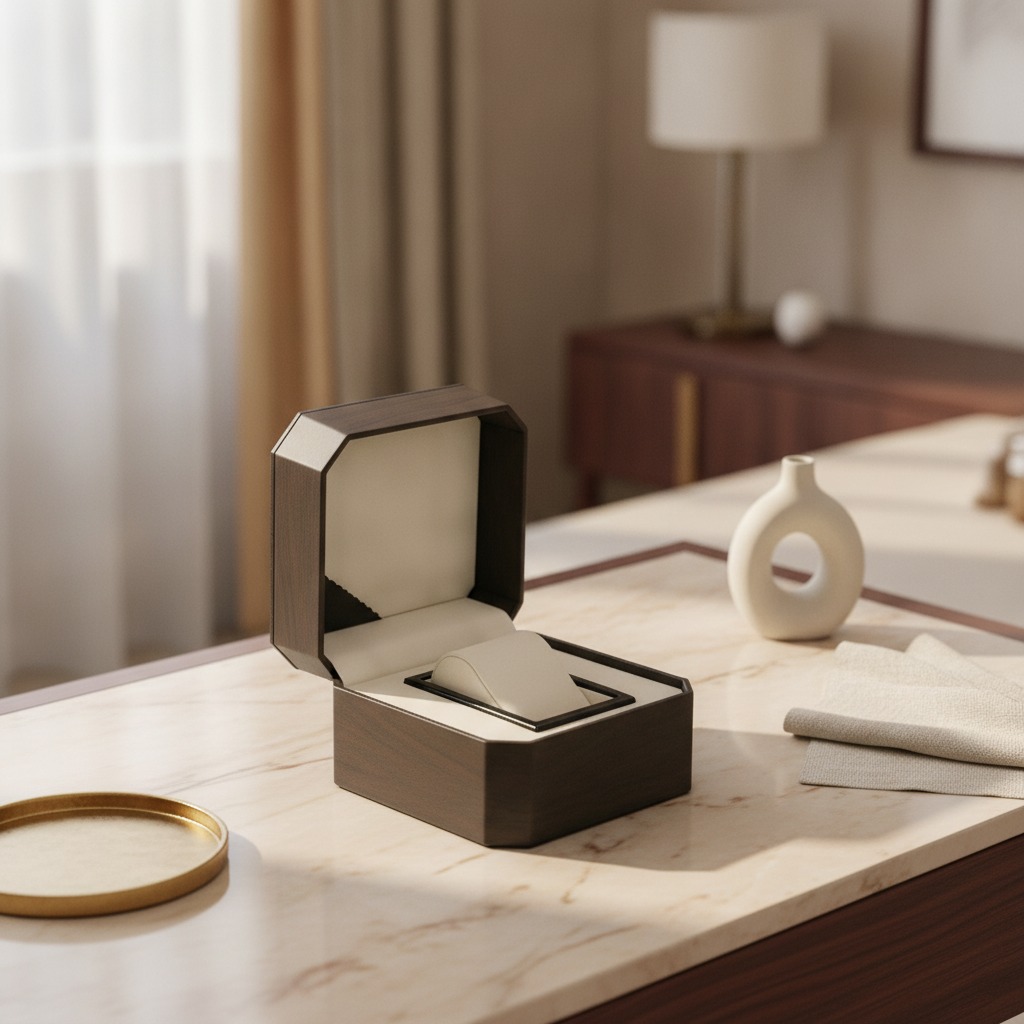
The core geometry of a presentation case dictates both structural integrity and how the piece is perceived on the retail counter. While simple square boxes dominate lower-tier packaging, octagonal or chamfered-corner profiles introduce higher rigidity along the vertical planes while reducing the visual mass of the case.
In high-grade presentation packaging, the lid assembly often incorporates a deep perimeter frame with a recessed interior panel. This multi-tiered profile serves two functions:
- It provides structural stiffness to prevent warping across broad flat surfaces.
- It builds vertical clearance for larger watch crowns and thicker crystals without unnecessarily increasing the overall outer height of the base.
Whether the structural core uses high-density fiberboard, injection-molded polymers, or composite cores, the hinge installation must support consistent resistance. An uncalibrated hinge that falls shut or feels loose instantly undermines the quality perception of the enclosed product.
Evaluating Substrates: Solid Timber vs. Engineered Wraps
A frequent decision point in watch packaging procurement is whether to specify solid hardwoods or rigid wrapped cores featuring wood-grain laminates, printed papers, or specialty films. A rich, dark wood-grain finish provides a classic backdrop for polished metals, but buyers should specify their material requirements with precision.
Genuine milled timber offers mass and authentic tactile warmth, but it introduces moisture-absorption risks, natural grain variance, and higher unit costs. Conversely, a precision-wrapped rigid shell provides tighter dimensional tolerances across long production runs. When evaluating prototypes with simulated wood finishes, check the corner wraps and chamfered edges carefully. Poorly controlled lamination lines along faceted corners will lift or split over time, especially when exposed to humidity shifts during ocean freight.
Interior Fitments and Movement Protection
The interior architecture centers on the collar or cushion. A single-item display layout usually employs a raised central cushion resting within a recessed collar or bezel. When auditing internal engineering, focus closely on fitment clearances:
Cushion Elasticity and Circumference: Watch straps and bracelets are sized across a broad spectrum of wrist dimensions. If an interior cushion is manufactured from rigid, dense foam, small-diameter metal bracelets will not close around it without placing structural stress on the clasp. Conversely, ultra-soft open-cell foam may collapse under the deadweight of a heavy diver's watch, allowing the caseback to rattle against the mounting recess during transit.
Lining Material Selection: The interior contrast—such as pairing a dark exterior with an ivory or cream-colored lining—drives visual focus straight to the dial. Common lining materials include microfibers, synthetic leathers, and wrapped velvet textiles. Sourcing teams must ensure that lining adhesives are completely cured and chemically inert. Volatile organic compound (VOC) outgassing from cheap bonding glues can haze anti-reflective watch crystals or tarnish polished silver and bronze components during storage in warehouse inventories.
Common Specification Oversights
Several failure modes occur when packaging specs are drawn strictly from two-dimensional graphic renderings:
- Neglecting Dial Clearance: Designing internal clearance based on the watch case diameter while forgetting vertical height. Domed sapphire crystals and thick automatic rotors require at least 5 to 8 mm of buffer between the crystal apex and the recessed lid ceiling.
- Vague Hardware Requirements: Specifying "metal hinges" without clarifying whether spring-loaded, quadrant, or stop-hinges are required. Quadrant hinges that hold the lid at an angle between 90 and 105 degrees are preferable for showroom presentation.
- Overlooking Secondary Outer Packaging: A high-gloss or laminated rigid box will scuff if packed directly into master cartons. Ensure the bill of materials includes an outer sleeve or two-piece packer box lined with tissue to protect the primary packaging finish during distribution.
Procurement Checklist for RFQ Stages
Before releasing a packaging tender to manufacturers, verify the following details within your engineering drawings:
- Exact inner dimensions (L x W x H) accounting for cushion travel and lid recess depth.
- Specified core material (MDF density, plastic polymer grade, or timber species).
- Wrapping substrate specifications (paper grammage, PU leather thickness, or UV coating specs).
- Lining backing foam density (specifying firm EVA base layers versus plush PU wrapping).
- Target hinge cycle life and closure mechanism (friction fit, magnetic catch, or mechanical push-button).
Frequently Asked Questions
What is the benefit of chamfered corners over standard 90-degree corners?
Chamfered corners mitigate transit damage caused by edge impacts, which commonly crush sharp 90-degree corners on paper-wrapped or timber boxes. They also add an architectural, faceted appearance that elevates shelf appeal.
Can one watch box design accommodate multiple case sizes?
Yes, provided the central cushion utilizes a dual-density core—a firm core to anchor the watch within the base bezel, surrounded by an adaptable, compressible outer layer that accommodates wrist bands from 15 cm up to 21 cm without forcing the clasp.
Next Steps for Brand Packaging Teams
If you are finalizing packaging specifications for an upcoming accessory release, do not commit to full-run tooling based purely on digital renders. Commission white-body or unlined mockups first to verify hinge friction, lid-to-base alignment, and cushion fit with physical production samples of your product before locking in surface finishes and bulk volumes.