Why Your Premium Jewelry Deserves Real Timber and Natural Textile
Jewelry brands routinely invest months into refining metal alloys, stone settings, and brand narratives, only to place the final product into a generic, synthetic-velvet plastic clam. If your collection targets an audience that values authenticity, craftsmanship, or organic design, that unboxing mismatch costs you perceived value. Specifying a Custom Wooden Ring Box With Natural Burlap Cushion bridges this gap, establishing a tactile, heirloom-grade impression before the ring or timepiece is even touched.
Packaging in the luxury and artisan sectors serves a singular commercial role: it validates the purchase decision. A dark-stained wooden box with a textured textile insert transforms an ephemeral retail container into a keepsake. For sourcing managers and product directors, however, switching from conventional injection-molded cases to customized wood-and-fabric packaging requires balancing aesthetic warmth with manufacturing reality.
The Visual Tension: Dark Timber Meets Raw Textile
Most mass-market ring boxes rely on uniform, high-gloss lacquer and flocked foam. While acceptable for commodity retail, this sterile presentation often feels cold.
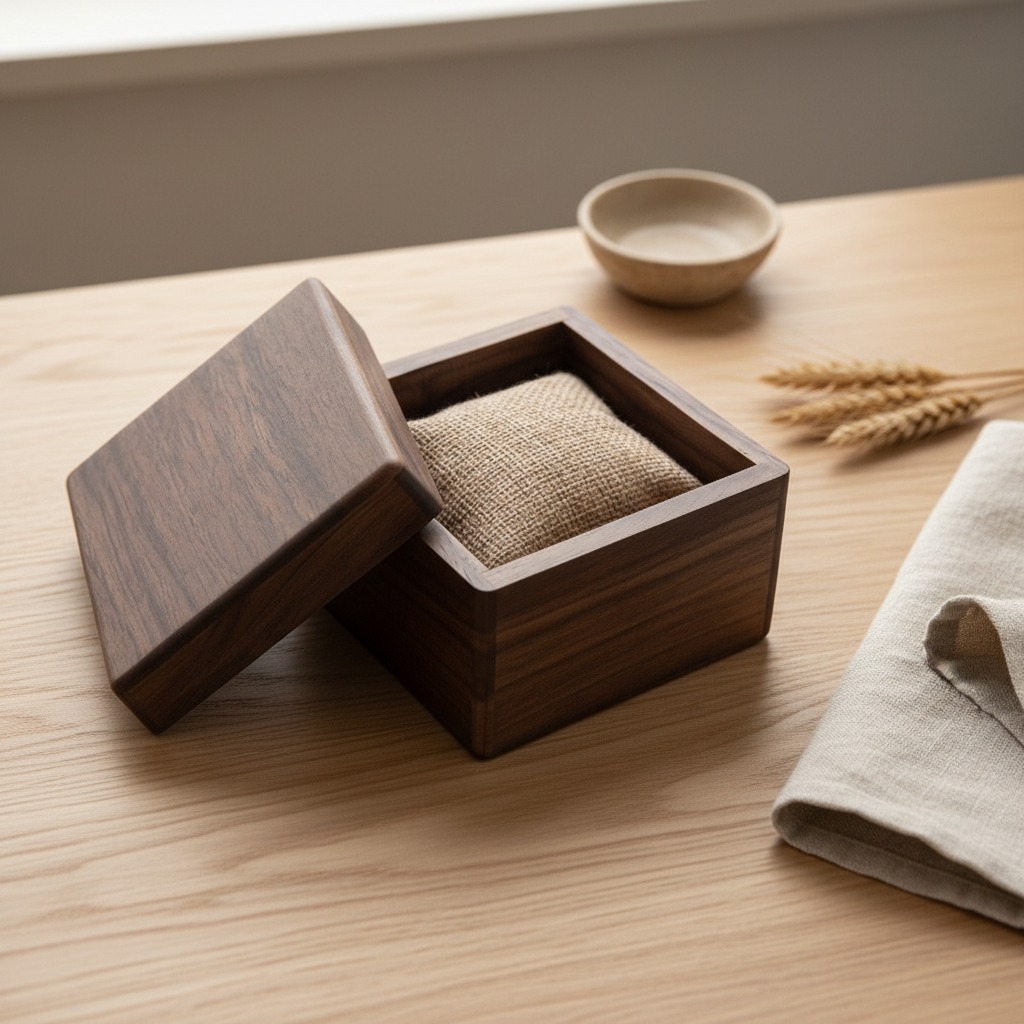
A wooden presentation case built with prominent linear grain and softened, rounded edges communicates craft immediately upon handling. When paired with a woven, beige textile cushion—reminiscent of natural burlap or raw linen—you create visual and tactile contrast:
- Warmth and Texture: The matte or satin finish on the wood exterior invites physical contact, while the porous, organic weave of the burlap cushion breaks the monotony of smooth surfaces.
- Versatile Display: A two-piece box with a separate, lift-off lid allows retail staff or gift recipients to remove the top entirely. The base functions as an open display plinth on a boutique counter or bedside nightstand, keeping the merchandise visible and elevated.
- Gender-Neutral Appeal: Unlike glossy pastels or high-pile velvet, natural wood paired with neutral burlap comfortably suits men's signet rings, textured wedding bands, bespoke watches, and fine jewelry alike.
Sourcing Decisions: What to Specify Before Ordering
When developing a custom wooden ring box with natural burlap cushion with an OEM or packaging partner, visual samples are only half the battle. Wood behaves differently from plastic, and procurement teams need to establish clear specifications early.
1. Substrate and Construction: Solid vs. Veneer
Factory quotes vary wildly based on core construction. Solid hardwoods offer unmatched heft and natural edge grain, but they are more susceptible to regional humidity swings and cross-grain movement. Engineered wood cores (such as MDF) wrapped in real-wood veneers offer tighter dimensional stability and lower unit costs for high-volume rollouts, though edges must be carefully detailed to avoid revealing the substrate.
2. The Lid Interface
In a lift-off design where the lid is fully separate from the base, tolerances determine user perception. If the clearance is too tight, the customer wrestles to open it; if it is too loose, the lid rattles during transit. Clarify whether your design relies on a stepped friction rim, an inner wooden collar, or hidden neodymium magnets set flush into the rim.
3. Cushion Density and Ring Retention
A common mistake with woven textile inserts is assuming the cushion can simply rest loosely in the cavity. A loosely filled burlap pad might look picturesque on a flat photograph, but during shipping, a heavy tungsten band or high-set diamond ring can shift, sink, or abrade against the underside of the lid. Ensure your packaging partner defines the interior support: is the burlap wrapped around a high-density EVA core with a pre-cut retention slit, or is it a soft-fill pillow intended primarily for display?
Common Manufacturing Pitfalls to Avoid
Moving to wood-and-textile packaging presents distinct quality-control challenges that do not exist with mass plastic:
- Coarse Fiber Snagging: Rough-woven textiles look beautiful, but loose fibers can catch on micro-prongs or delicate pavé settings. Ensure the textile has been stabilized or singed so fibers do not shed onto fine metal surfaces.
- Adhesive Fumes and Metal Tarnishing: Solvents used in interior box glues can off-gas inside a sealed box, accelerating tarnish on sterling silver and low-karat gold. Always specify solvent-free, water-based, or non-reactive adhesives for interior lining.
- Grain Misalignment: On two-piece boxes where the lid and base share the same exterior footprint, misaligned wood grain between the top and bottom looks careless. While an exact grain match across different pieces of wood is difficult, the finish tone and grain direction should remain aligned.
Frequently Asked Questions
Can burlap cushions accommodate different ring shank sizes?
Yes, provided the interior core beneath the burlap is engineered correctly. A dense foam core with a reinforced vertical slit allows both delicate 1.5 mm bands and wide 8 mm men's bands to sit securely without permanently deforming the insert.
Is this packaging suitable for e-commerce shipping?
On its own, a loose-lid wooden box is not protective freight packaging. If your brand ships directly to consumers, you must pair the custom wooden ring box with a fitted rigid paperboard outer sleeve or matching cardboard shipper to keep the lid immobilized during courier transit.
How should we evaluate sample boxes from a new supplier?
Inspect the corners for smooth transitions, test the lid closure multiple times in different ambient temperatures, and press firmly into the textile cushion to verify that it springs back without separating from the interior walls.
Moving Forward with Your Packaging Program
Packaging is the only marketing collateral your customer keeps in their drawer for years. Transitioning your presentation to a custom wooden ring box with natural burlap cushion signals confidence, sustainability, and tangible craftsmanship. To begin development, request physical material swatches of both the wood finish and the inner textile, run a drop test with your heaviest product sample, and ensure your supplier guarantees dimensional consistency across your entire production run.