For any watch brand, boutique retailer, or lifestyle distributor, selecting the right display accessories is just as critical as curating the timepieces themselves. When a customer steps away from their mechanical watch for several days, an Automatic Single Watch Winder bridges the gap between passive storage and active preservation. Yet in the contract manufacturing landscape, small desktop winders are frequently treated as commodity novelty items rather than mechanical instruments. Sourcing teams that cut corners on drum geometry, motor isolation, or lining materials quickly find themselves dealing with warranty returns, noisy motors on bedside tables, and disappointed collectors. To build a reliable accessory line, buyers must approach the single-slot winder with an eye for both aesthetic presentation and mechanical dependability.
The Strategic Advantage of Single-Slot Architecture
While multi-rotor cabinets command high retail price points, single-unit winders consistently drive volume across retail gifting, corporate promotions, and collector starter kits. A multi-bay unit requires dedicated floor or shelf space, but a single-unit footprint fits naturally on a desk, an executive credenza, or a nightstand. More importantly, it serves an immediate practical need: keeping a secondary daily driver or an intricate perpetual calendar running without subjecting the user to tedious manual crown adjustments every Monday morning.
From a product development standpoint, a standalone desktop unit serves as an accessible entry product. It allows private-label brands to test customer appetite for horological accessories without committing to complex multi-motor internal wiring or heavy freight weights associated with multi-watch safes. However, because these units live out in the open on fine furniture, exterior craftsmanship cannot be an afterthought.
Aesthetic Architecture: Presentation Meets Protection
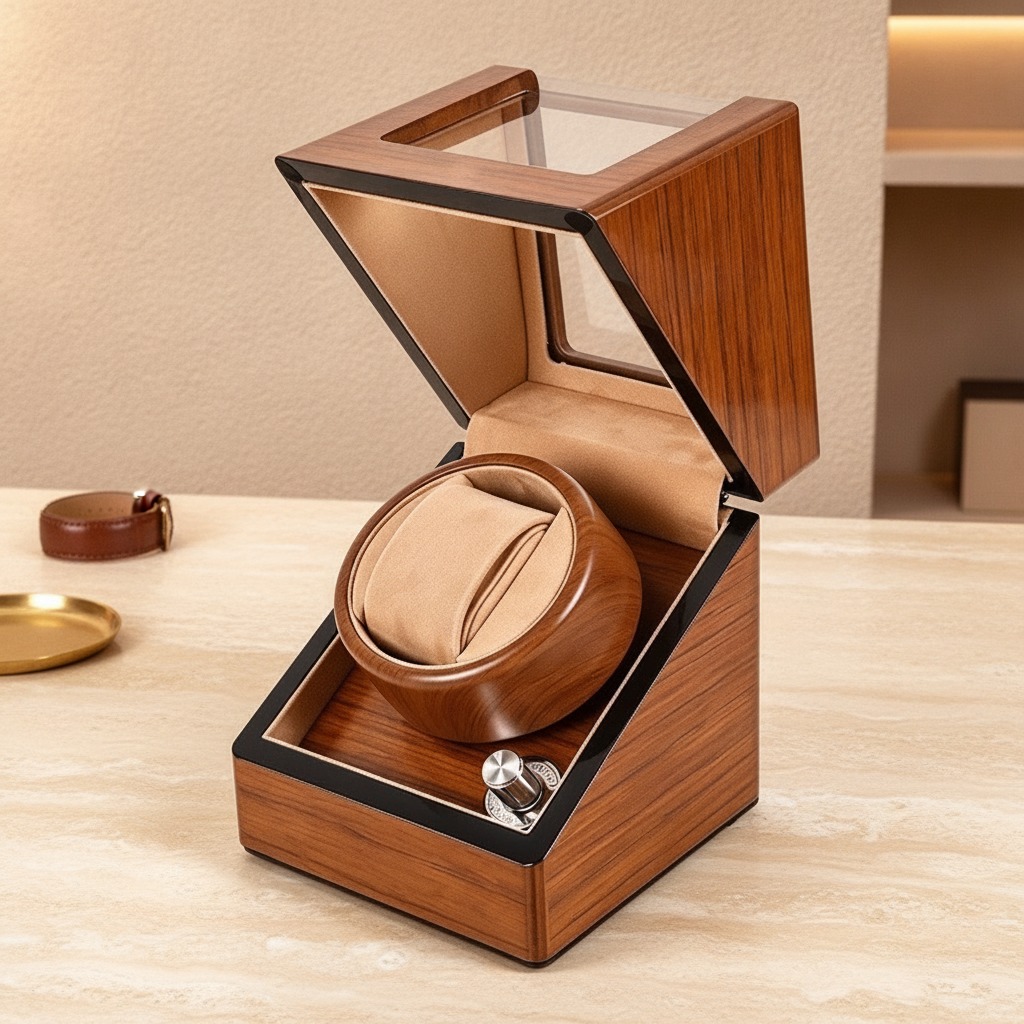
The visual appeal of a display winder hinges on fine cabinetmaking principles. In units featuring a high-gloss, reddish-brown wood-grain exterior—reminiscent of polished rosewood or walnut—the finish communicates prestige before the unit is even powered on. Contrast edging, such as high-gloss black trim bordering the panel seams, provides a framed, architectural look that elevates the piece from a utilitarian tool to a tabletop jewelry box.
When specifying these cases, sourcing managers should pay close attention to three tactile touchpoints:
- Lid Construction and Glazing: A flip-top lid mounted on robust rear hinges provides dust protection while keeping the watch visible. Sourcing teams must clarify whether the transparent viewing panel is acrylic or mineral glass; acrylic lowers shipping weight and resists impact, while glass provides superior scratch resistance over years of cleaning.
- Interior Contact Linings: Every surface within the winder chamber—including the lid underside—must be soft-lined. Microfiber or suede-like fabric over foam padding ensures that deployment clasps, metal bracelets, and polished gold or steel lugs do not make contact with rigid structural walls during insertion or removal.
- Cylindrical Drum Tolerances: The rotating cup should feature a matching perimeter finish and house a compliant, padded cushion. The cushion must compress sufficiently to accept small ladies' watch bracelets without stretching the links, yet maintain adequate tension to prevent a heavy 44mm sport diver from sagging and striking the viewing window during rotation.
What to Validate with Manufacturing Partners
Because finished samples often mask interior assembly shortcuts, procurement teams evaluating an Automatic Single Watch Winder prototype need to dig beneath the lacquered shell. A winder is an electromechanical product, and long-term customer satisfaction relies on variables that cannot be confirmed from an exterior photograph alone.
1. Drive Assembly and Motor Selection
The core of any rotating winder is its electric drive. Sourcing briefs should explicitly request details on the internal motor—typically a low-noise geared DC motor—and its mounting architecture. Rigidly mounting a motor directly to an MDF or wooden sub-frame creates an acoustic soundboard, amplifying gear whine across a quiet bedroom. Ensure the factory incorporates rubber vibration dampening around the motor bracket.
2. Control Interface and Programming
A front-mounted rotary dial offers immediate, intuitive tactile feedback compared to hidden toggle switches on the back panel. However, you must determine what that knob actually controls. Does it govern a stepped cycle of turns-per-day (TPD), switch between clockwise, counter-clockwise, and bi-directional winding patterns, or simply toggle basic timed run-and-rest intervals? Clarify these mode settings in your technical spec sheet to match the winding requirements of major Swiss and Japanese calibers.
3. Substrate and Environmental Stability
A deep piano-gloss finish requires a stable core. Most commercial units rely on precision-machined Medium-Density Fiberboard (MDF) overlaid with natural veneer or high-grade decorative wraps. If you are shipping across multiple climate zones, verify the curing standards for the gloss coat to prevent moisture-induced cracking or bubbling around the seams.
Key Questions for Your Sourcing Checklist
Before issuing a formal purchase order for an automatic single watch winder, require your factory partner to answer these operational questions:
- Power Supply Options: Is the unit powered exclusively via a DC barrel jack, a universal USB connection, or does it include a concealed battery compartment for cord-free placement inside a closet or safe?
- Magnetic Shielding: Mechanical balance springs are sensitive to stray magnetic fields. Does the motor housing feature appropriate magnetic shielding to isolate the rotating drum from electromagnetic interference?
- Cushion Sizing: Does the cushion assembly include an outer sleeve or adjustable core to fit wrist circumferences ranging from 15 cm to over 20 cm?
Next Steps for Sourcing Teams
An executive-style winder should complement high-value timepieces, not put them at risk. If you are developing a new retail-ready accessory line or looking to upgrade your brand's promotional packaging, focus your supplier negotiations on motor decoupling, dial program clarity, and lining quality. Request physical golden samples to test cushion retention with real watches before finalizing tooling or production runs.