For boutique creators, packaging engineers, and bespoke makers, flat ink printing often fails to communicate tactile authenticity or luxury craftsmanship. Custom blind embossed stickers and tactile impression seals solve this aesthetic shortfall by relying on shadow, depth, and tangible contours rather than colored pigments. The precision embossing tool shown here serves as a handheld marking die, engineered to press delicate, inkless relief patterns directly into paper label stocks, craft packaging, wet clay, or specialized impressionable mediums. By transforming simple flat surfaces into sculptural brand touchpoints, this tooling style gives artisanal goods a subtle, three-dimensional identity that customers can instantly feel beneath their fingertips.
Product Overview and Physical Geometry
Handheld Architecture and Tool Form
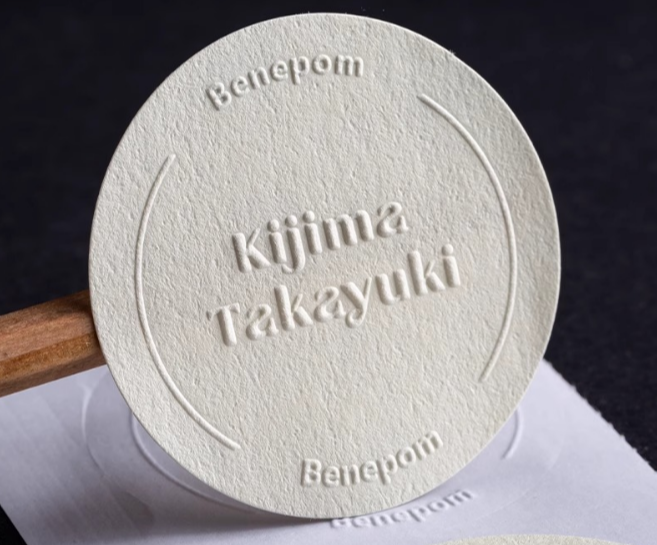
The marking instrument is built around a compact, circular impression face set atop a contoured wooden handle. The perimeter of the disk features a gentle bevel that softens outer contact pressure, preventing harsh edge-bites into sensitive substrates. Extending straight from the rear of the disk, the turned wooden shaft provides a balanced, organic grip designed for direct manual downward compression. With no visible metallic fasteners, brackets, or exposed mechanical adjustments, the unified assembly prioritizes simple ergonomic alignment and unobstructed view of the contact area during pressing.
Face Details and Relief Typography
The marking face presents a chalk-white, dry matte finish with a fine, micro-porous texture visible under raking light. Raised linear elements and custom typography—including Japanese-style Latin lettering and sweeping decorative arc accents—stand proud against the circular base plane. Because the geometry rises cleanly from the background, the die can generate either a sunken deboss or a proud emboss depending on whether it is pressed directly into a soft medium or used in tandem with a counter-die behind adhesive sticker paper.
Material Observations and Structural Attributes
While industrial debossing blocks are frequently milled from solid brass or magnesium, the head on this specialized stamping tool exhibits the distinct visual characteristics of a high-density polymer, cast resin, ceramic, or fine mineral composite. The face shows none of the high-sheen specular reflection common to polished alloys, carrying instead a velvety, non-glare surface that helps prevent tacky materials from sticking to the plate during release.
The handle is turned from natural hardwood, lightly stained or sealed, to highlight organic wood grain while safeguarding the wood against studio moisture and hand oils. Buyers should note that while this composite-and-wood build is exceptionally well-suited for benchtop craft production, exact material specifications, shore hardness, thermal thresholds, and food-contact compliance ratings remain uncertified unless explicitly designated for specific production batches.
Functional Applications and Buyer Scenarios
Bespoke Packaging and Label Creation
When paired with heavy fibrous papers or specialty label stocks, the tool enables the creation of small-run blind embossed stickers for wine bottles, apothecary jars, hand-poured candle vessels, and luxury stationery. Applying pressure across self-adhesive blanks brings forth crisp text silhouettes that interact with ambient light, eliminating the need for metallic foils or industrial printing presses on short-run orders.
Artisanal Studio and Workshop Branding
Beyond paper converting, the relief face is well adapted for soft craft materials. Ceramic artists can depress studio logos into leather-hard clay prior to firing, soapmakers can mark setting cold-process loaves, and confectioners or candle studios can imprint cold waxes and specialty doughs. The hand-driven format grants individual control over impression depth, allowing makers to adapt their strike pressure to the shifting elasticity of each batch.
Customization Guidance and File Preparation
Producing a custom marking die requires clean vector assets with conscious attention to physical tolerances. Because blind embossing relies purely on highlight and shadow, very thin strokes under certain point sizes can lose visual clarity or fail to displace the material adequately.
Buyers designing circular seals should establish at least a two-millimeter perimeter margin to allow the beveled shoulder to clear the design safely. Continuous cursive fonts, geometric crests, and bold typographic marks produce the most striking relief results. When submitting graphics, vector files (such as AI, EPS, or high-resolution DXF) with converted outlines ensure that typography scales precisely without distortion or rasterized edge artifacts.
Buyer Decision Criteria
Selecting the right marking hardware hinges on balancing batch volume with substrate resistance. Handheld stamping tools of this style excel in studio workflows where low unit volumes, deliberate placement, and artisanal variety take precedence over high-speed automated throughput. Prospective buyers should evaluate the target substrate's fiber length, caliper, and compressibility; softer, uncalendered cotton papers and malleable paste mediums yield significantly deeper, more distinct contours than hard, glossy coated boards.
Consult with Our Tooling Specialists
Elevate your product presentation with distinctive three-dimensional branding. Contact our technical team today to review your vector artwork, discuss suitable face materials, and configure a custom marking seal tailored to your specific studio or packaging workflow.