Procuring specialized packaging accents often presents a choice between high-contrast printed graphics and understated physical texture. Sourcing custom blind embossed heart stickers resolves this dilemma for brands seeking tactile, inkless embellishment that elevates secondary packaging without clashing with existing color palettes. By creating a physical relief directly within the substrate fibers, blind embossing introduces shadow, depth, and tangible sophistication to closures, envelopes, and product containers.
Product Overview and Functional Profile
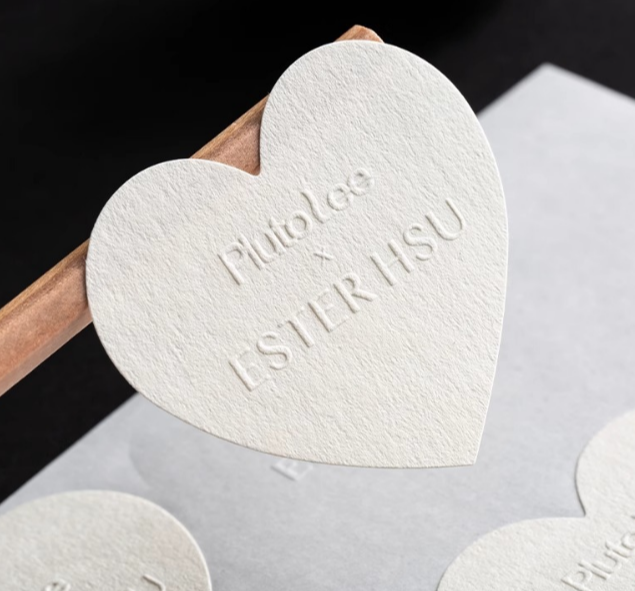
Blind embossed heart components are produced as precision-cut decorative elements featuring a distinct curved profile tapering to a defined bottom point. The primary visual and tactile feature is the raised or recessed graphic pattern—typically custom typography, logos, or monograms—formed without ink, foil, or secondary coatings. The resulting aesthetic relies entirely on light and shadow falling across the deformed paper fibers.
Physical samples typically demonstrate a clean, matte paperboard or paper face with subtle natural grain. Production runs are commonly delivered in sheet configurations, which stabilizes delicate cut edges during transport and facilitates manual or semi-automated peeling and application depending on the backing selected.
Substrate and Finish Characteristics
Because blind embossing relies on paper displacement rather than pigmentation, the physical properties of the selected stock dictate the finished result:
- Surface Texture: Uncoated, natural-felt, or lightly textured matte papers provide the highest contrast for blind impressions, reducing glare and allowing ambient lighting to define the embossed contours.
- Fiber Length and Caliper: Long-fiber pulp stocks are generally preferred to allow permanent structural elongation under die pressure without cracking or tearing the sheet surface. The caliper (thickness) influences how dramatically the male die can push into the counter-die.
- Adhesion and Backing Variations: Depending on the required use case—whether permanent container labeling, removable sealing, or cardstock inserts—converting options can range from pressure-sensitive adhesives paired with silicone release liners to non-adhesive dry-backed card stock.
Manufacturing and Converting Workflow
Producing consistent blind embossed elements requires balanced mechanical calibration across multiple converting stages.
1. Tooling and Die Fabrication
A matched pair of dies—a raised male punch and a recessed female matrix—is machined from brass, magnesium, or photopolymer. The choice of tooling determines line crispness, draft angle, and the level of bevel achievable across delicate letterforms.
2. Sheet-Fed Embossing
The substrate is registered between the die set under controlled dwell time and tonnage. Pressure must be sufficiently high to compress and rearrange the internal matrix of the paper fibers without fracturing the upper layer or causing unwanted wrinkling outside the impression area.
3. Profile Die-Cutting
Following embossing, the heart perimeter is cut using precision steel-rule dies, rotary cutting tools, or digital plotter systems. Precise mechanical registration ensures the raised embossing remains perfectly centered within the heart contour, preventing uneven margins across batch sheets.
Application Scenarios
The versatility of monochromatic, relief-stamped paper shapes makes them adaptable to diverse presentation needs:
- Luxury Retail and Packaging Seals: Applied across tissue wraps, folding box tabs, or glassine bags to confirm closure while signaling bespoke craft.
- Stationery and Event Collateral: Serving as wax-seal alternatives on wedding invitations, thank-you notes, and envelope flaps without adding brittle bulk.
- Handmade and Artisanal Goods: Positioned as branded closures or tamper-evident visual markers on boutique cosmetic jars, candle boxes, and dry goods packaging.
- Insert Cards and Hang Tag Accents: Incorporated as modular design elements pinned or adhered to larger retail backer boards.
Quality Control and Visual Inspection
Evaluating embossed paper pieces involves strict visual and dimensional standards to maintain uniformity across high-volume orders:
- Relief Sharpness and Consistency: Auditing impression depth under angled lighting to ensure fine lines and serifs do not wash out across sheets.
- Perimeter Registration: Verifying that the die-cut heart profile maintains consistent spacing relative to the internal embossed artwork, typically holding tight converting tolerances.
- Edge Cleanliness: Inspecting die cuts to confirm smooth curves without fiber burrs, fuzzing, or nicking that would detract from a clean presentation.
- Surface Integrity: Checking for paper fiber rupture, haloing, or unwanted glossing caused by localized friction or excess tonnage.
Customization and Technical Guidance for Buyers
When preparing technical files and procurement briefs for embossed paper goods, several factors should be addressed prior to tooling production:
- Artwork Vectorization: Linework must be supplied as continuous vector paths. Because blind embossing relies on tactile displacement, hair-thin lines under 0.5 points or overly dense crosshatching may blur or fail to register adequate relief.
- Specifying Relief Direction: Clarify whether the design requires standard embossing (raised upward toward the viewer) or debossing (depressed downward into the stock).
- Substrate Compatibility: Specify the final contact surface (e.g., corrugated fiberboard, smooth coated carton, glass, or plastic) to evaluate whether an adhesive liner or dry insert format is most appropriate for your assembly process.
Summary for Procurement Teams
Blind embossed accents bridge the gap between minimalist design and tangible brand value. Specifying the correct substrate weight, confirming die clearance for intricate artwork, and aligning delivery formats (sheet vs. single-cut pieces) ensures reliable, repeatable production runs tailored to your packaging line.
Request Technical Specifications and Sampling
Contact our converting specialists to discuss die options, review substrate swatches, or submit vector artwork for manufacturability review on your upcoming custom label and packaging runs.