Balancing product protection with visual merchandising is a perennial challenge for consumer goods brands, giftware merchants, and jewelry retailers. Sourcing a tabletop jewelry box that functions simultaneously as an organized home organizer and a presentable countertop display requires a close look at structural assembly, hardware reliability, and interior partitioning. When a storage unit incorporates a transparent viewing window, these procurement decisions become even more nuanced, affecting everything from parcel shipping drop tests to how long delicate metals can sit in a closed compartment without surface tarnishing.
Structural Composition: Shell, Framing, and Glazing
For single-tier desktop storage units, the exterior carcass dictates structural rigidity, tactile weight, and surface finish longevity. Most units in this product profile utilize an engineered substrate—predominantly medium-density fiberboard (MDF) or composite board—finished through spray lacquering or wrapped in a synthetic outer skin like polyurethane (PU) leather.
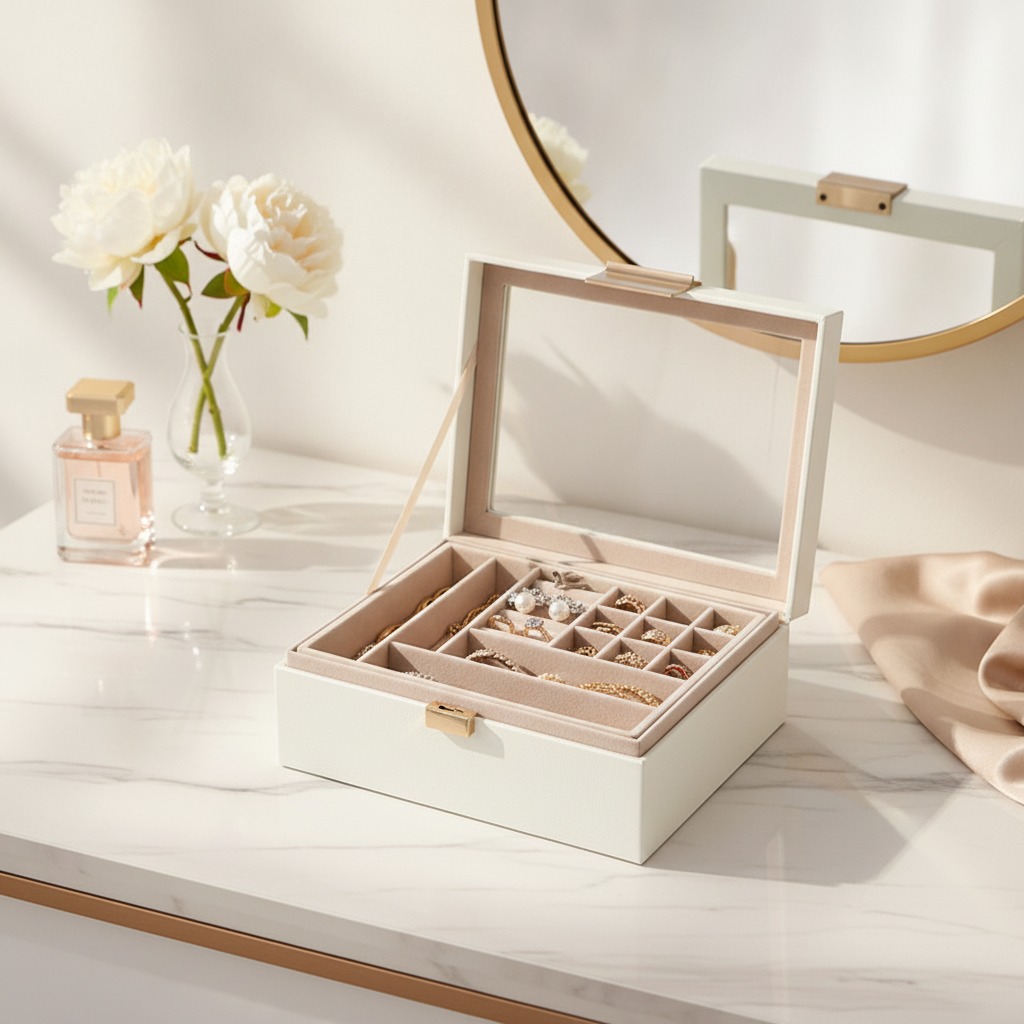
A central design feature is the recessed window lid. Sourcing managers generally choose between tempered/soda-lime glass and transparent acrylic sheets. Each presents a trade-off that should be explicitly specified in factory bills of materials:
- Glass Inserts: Deliver high optical clarity, excellent surface scratch resistance, and an authentic weighted feel. However, glass increases carton weight and carries a higher risk of in-transit fracture during small-parcel direct-to-consumer delivery unless protected by molded EPE foam corners.
- Acrylic (PMMA): Substantially reduces transit breakage risks and unit shipping weight. The downside is susceptibility to hairline scuffs from cleaning rags or abrasive dust, along with potential static charge that attracts dust particles during retail display.
The lid is commonly anchored by rear butt hinges, supplemented by a fabric stay ribbon or internal strap connecting the lid flank to the base. This ribbon acts as an angle stop—typically holding the lid open between 90 and 100 degrees—which prevents the hinge leaves from over-rotating and shearing the small mounting screws out of the composite substrate.
Interior Architecture: Zoning for Mixed Jewelry Lines
A well-planned jewelry box layout must isolate disparate pieces to prevent chain tangling, stone-on-stone abrasion, and friction damage. Fixed-divider interiors eliminate shifting parts during handling, though they require a diversified compartment ratio to handle typical consumer collections.
Linear Channels for Chains and Pendants
Longitudinal channels running along the perimeter provide dedicated straight-lay storage for delicate chain necklaces and pendants. Storing chains extended flat minimizes knotting, which remains one of the primary points of consumer dissatisfaction with open-dish or undivided jewelry trays.
High-Density Grid Cells
A segmented cluster of approximately 10 to 12 square cells accommodates stud earrings, signet rings, cufflinks, and small brooches. When assessing factory samples, check the perimeter wrapping around these miniature cell walls. Poorly bonded flocking frequently peels at the sharp intersections of the dividers under routine use.
Broad Format Compartment
A wider rectangular section within the core layout serves irregular items: pearl drops, wider bands, statement brooches, or charm pendants. Lining all visible surfaces with a soft, champagne-toned velvet-like or flocked microfiber creates a high-contrast neutral background that complements both yellow gold and silver-tone hardware.
Procurement Pitfalls: What Sourcing Teams Must Inspect
When reviewing production samples from packaging and organizer manufacturers, structural defects are often subtle. Sourcing managers should pay attention to several recurring failure points:
- Adhesive Curing and Off-Gassing: Low-grade contact adhesives used to laminate the velvet interior lining can release volatile organic compounds (VOCs). In an enclosed or sealed box, these fumes can accelerate oxidation and tarnish sterling silver pieces. Always request neutral-curing, solvent-free adhesives.
- Window Rattle and Seating: Tap the framed window panel firmly. An undersized acrylic or glass sheet sitting loose within its perimeter channel indicates insufficient adhesive beading or loose retaining splines, which creates an audible rattle during handling.
- Clasp Alignment: A decorative front latch—often finished in polished or brushed gold tones—must align precisely with the base catch. If the lid has even half a millimeter of hinge play, the clasp tongue will scrape the housing, wearing down electroplated decorative layers over repeated open-close cycles.
Frequently Asked Questions
Can this style of jewelry box be stacked?
Generally, framed-window boxes with protruding decorative front latches are intended as standalone single-tier display units. Stacking them directly on top of each other risks scratching the clear top window or exerting downward pressure on the framed glazing. If vertical expansion is a priority, consider drawer-based storage units instead.
How can buyers verify the quality of the interior lining?
Conduct a simple rub-fastness check on the velvet-type fabric using a clean, damp white cloth to verify dye stability. Additionally, inspect the inside corners of each cell: clean factory execution shows crisp, folded seams without stray adhesive threads or visible cardboard core edges.
Specifying Your Next Production Run
When preparing request-for-quotation (RFQ) packages for a glass-topped jewelry box, avoid generic descriptions. Define substrate thickness, window material composition, electroplating specifications for hardware components (such as rack plating versus barrel plating), and adhesive safety standards. Clarifying these material boundaries upfront protects both brand reputation and margin stability across global fulfillment networks.