Why Your Next Accessory Program Should Rethink the Traditional Watch Box
For decades, the standard procurement playbook for timepiece presentation started and ended with a heavy, velvet-lined watch box. Brand managers spent significant portions of their packaging budget on rigid clamshells or lacquered wooden cases, assuming mass equaled prestige. But talk to actual end users, and a different pattern emerges: those heavy cases almost immediately end up in the back of a closet or tucked beneath a bed. A traditional presentation watch box might look stately on a showroom counter, but it provides almost zero utility to someone who travels, commutes, or prefers a minimalist dresser.
If your brand is planning an accessory rollout, corporate gift tier, or secondary retail packaging line, it is time to pivot toward flat, travel-ready watch sleeves. Designing around a functional, single-watch format shifts the spend from inert packaging to an everyday accessory that travels with the customer—keeping your product in active rotation rather than trapped in storage.
The Functional Anatomy of a Flat Watch Sleeve
Moving away from a rigid cube does not mean compromising on protection. The cut-and-sew architecture of a flat travel case relies on clever geometry rather than bulky padding to safeguard a timepiece.
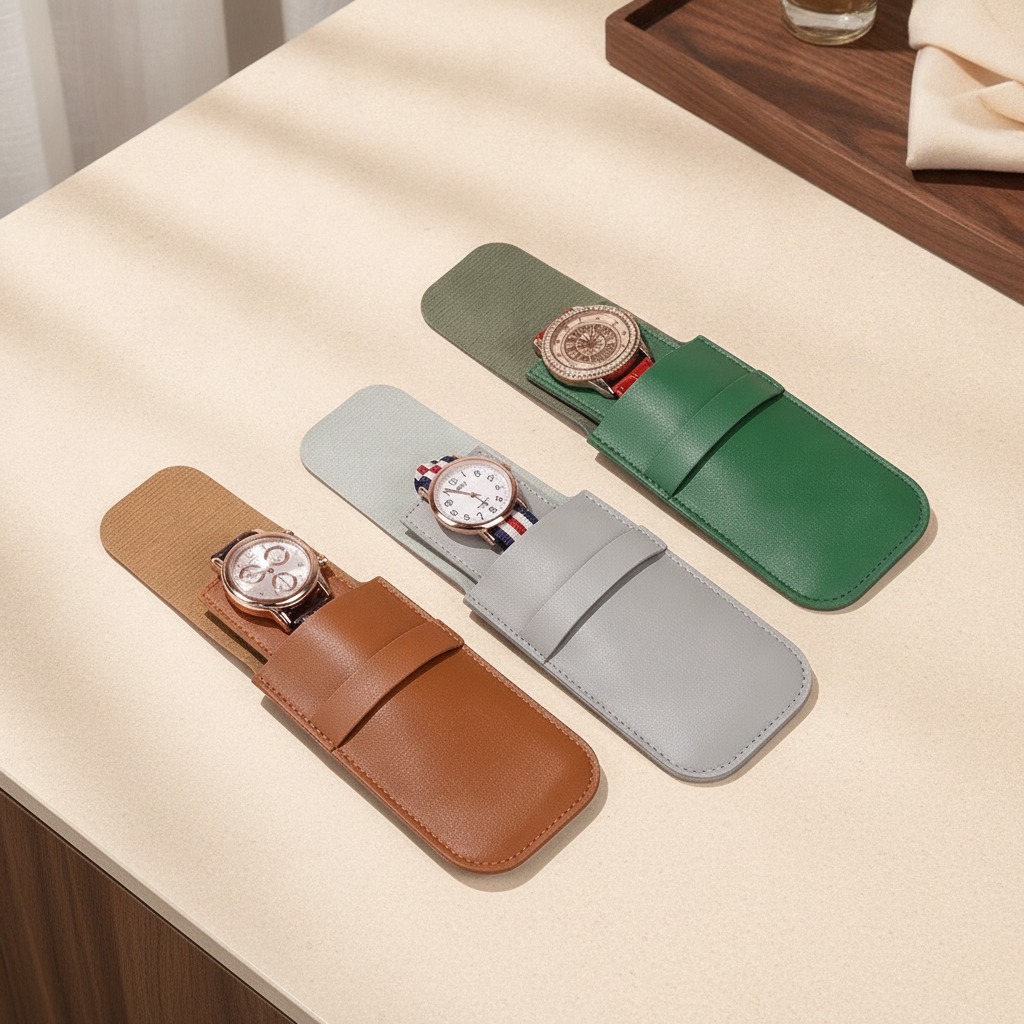
A well-proportioned sleeve typically employs an elongated rectangular footprint with softened, rounded corners that slip easily into a carry-on or briefcase without snagging lining fabrics. The internal architecture centers on a raised watch-support area engineered to cradle the case back, paired with a broad overlapping retaining band across the midsection. This wide strap secures the watch head and bracelet, preventing the piece from shifting vertically or rubbing against its own folding clasp.
Because the perimeter is joined with reinforced stitching, the case maintains structural tension without needing a brittle plastic skeleton. Available in versatile, understated tones like deep brown, light gray, and forest green, this profile delivers an executive aesthetic while remaining remarkably discreet.
Material Realities: Specifying for Cut-and-Sew Production
When sourcing these sleeves from leather-goods manufacturers, procurement teams need to look beyond surface aesthetics. While samples often feature smooth, fine-grain leather-like finishes, performance comes down to construction integrity and material composition.
Whether you choose genuine top-grain hides, synthetic PU, or microfiber-based alternatives depends on your target price tier and sustainability goals. However, the manufacturing details warrant strict quality parameters regardless of substrate:
- Edge Treatment: Pay close attention to edge finishing. Perimeter cut edges must be cleanly painted, edge-coated, or folded before final stitching. In travel accessories subject to friction inside bags, cheap single-layer lacquer will crack prematurely along the corners.
- Stitch Tension and Thread Gauge: Consistent perimeter stitching is the primary structural bond. Thread weight must balance aesthetic refinement with tensile strength, especially around stress points where the central retaining band meets the main backer.
- Internal Contact Surfaces: While outer finishes catch the eye, ensure whatever material faces the watch dial and case back has a non-abrasive surface. Even minor friction during transit can scuff polished lugs or acrylic crystals if the interior substrate is rough.
Logistics: The Freight Math You Cannot Ignore
Beyond consumer usability, there is an unavoidable operational reason to rethink packaging geometry: shipping volume. Replacing or supplementing an unwieldy display watch box with a tailored sleeve cuts transit cube drastically. Rigid boxes waste enormous amounts of internal space, meaning you are essentially paying international freight, drayage, and warehousing fees to ship trapped air.
Flat, stitched travel cases nest tightly in cartons. You can easily fit multiple dozens of sleeves into the volumetric footprint of five or six standard rigid display cubes. For direct-to-consumer e-commerce brands, the dimensional weight savings on outbound parcel shipping alone can offset the cost of developing a custom sleeve.
Common Procurement Oversights
Before issuing a purchase order for a custom run, watch out for these subtle traps:
First, verify watch compatibility limits. A sleeve that fits a classic 38mm dress watch on a thin leather strap will struggle to accommodate a 44mm tool watch mounted on a thick steel bracelet. Ensure your manufacturer tests the clearance beneath the central retaining band across varying case thicknesses and clasp styles.
Second, don't overlook closure hardware. Some sleeves rely on friction-fit tuck straps, while others use hidden magnetic snaps or mechanical studs. If your design incorporates metal hardware, ensure the interior backing is insulated so metal fasteners never contact the watch case directly.
Frequently Asked Questions
Are flat watch sleeves suitable for primary retail packaging?
Yes, particularly for direct-to-consumer, field, or tool watch brands. Many modern horology companies now ship their watches inside a functional travel sleeve packed inside an outer paperboard shipper, giving the customer an accessory they will actually keep and use instead of a disposable display cube.
Can these cases accommodate watches on metal bracelets as well as leather straps?
Generally, yes, provided the central retaining band and raised internal support have adequate clearance. Because metal bracelets cannot lay completely flat like two-piece leather straps, the sleeve requires slightly more vertical tolerance at the band section.
Moving Forward with Your Sourcing Plan
If your goal is to deliver lasting value while controlling freight overhead, a slim, stitched travel sleeve makes far more commercial sense than another rigid box destined for a closet shelf. Start by defining your required material grade and testing tolerances with physical samples across your brand's thickest and thinnest watch models before approving volume production runs.