Why a large jewelry organizer tray matters in day-to-day operations
A Large Jewelry Organizer Tray PU Leather is one of those unglamorous tools that quietly improves a jewelry workflow. It is not just about putting items away. For retailers, brand owners, and small workshop teams, a tray like this helps keep bracelets, chains, necklaces, and other slender accessories separated, visible, and easier to handle without unnecessary tangling. That matters when the workday includes sorting returns, preparing displays, packing orders, or moving inventory between drawers and counters.
In jewelry, small handling mistakes can waste time fast. A chain knot that takes two minutes to untangle becomes ten when repeated across a tray of mixed pieces. A shallow, compartmented organizer reduces that friction. The light interior also gives better contrast against metal, beads, stones, and plated finishes, which makes visual checking simpler than working over a dark bin or loose pile.
What this tray format is designed to do
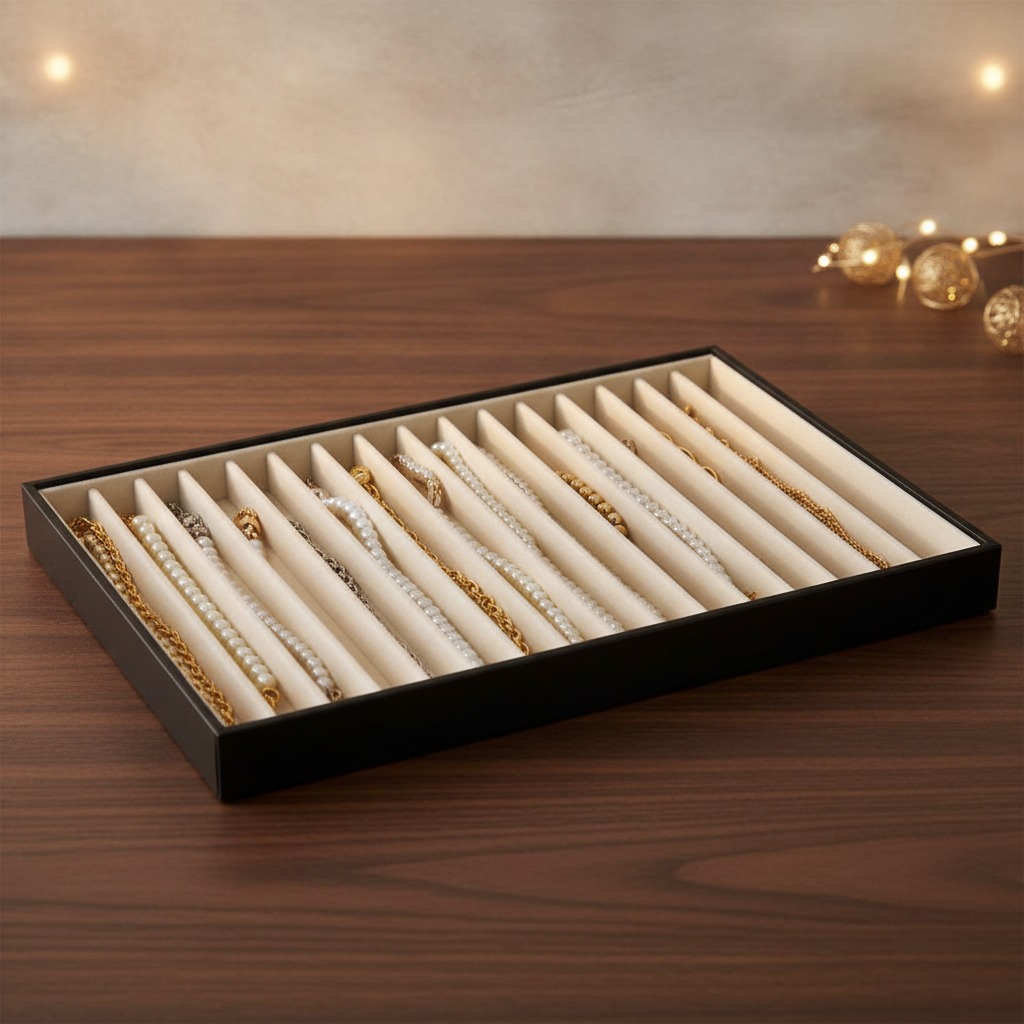
The product described here is a rectangular, low-profile display or storage tray with multiple narrow vertical compartments. The outer frame appears black, while the interior dividers and lining are a light beige or cream tone. That contrast is practical, not decorative. It helps the eye separate one item from the next, especially when pieces are small or similar in color.
Although the exact material composition is not visible, the tray likely uses a rigid board or molded structure covered with a synthetic leather-like finish on the outside and a softer lining inside. In the market, trays of this type are often used as retail display inserts, drawer organizers, or sorting trays for jewelry storage. Some buyers use them on countertops for presentation, while others use them inside cabinets or packaging systems to keep sets together.
Quick buyer takeaways
If you are comparing trays for inventory or retail use, the most important questions are usually simple: how many items need to be separated, how often the tray will be handled, and whether presentation matters as much as storage. A tray with many narrow slots is better for individual pieces and reduced movement. A wider open insert may suit bulkier accessories, but it will not control tangling as well.
For buyers, PU leather usually signals a practical balance. It can give a clean retail look without the cost or maintenance burden of more delicate coverings. That said, the quality of the base structure and the interior lining often matters more than the finish alone. A polished exterior on a weak frame is a poor trade.
Where PU leather organizer trays fit best
Retail display
On a sales counter, a divided tray makes products easier to browse and easier for staff to reset after customers handle them. It can support a tidy, premium impression without requiring elaborate fixtures.
Inventory sorting
For back-of-house operations, compartmented trays help separate SKUs, mixed lots, or repaired items. This is especially useful when similar-looking accessories need to be checked one by one.
Drawer organization
In a drawer, the low-profile format is an advantage. It uses vertical space efficiently and keeps pieces from sliding into one another.
Selection criteria that matter more than appearance
The first thing to evaluate is compartment spacing. Narrow slots are useful only if they match the item sizes you actually carry. If your assortment includes thicker bracelets or pendant-heavy necklaces, check whether the slot depth and width make sense for daily use. A tray can look excellent and still be awkward if the geometry is wrong.
Next, examine the stiffness of the body. A tray used in retail or transport should hold its shape when filled and moved. Pay attention to the interior lining as well. A soft surface reduces scuffing, but if it is too loose or poorly finished, fine pieces may shift around instead of staying neatly upright.
One practical caution: do not assume every PU leather tray is equally suited to heavy handling. Some are intended more for display than frequent warehouse use. If the tray will be carried often, stacked, or loaded and unloaded repeatedly, durability should carry more weight than visual finish.
Common mistakes buyers make
The most common mistake is buying for looks alone. A handsome organizer that cannot hold the actual assortment is a shelf accessory, not a working tool. Another mistake is ignoring how the tray will be cleaned. Jewelry environments can collect lint, polishing residue, and fine dust; an organizer should be easy to maintain without damage to the surface.
It is also easy to overlook the role of contrast. A light interior is useful because it makes sorting faster, but if the tray will be used with very pale jewelry or packaging, visibility may be less dramatic than expected. That is not a flaw, just a reminder that the display context matters.
Practical advice for sourcing teams
Ask for clear product specifications before placing volume orders. Exact dimensions, slot count, and material details should be confirmed in writing, especially when the tray will need to fit existing drawers, cases, or display cabinets. If the application involves retail presentation, request photos showing how the tray looks with actual products inside, not just empty shots.
For packaging or transport workflows, consider whether separation alone is enough or whether you also need a lid, protective cover, or stackable system. The tray described here may work well as a standalone insert, but buyers should verify those features rather than assume them.
Frequently asked questions
Is PU leather good for jewelry organizers?
Yes, for many commercial and display uses. It offers a neat appearance and can be easier to maintain than some more delicate materials, though overall quality depends on construction.
What types of jewelry benefit most from divided trays?
Thin, easily tangled pieces such as chains, bracelets, and similar accessories usually benefit the most. Segmentation keeps them separated and easier to inspect.
Can these trays be used at home?
Yes. Home users often choose them for drawer organization or personal collections, especially when they want a cleaner, retail-style layout.
Next step
If you are sourcing a Large Jewelry Organizer Tray PU Leather for retail, storage, or packing workflows, start with the fit: item size, slot layout, and handling needs. Once those are clear, the rest of the decision becomes much simpler, and usually much cheaper to get right the first time.