For retail buyers, lifestyle brand merchandisers, and interior sourcing teams, determining how to choose jewelry box? units that balance aesthetic display with physical protection comes down to dissecting construction nuances rather than merely browsing catalog imagery. A jewelry organizer intended for a retail counter or a residential vanity serves two masters: it must present pieces cleanly under interior lighting, and it must shield sensitive metals and stones from friction and clutter. Choosing the wrong configuration often leads to practical headaches, such as unstable lids, jammed sliding drawers, or abrasive interior textiles that undermine the quality of the jewelry placed inside.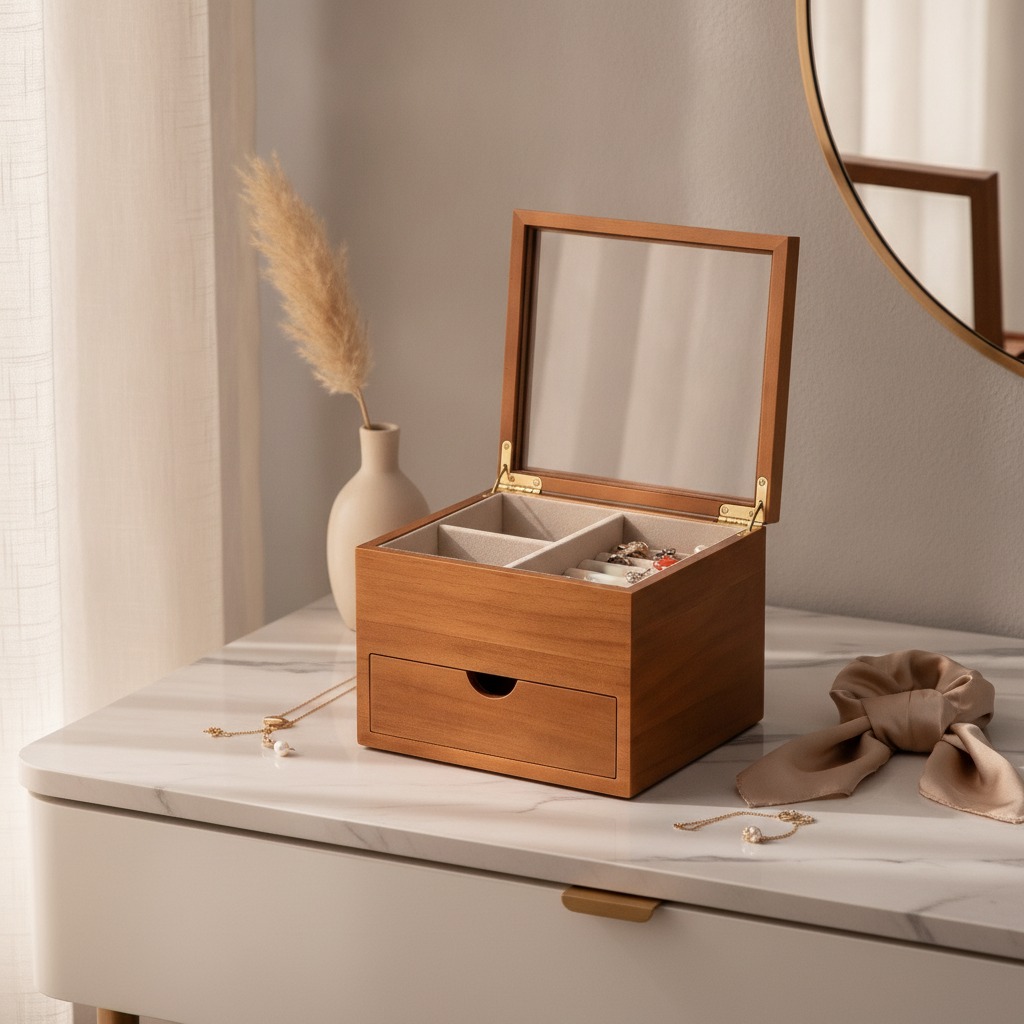
Whether you are curating tabletop organizers for a private label line, stocking a boutique, or sourcing corporate gifts, assessing basic architectural elements—tier division, surface materials, and internal lining—will help you make an informed decision.
Display vs. Concealed Storage: The Purpose of a Transparent Lid
One of the first functional decisions is whether the organizer should conceal its contents or display them. Traditional solid-wood jewelry boxes act strictly as concealed storage chests, whereas designs incorporating a transparent top lid—framed in wood—function simultaneously as storage and showcase units.
In retail environments or on a bedroom dresser, a transparent panel lets users immediately locate rings, stud earrings, and smaller accessories without repeatedly opening and closing the unit. When evaluating these styles, consider the viewing material:
- Glass panels: Provide high scratch resistance and clear optical quality, adding a weighty, premium hand-feel to the lid. However, glass adds shipping weight and requires careful impact packaging during transit.
- Acrylic panels: Significantly lighter and less prone to shattering during freight, making them popular for high-volume shipping. The trade-off is susceptibility to surface scratches and static dust accumulation over prolonged shelf use.
Interior Organization: Tiering, Dividers, and Linings
Jewelry comes in radically disparate profiles. A box that accommodates a cocktail ring may be completely unsuitable for a rigid bangle or a delicate pendant chain. A multi-tier architecture, such as a top compartment paired with a pull-out lower drawer, maximizes a compact footprint.
Top-Tier Compartments and Ring Rolls
In typical desktop configurations, the upper level under the lid is dedicated to high-frequency items. A well-designed upper tray generally integrates parallel padded cushion rolls alongside open bays. The slotted rolls secure rings and small stud earrings upright, preventing metal-on-metal abrasion. Sourcing managers should inspect the tension of these rolls: if the padding is overly dense, inserting wide-band rings becomes difficult; if too loose, rings tip sideways during handling.
Secondary Drawer Storage
A lower, full-width drawer adds capacity for flatter, bulkier, or less frequently accessed valuables. Because secondary drawers in tabletop woodenware rarely feature mechanical ball-bearing slides, smooth wood-on-wood tolerance is critical. Look for clean, recessed finger pulls—such as an oval routed notch directly on the drawer face—which preserve clean lines and avoid external hardware that can loosen or snag fabrics.
Lining Textiles
Regardless of exterior styling, the interior textile is what directly contacts the jewelry. Soft-touch fabric linings—such as micro-suede or low-pile velvet in neutral cream or beige tones—provide contrast against both yellow gold and silver while cushioning items against vibration. While some commercial packagers promote anti-tarnish treated textiles, standard consumer wooden boxes typically rely on standard upholstery fabrics glued to structural card inserts. Always inspect edge bonding around dividers to ensure the fabric does not peel under normal friction.
Materials and Hardware Integrity
Small woodenware manufacturing encompasses everything from solid timber species like beech or rubberwood to engineered MDF cores wrapped in natural wood veneer. While a continuous straight wood grain and a satin clear coat suggest careful finishing, procurement teams should dig into the underlying material:
- Solid Wood: Offers durable edges, natural weight, and long-term repairability, but can expand or contract with seasonal ambient humidity shifts, occasionally affecting drawer fit.
- Veneered Panels: Deliver superior dimensional stability and uniform grain consistency across batches, though exposed corner joints require strict inspection to verify veneer adhesion.
Pay close attention to the rear hinges and support hardware. Transparent framed lids carry appreciable weight relative to the base. A box equipped with dual rear metal hinges (often finished in contrasting brass tones) and an integrated folding lid stay on one side ensures the lid remains securely propped open during selection. Without a stay brace, heavy lids can pivot past their center of gravity or snap backward, damaging the rear hinge screws.
Common Procurement and Selection Mistakes
When reviewing samples from manufacturers or evaluating vendor catalogs, several subtle flaws can slip past initial inspections:
- Adhesive Fumes and Off-Gassing: Boxes assembled quickly with solvent-heavy adhesives can trap chemical odors inside the closed compartment. In worst-case scenarios, volatile organic compounds (VOCs) from curing glues can accelerate the oxidation of silver jewelry stored inside.
- Loose Drawer Tolerances: A drawer cut with too much play will wobble and jam diagonally upon closure, while one with zero tolerance will bind completely in humid environments.
- Overly Shallow Compartments: If top dividers sit too close to the lid pane, taller statement rings or thick bands may touch and scratch the underside of the transparent panel when closed.
Frequently Asked Questions
Can a single jewelry box safely store both fine and costume jewelry?
Yes, provided the interior features distinct divided sections. Costume jewelry containing base metals or plated finishes should ideally be kept separate from pure silver and gold to avoid chemical reaction or accidental scratching from harder stones.
What should I look for in drawer joints on small wooden jewelry organizers?
Examine the corners of both the outer frame and the sliding drawer. Neat mitered corners or well-aligned butt joints without visible glue squeeze-out or stepped edges are the clearest signs of precise CNC cutting and controlled assembly jigs.
Is a transparent lid suitable for items prone to light exposure?
While a glass or acrylic lid provides excellent visual organization, prolonged direct sunlight can degrade certain organic gems (such as pearls or opals) and accelerate tarnishing on certain silver alloys. If storing light-sensitive pieces, ensure the box is placed away from direct window sills or store those specific items inside the lower drawer.
Next Steps for Sourcing
When ordering production runs or evaluating initial samples, request unvarnished structural specifications from your vendor, verify the exact substrate (solid timber vs. veneered board), and conduct a drop-and-pull check on the drawer mechanism. Aligning these physical details with your customers' everyday jewelry habits guarantees an organizer that performs as well as it displays.