Balancing Compact Footprint with Compartmentalized Protection in Travel Jewelry Packaging
For product teams and sourcing managers in the personal accessories and gift packaging sectors, the challenge of small-footprint storage rarely comes down to sheer volume. Instead, the real bottleneck is internal separation. Hard-surfaced accessories—beaded strands, link chains, pronged stone settings, and polished metal bands—naturally abrade one another when jostled together in transit. Sourcing a viable Double-Layer Portable Cream Leather Jewelry Organizer Box requires examining not just the outer shelf appeal, but the underlying cut-and-sewn construction, partition stability, and closure mechanics that keep delicate items isolated.
Exterior Construction and Structural Geometry
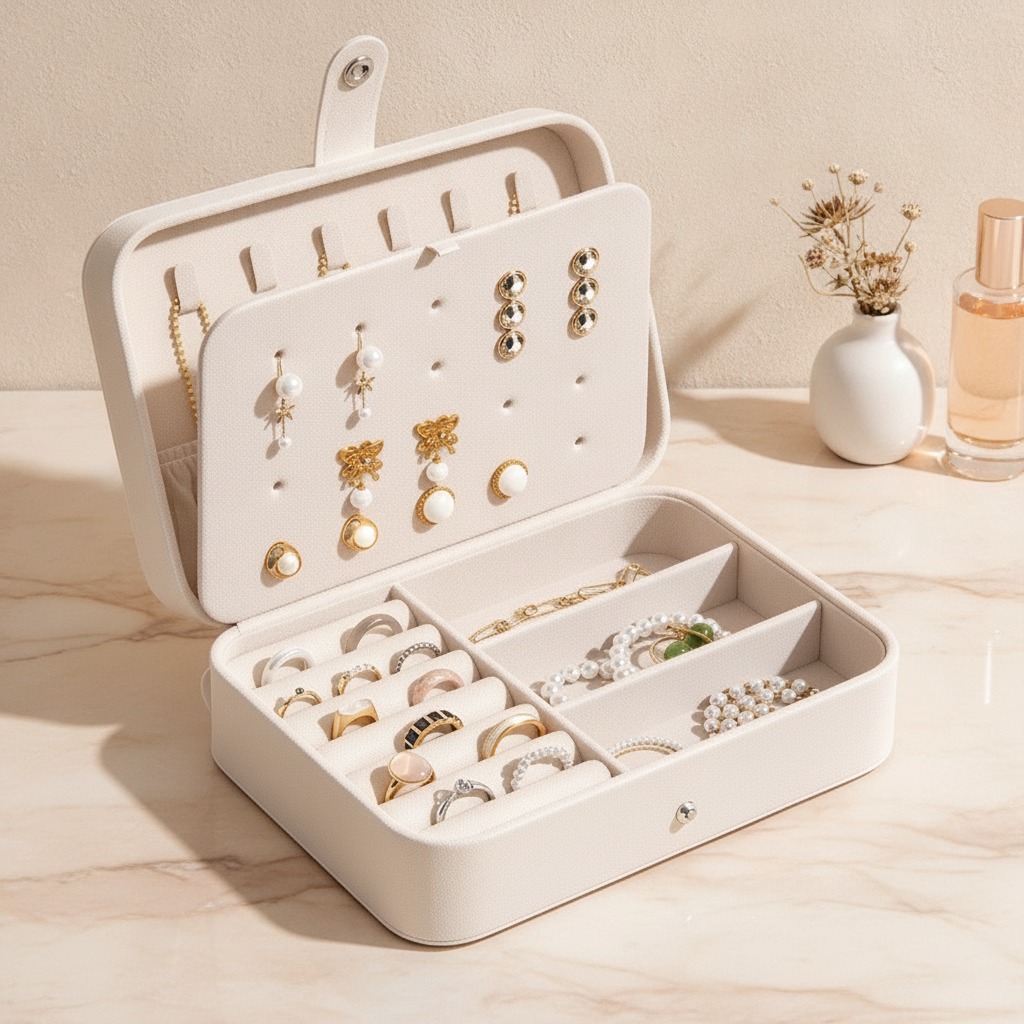
The unit features a rectangular profile with softened, rounded corners and an upright hinged lid. The exterior shell presents a fine-grained, textured finish in an off-white or cream tone. In soft-goods manufacturing, this exterior is typically achieved using a synthetic polyurethane (PU) or coated textile wrapped over die-cut structural board, though high-end lines may specify genuine leather hides. Sourcing teams must clarify the base substrate directly with manufacturers, as surface graining can easily mask the difference between coated vinyl, PU, and top-grain leather.
Structural integrity depends heavily on how the outer cover bonds to the core board. When curved corners are formed, the material must be notched or thermo-formed cleanly to prevent bunching along the bottom seams. A small hanging tab fitted with a metal eyelet or snap is integrated along the top lid edge, functioning either as an auxiliary anchor or a display point for retail fixtures.
Internal Layout: Two-Tier Organization and Contact Prevention
The interior architecture divides storage between the lid assembly and the deep base compartment, minimizing void space while providing distinct holding methods for varied jewelry profiles:
- Lid-Mounted Earring Panel: The upper tier incorporates a flat panel pierced with dedicated stud holes and slotted cuts. This keeps drop earrings and posts suspended against a soft lining rather than resting loose in a tray. Buyers should verify whether this flap is permanently hinged or removable, as clearance between the flap and the base tray determines whether bulky stones will collide when the box snaps shut.
- Padded Ring Channels: Running along one section of the lower tray, parallel padded rolls compress gently against ring bands. Proper roll density is critical; foam cores that are too dense will distort thin bands, while low-density open-cell foam collapses permanently after repeated use.
- Partitioned Open Compartments: The remainder of the base is subdivided into rectangular wells suited for chain bracelets, bangles, or loose pendants. Rigid dividers limit lateral shifting during handling.
Hardware, Closure Tension, and Fastener Selection
The organizer relies on a mechanical front snap button rather than a perimeter zipper. A press-stud or snap enclosure provides a cleaner, traditional jewelry-case aesthetic and allows one-handed opening. However, snap closures introduce a point of focused mechanical stress on the front lip of the case.
During specification reviews, product developers should inspect the backing reinforcement behind the female snap socket. If the substrate behind the snap is unreinforced chipboard, repeated pulling will cause the hardware to tear free from the casing. Hardware plating is another common failure point; base-metal hardware subjected to sweat and cosmetic lotions requires adequate topcoat sealing to resist premature tarnishing.
Critical Inspection Points for Procurement Teams
When evaluating production samples of a Double-Layer Portable Cream Leather Jewelry Organizer Box, quality teams should focus on three easily overlooked risks:
First, test for adhesive outgassing. Many inexpensive soft-goods factories use contact adhesives with volatile solvents to laminate the soft inner lining to the internal dividers. In a sealed box, residual chemical vapors can rapidly tarnish sterling silver and low-karat gold plating before the product reaches the end consumer. Water-based adhesives or properly cured assemblies are essential for jewelry-safe packaging.
Second, inspect lining alignment within the ring rolls and corner folds. Exposed substrate edges or glue seep along the partition borders not only degrades the unboxing experience but can snag delicate chain links.
Finally, confirm clearance tolerances. Sourcing managers should test the case filled with realistic, dimensional pieces—such as signet rings and teardrop earrings—to ensure the lid fastens flush without forcing the exterior hardware out of alignment.
Frequently Asked Questions
Can this style of organizer accommodate larger cuffs or watches?
Generally, compact double-layer formats with shallow lower wells are engineered primarily for rings, studs, fine chains, and thin bracelets. Larger timepieces or rigid cuffs typically require deeper cavities or removable pillow inserts, which may exceed the vertical clearance of this low-profile case design.
What exterior materials are most common for production runs?
Most commercial production utilizes textured PU synthetic leather due to its consistent grain, cost efficiency, and ease of cleaning. Genuine leather can be specified for luxury retail lines, but tooling patterns, skiving tolerances, and minimum order quantities will adjust accordingly.
Next Steps for Sourcing Teams
If you are developing a branded accessory case or seasonal retail gift set, begin by defining your target jewelry dimensions and packaging tolerances. Request white-label pre-production prototypes to verify divider rigidity, snap retention strength, and lining chemistry before releasing purchase orders for mass production.